Malaysia has set the mandatory Employees Provident Fund (EPF) contribution rate for foreign workers at two per cent to ensure fair treatment of workers of all nationalities, in accordance with international standards.
The move follows the tabling of the 2025 Budget in October 2024 by prime minister Anwar Ibrahim, and details will be announced by the Human Resources Ministry following Cabinet discussions.
The Malaysia Budget and Business Hotel Association has urged strict enforcement of minimum sum contribution to Employees Provident Fund by short-term rental accommodation providers
The Malaysia Budget and Business Hotel Association (MyBHA) has welcomed the government’s decision.
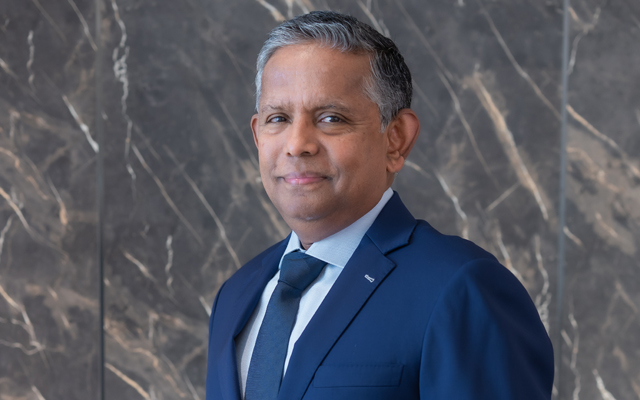
MyBHA president Sri Ganesh Michiel described the move as a progressive step toward supporting the resilience of local businesses, particularly in the hospitality sector, amid rising operating costs.
“However, we urge the government to ensure that this policy is followed by strict enforcement against short-term rental accommodation providers that often employ foreign workers without complying with labour laws and regulations,” he said.
Michiel highlighted that many short-term rental accommodation (STRA) operators fail to meet legal requirements such as tax payments and safety compliance, while also employing undocumented foreign workers without adhering to the EPF contribution law.
“This situation has not only created unfair disadvantages for licensed hospitality providers but has also negatively impacted the sector’s competitiveness and the country’s revenue. Additionally, STRA operators can attract customers with lower prices due to the lack of operational costs they bear compared to licensed hotels,” he added.
The Singapore Airlines (SIA) Group has signed an MoU to potentially source neat sustainable aviation fuel (SAF) from Aether Fuels, a climate technology firm that plans to set up SAF production plants in the US and South-east Asia.
The agreement outlines the SIA Group’s intention to procure neat SAF for five years when Aether Fuels plants begin commercial production, with an option for a five-year extension. The neat SAF will be blended with regular jet fuel before being supplied to selected airports served by Singapore Airlines and Scoot.
The Singapore Airlines Group will procure neat SAF from Aether Fuels for an initial five years, with option for extension
Aether Fuels will use waste carbon feedstock to produce the fuel through its proprietary technology that reduces plant capital cost, increases production efficiency, and achieves higher SAF yields compared to existing techniques.
Lee Wen Fen, chief sustainability officer, Singapore Airlines, said: “This partnership marks another step in the SIA Group’s journey towards our long-term decarbonisation goal of net zero carbon emissions by 2050. By collaborating with like-minded ecosystem partners such as Aether, we aim to accelerate and scale up the adoption of SAF in our flight operations, laying the groundwork for more sustainable air travel.”
Singapore Airshow 2024 was among a long list of notable leisure and business events that boosted visitor arrivals and reinforced the country’s position as an attractive destination
Singapore’s tourism sector has turned in a strong report for 2024, with both international visitor arrivals (IVA) and tourism receipts (TR) showing year-on-year increments.
TR reached S$22.4 billion (US$16.4 billion) between January and September 2024 – an increase of 10 per cent when compared to the same period in 2023. The Singapore Tourism Board (STB) expects the full-year TR to reach the upper bound of its 2024 forecast, setting a new record in tourism spend.
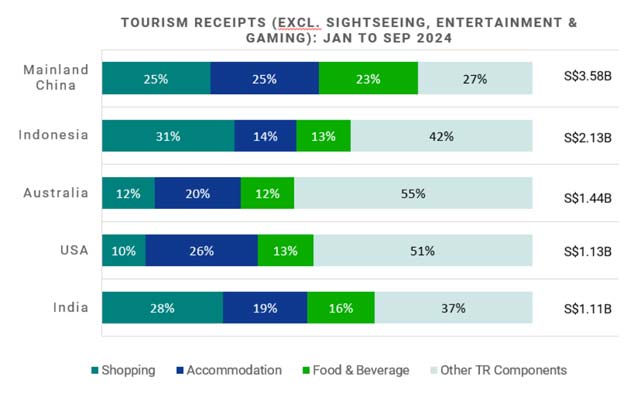
Tourism receipts by top spending (excluding sightseeing, entertainment & gaming) from January to September 2024
All spend categories have shown year-on-year growth, led by sightseeing, entertainment & gaming (SEG) at 25 per cent, followed by accommodation at 17 per cent. Meanwhile, F&B and shopping saw a six and five per cent increase respectively, with other categories such as airfares and business spending contributing to TR as well.
China, Indonesia, and Australia emerged as the top TR generating markets, contributing S$3.6 billion, S$2.1 billion, and S$1.4 billion respectively (excluding SEG). Notably, China and Japan showed strong year-on-year growth in TR.
IVA increased by 21 per cent over 2023 to reach 16.5 million, with China (3.1 million), Indonesia (2.5 million) and India (1.2 million) topping the source market charts. Other markets that exhibited healthy year-on-year growth included Japan, Taiwan, the UK, and the US, representing a good mix of short, mid and longhaul markets.
Singapore Airshow 2024 was among a long list of notable leisure and business events that boosted visitor arrivals and reinforced the country’s position as an attractive destination
STB attributed the strong IVA performance to several things, including the 30-day mutual visa exemption with China, Singapore’s strong growth in air connectivity, and the robust year-round calendar of lifestyle events and concerts in the city-state.
The presence of family-friendly attractions along side key leisure events helped drove economic benefits to the tourism sector and related industries.
In addition, Singapore’s hotel industry demonstrated positive growth in 2024, with ARR and RevPAR increasing year-on-year, reaching S$276 (1.4 per cent increase compared to 2023 ARR) and S$226 (three per cent increase compared to 2023 RevPAR) respectively. AOR was 81.8 per cent in 2024, a 1.3 percentage point increase compared to 80.5 per cent in 2023.
There was an addition of 1,421 new hotel keys, including notable openings such as The Standard Singapore, Into the Woods, and Mercure Icon Singapore City Centre.
Melissa Ow, chief executive, STB, said the strong performance in 2024 was “an affirmation of the industry’s efforts in refreshing our products and experiences, as well as embarking on new collaborations this past year”.
She added: “Collectively, these efforts elevated Singapore’s destination appeal and strengthened the sector’s capabilities and competitiveness.”
Looking ahead, STB expects 2025 IVA to reach between 17 to 18.5 million, bringing in approximately S$29 billion to S$30.5 billion in TR.
While acknowledging potential headwinds stemming from geopolitical tensions and macroeconomic challenges, STB remains focused on driving quality tourism growth to defend and extend Singapore’s global position into the years ahead.
Ow said: “As we look back at 2024, as well as our achievements over the last 60 years, tourism has contributed to the economy, reinforcing our international reputation, and providing more lifestyle options for visitors and residents. Together with our industry partners, STB is committed to sustain our tourism growth, by increasing Singapore’s mind share and market share, maintaining a diversified market portfolio, and strengthening destination vibrancy. Our Tourism 2040 roadmap will guide our efforts to drive the next phase of quality tourism growth for Singapore. This will ensure Singapore continues to thrive as a world-class destination that meets the needs of the evolving global traveller.”
This year, Singapore will welcome even more tourism developments, as well as leisure and business events, such as Mandai Rainforest Resort by Banyan Tree, Disney Cruise Line’s Disney Adventuremaiden sailing and year-round homeport, Anime Festival Asia 2025, World Aquatics Championships 2025, and Usana Regional Convention 2025.
Tell us about Tourism Malaysia’s 2024-2026 roadmap please. Tourism Malaysia’s 2024-2026 strategic roadmap focuses on high-impact, fast-conversion strategies to boost international arrivals. The plan identifies three core strategies to achieve this goal: creating demand, increasing traffic, and prioritising target markets.
To create demand, we implement targeted marketing campaigns, craft compelling content, and ensure high visibility through digital and traditional channels. To increase traffic, we form strategic partnerships with airlines to boost flight frequency, collaborate with travel agents and OTAs, and simplify entry procedures, like visa-free policies.
What are Tourism Malaysia’s arrival targets and the key markets for 2025? Tourism Malaysia has set a target of 31.4 million international tourist arrivals and 125.5 billion ringgit (US$28.1 billion) in revenue for 2025. To achieve this, we have prioritised key target markets, categorised into three tiers: Level 1, Level 2, Level 3, and traditional markets. Level 1 includes China, India, Indonesia, Australia, and Vietnam. Level 2 comprises the UK, South Korea, and the Gulf Cooperation Council countries. Level 3 consists of Taipei and Germany, while our traditional markets include Singapore, Thailand, and Brunei.
These markets were chosen based on their significant contribution to tourist receipts in Malaysia, strong air connectivity, positive market outlook, and encouraging future outbound trends, based on intelligence reports.
How is Tourism Malaysia working with travel trade players to support inbound tourism? We are committed to working closely with the travel industry to support its recovery from the Covid-19 pandemic. To increase international traffic, we collaborate with airlines on joint promotions, offering matching grants for international and charter flights to create new routes, thereby improving air connectivity to Malaysia.
We also implement tactical campaigns with OTAs, land transport providers, and ferry operators to offer competitive travel packages. We provide incentives through special grants for organising tourism events in Malaysia and for industry players participating in B2B and B2C events overseas.
How is Malaysia tailoring its tourism offerings to meet the evolving demands of international travellers in the post-pandemic era? To adapt to evolving travel preferences, we are embracing tourism-related technology to offer immersive experiences for tourists. We are also working with the Malaysia Digital Economic Corporation to promote digital tourism solutions from local start-ups.
In line with the National Tourism Policy, Tourism Malaysia is implementing a Smart Tourism model, using data-driven decision-making to identify new market segments and rejuvenate tourism products. This ensures that our offerings align with current trends such as experiential tourism, sustainable tourism, and bleisure.
Sustainability is increasingly being prioritised by travellers. What efforts is Tourism Malaysia making to promote ecotourism and sustainable travel practices. As a marketing agency under the Ministry of Tourism, Arts and Culture Malaysia, we support the ministry’s collaboration with the United Nations Development Programme to implement the UN International Network of Sustainable Tourism Observatories. This partnership highlights our commitment to advancing sustainable tourism in Malaysia, including developing indicators to measure sustainable tourism as part of the national tourism statistics.
Additionally, Malaysia embraces UN Tourism’s Flagship Initiatives as new opportunities for collaboration, particularly in global sustainability certification and measurement tools.
Editor’s note: The original copy had identified Manoharan Periasamy as the director of marketing and communications. We apologise for this error.
Travel Exclusive Asia (TEA), a Bangkok-based DMC which operates in Thailand, Cambodia, Laos and Vietnam, has now stretched its hands into Indonesia in partnership with Peter Nielsen and Ni Made Ayu Triska, both of whom possess over a decade of destination management experience with a base in Bali.
TEA Indonesia will serve both leisure travel and business events
Nielsen, founder and managing director of TEA Indonesia, previously owned Stjernegaard Reijser, a leading tour operator in Denmark with its own DMC in Bali that managed operations across Indonesia. The company was sold in 2018, but Nielsen remains active in the industry and works with Triska to provide DMC services in Indonesia from their office in Sanur.
In their quest of expansion, Nielsen and Triska sought a partner that would share their values and ambitions.
“We found a perfect match in TEA. After our initial meeting with André Van der Marck (founder and CEO of TEA) and Yves Van Kerrebroeck (partner and managing director TEA Indochina), we were convinced that TEA was the right partner for us, as we share a common vision for the future of DMC operations,” Nielsen told TTG Asia.
According to van der Marc, TEA enjoyed a prosperous year in 2024 and has been experiencing significant growth across both business events and leisure tourism.
“We are confident in continuing this momentum. With this new venture, TEA will strengthen its position as a trusted partner for delivering extraordinary travel experiences across South-East Asia,” said van der Marc.
Nielsen said Indonesia has “major potential, particularly with Bali as a standout destination in South-east Asia”.
“When travellers combine Bali with other Indonesian islands, they can create a holiday experience like no other. Given this potential and diversity, we believe now is the perfect time for TEA to expand into Indonesia. Our goal is to provide travellers with unforgettable experiences no matter what they are looking for,” said Nielsen.
Nielsen believes that Indonesia holds great appeal to both leisure and corporate clients.
When asked how TEA Indonesia would compete against other Indonesian DMCs, Nielson pointed to the team’s rich experience in tour operations.
“We understand the intense competition in the industry and what it takes to convince customers and close a sale. Travel agents and tour operators are not only competing with each other, but also with OTAs and booking engines where customers constantly compare prices. To stand out, we must offer something of extra value to our customers.
“We believe that competing on quality products, creativity, and innovative trip combinations is key. Our goal is to provide exceptional service standards.”
He also highlighted TEA Indonesia’s use of full-time guides, instead of freelance ones. “Our office staff also possess extensive knowledge and are trained to efficiently solve any issues that may arise. Their decision-making skills are top-notch, ensuring fast and effective solutions,” he said.
TEA Indonesia will aim for organic growth in the initial two to three years, allowing the company to focus on existing customers while delivering high quality products and services.
“We expect to increase revenue by three to four folds over the next three years. However, it is important to say that volume is not our goal. We intend to be here for many years, so we have time to develop the business, secure our processes, and maintain high standards.”
Venture farther
Driven by both a desire to not contribute to overtourism and to broaden their horizons while on holiday, more consumers are making a conscious effort to visit less touristy destinations in 2025.
According to the Skyscanner Horizons: 2024/5 report, travellers are increasingly interested in exploring lesser-known destinations, with 27 per cent of Asia-Pacific respondents expressing intentions to visit these areas. This intention is strongest among South Korean travellers.
Travellers can opt to detour to Fukuoka from Tokyo
Unpack ’25, Expedia Group’s annual data-driven outlook on travel motivations, also spotted a rising trend for what it terms, Detour Destinations. Travellers will not skip tried-and-true tourist destinations in 2025, but will add on less crowded and lesser-known places that are close to popular hotspots.
Based on flight searches, Expedia has identified some top trending Detour Destinations in Asia-Pacific. They are Fukuoka, Japan as a detour from Tokyo; Abu Dhabi, the UAE as a detour from Dubai; Krabi, Thailand as a detour from Phuket; and Waikato, New Zealand as a detour from Auckland.
Slow and meaningful
Back in 2019, Skyscanner spotlighted the growing preference for slow travel, where travellers throw out packed itineraries to truly savour the moment.
At the same time, the term JOMO – joy of missing out – took hold among travel marketers, content creators and consumers, further highlighting the value of escaping the hustle and bustle of city life and priortising quality travel experiences.
Seek wellness options like cryo therapy
Five years on, JOMO is still here to stay, observed Vrbo, an online marketplace for vacation rentals that is owned by Expedia Group. Sixty-two per cent of respondents in the Unpack ’25 study say JOMO trips reduce stress and anxiety, and nearly half say that it enhances quality time with loved ones. Such trips can be found by staying in cosy cabins, peaceful beach houses, or secluded lakeside lodge that are equipped with all the amenities to help them unwind.
It is clear that travellers are strategic about what they are choosing not to miss out. Booking.com ’s annual Travel Predictions research highlights a firm recognition that holidays are more than just a time to unwind. Sixty per cent of travellers want a longevity retreat -– a super-charged flex on traditional well-being itineraries that could include body vibration (61 per cent) and red light therapies (54 per cent) to cryotherapy (51 per cent) and stem cell treatment (51 per cent). More than two thirds of respondents want new wellness activities that can be mix into their daily lives. In this region, travellers say they are willing to pay for a holiday that is solely meant to extend their lifespan and well-being.
Natural pursuits
Expedia Group found that droves of travellers booked private holiday homes along the path of totality to see the total solar eclipse in 2024, proving people will travel great distances to see natural phenomena in real life. Unpack ’25 study revealed that the Northern Lights (61 per cent) are the top phenomenon travellers want to see, followed by geological phenomena (30 per cent) like volcanoes, geysers and hot springs. In Asia-Pacific, travellers will be drawn to Hokkaido, Japan to witness the graceful ballet of Red-crowned cranes and Melbourne, Australia for the adorable penguin parade.
The fascination for nature’s greatness is also picked up by Booking.com, which spotlights the trend towards noctourism – trips that are tailored around night-time activities. Two thirds (67 per cent) of respondents are considering visiting dark sky destinations in 2025, with star-bathing experiences (76 per cent), star guides (66 per cent), constellation tracking (62 per cent), and once-in-a-lifetime cosmic events (61 per cent) topping the stellar adventure list.
Concerns around climate change have also influenced this shift, with 57 per cent planning to elevate their night-time pursuits to avoid rising day-time temperatures and 56 per cent preferring to take their holidays in cooler locations. An appreciation for the nocturnal world is also deepening travellers’ connections with nature, as the majority of travellers (60 per cent) say they would book an accommodation without lights to encourage less light pollution and preserve flora and fauna.
Iceland is a choice destination for travellers who want to view the Northern Lights
All-inclusive attention
According to Unpack ’25, the year 2025 will be the all-inclusive era, as more Gen Z travellers discover the appeal of all-inclusive accommodation options. The report stated that all-inclusive resorts were no longer just attracting families looking for fun in the sun by the pool, but also younger travellers who want stress-free stays and a good deal that still feels luxurious.
One-third of Gen Z travellers say their perception of all-inclusive hotels has changed for the better, and 42 per cent say an all-inclusive resort would be their preferred hotel type.
Precious procurement
Shopping on holidays are turning a refined turn, as more travellers make time during their trip to pick up local speciality goods, from viral chocolate bars from Dubai and butter from France to skincare products from South Korea and tea leaves from China.
Some travellers, according to Expedia’s Unpack ’25, are even creating entire trips around getting the goods.
The study found that 39 per cent of travellers visit grocery stores or supermarkets while 44 per cent shop for local goods they cannot get at home.
The love for Goods Getaways, as Unpack ’25 terms this trend, extends to experiences unique to the destination, such as coffee tours in Costa Rica, tea tastings in China, and matcha experiences in Japan.
Tea-tasting experience in China
Taste paradise
Food is the biggest decision-making factor when choosing a destination, finds Skyscanner Horizons: 2024/5. Two thirds of Asia-Pacific travellers agreed that food is important when picking a holiday destination – this consideration triumphs over weather (55 per cent), natural landscape (55 per cent), the attractions (54 per cent) and culture (54 per cent).
Echoing this observation is Hotels.com’s findings that point to travellers seeking standout hotel dining experiences and making dinner reservations when planning ahead for their holidays.
Nearly a third of travellers say room service from a famous hotel restaurant would make them more likely to book, while 31 per cent say restaurant tables reserved exclusively for hotel guests would be their top reason.
Attention to hotel dining is also reflected in the rise in positive reviews about hotel restaurants, chefs and bars on the Hotels.com website.
Sabre launches new dynamic pricing solutions for airlines
IATA’s 2024 full-year and December 2024 passenger market performance report have shown record high demand with total full-year traffic up 10.4 per cent over 2023 and 3.8 per cent above 2019 levels.
Total capacity, measured in available seat kilometers (ASK), was up 8.7 per cent in 2024, while the overall load factor reached 83.5 per cent, a record high.
Air traffic grew across all regions
International full-year traffic in 2024 rose 13.6 per cent compared to 2023, and capacity rose 12.8 per cent. There was growth in all regions.
Asia-Pacific airlines posted a 26 per cent rise in full year international 2024 traffic compared to 2023, maintaining the strongest year-over-year rate among the regions. Capacity rose 24.7 per cent and the load factor climbed 0.8 percentage points to 83.8 per cent. Despite this strong growth, opportunities for further growth remain high, as international revenue passenger kilometers or RPKs remain 8.7 per cent below 2019 levels. December 2024 traffic rose 17.1 per cent compared to December 2023.
In terms of domestic passenger markets, full-year demand reached record highs for passenger numbers and load factors. The standout performer for 2024 Domestic RPK was once again China, which increased 12.3 per cent over 2023. There was stable growth across other major domestic markets. To note, Japan achieved 3.2 per cent growth while capacity contracted by 0.3 per cent. Only India had a fall in load factor (-0.6 percentage points), but still achieved a load factor of 86.4 per cent – the highest among all domestic markets.
December 2024 put in a strong finish to the year, with overall demand rising 8.6 per cent year-on-year, and capacity grew by 5.6 per cent. Load factor was 84 per cent, a record for the month.
Willie Walsh, IATA’s director general, said in a statement: “2024 made it absolutely clear that people want to travel.”
He said that “airlines met that strong demand with record efficiency”.
“Aviation growth reverberates across societies and economies at all levels through jobs, market development, trade, innovation, exploration, and much more,” he added.
He has predicted continued growth for travel demand in 2025, at a moderated pace of eight per cent “that is more aligned with historical averages”.
“The desire to partake in the freedom that flying makes possible brings some challenges into sharp focus. First, the tragic accident in Washington reminds us that safety needs our continuous efforts. Our thoughts are with all those affected. We will never cease our work to make aviation ever safer.
“Second is the airlines’ firm commitment to achieve net zero carbon emissions by 2050. While airlines invested record amounts in purchases of SAF in 2024, less than 0.5 per cent of fuel needs were meet with SAF. SAF is in short supply and costs must come down. Governments could fortify their national energy security and unblock this problem by prioritising renewable fuel production from which SAF is derived.
“In addition to securing energy supplies and increasing the SAF supply, diverting a fraction of the subsidies given for fossil fuel extraction to support renewable energy capacity would also boost prosperity through economic expansion and job creation,” said Walsh.
Singapore Tourism Board (STB) and Gojek have signed their first-ever strategic collaboration that aims to enhance the travel experience for Indonesian visitors to the Lion City.
The Memorandum of Cooperation leverages Gojek’s extensive Indonesian user base and Singapore’s strong brand recognition and diverse tourism offerings. The intended outcome is a positioning of Singapore as a destination with numerous attractions beyond the popular city centre, like Orchard Road, and the ease of exploration through Gojek.
The Memorandum of Cooperation was signed by Singapore Tourism Board’s Juliana Kua and Gojek’s Shobhit Singhal in Jakarta
Juliana Kua, assistant chief executive, international group, STB, said: “We are delighted to build on our past collaborations with Gojek to enhance the Singapore experience for their users. Indonesians are generally familiar with Singapore, and we hope to show that there is much more to be discovered in our city – where every moment counts and a new experience is just a short ride away.”
Shobhit Singhal, chief operating officer, Gojek, added: “This collaboration is designed to make travel easier and more enjoyable for our users, from the moment they begin planning their trip to their exploration on the ground. Beyond this collaboration with STB, we are also actively collaborating with stakeholders in Indonesia to deliver travel experiences, exclusive promotions, and tailored offers that meet the needs of our users.”
Gojek’s GoCar services have been operating in Singapore since 2018. The service is also integrated with local taxi services to expand its reach, bringing its benefits to a broader customer base.
Mario Alvin, head of global transport marketing, Gojek said the ride-hailing company has various promotions to support traveller’s mobility, from the start of the trip to the airport in Indonesia to the end of their visit.
Promotions include vouchers that offer discounts on rides in Indonesia and Singapore.
Terrence Voon, executive director South-east Asia, STB, said Indonesian arrivals to Singapore between January and November 2024 reached 2.2 million, an 8.1 per cent growth over the same period in 2023. Indonesia is Singapore’s second biggest tourism source market after China.
He expects the collaboration with Gojek to encourage Indonesian travellers to stay on longer in Singapore to explore lesser known but attractive areas like Katong, Mandai, and Joo Chiat.
STB highlights several upcoming attractions that will entice longer stays among visitors – Minion Land at Universal Studios Singapore (opening February 14), Rainforest Wild Asia (opening March), Mandai Rainforest Resort by Banyan Tree (opening April), and more.
Kua said Singapore has “much more to offer in 2025”, and STB will work with like-minded partners to deliver greater value and convenience for Indonesian travellers.
Australia is welcoming more FITs and smaller premium groups from China
Australia’s tourism industry is seeing mixed results in arrivals from China this Lunar New Year season, with demand not equal across businesses.
There is also a growing shift towards FITs and smaller premium groups, while larger group travel – historically driven by the Approved Destination Scheme (ADS) – remains soft.
Australia is welcoming more FITs and smaller premium groups from China
“Given the market remains well below pre-pandemic levels, revitalising the ADS is critical to driving a stronger and more sustainable pipeline of Chinese visitors to Australia. A modernised ADS could better align with the changing travel preferences of the Chinese traveller, ensuring Australia remains competitive as this market continues to recover,” said Peter Shelley, managing director of the Australian Tourism Export Council (ATEC).
To drive recovery, ATEC is urging targeted government investment in the China market through its 2025 pre-budget submission. Key priorities include revitalising group travel from China through a modernised ADS, trade missions and regional itineraries; co-funded grants for inbound tour operators to rebuild global distribution networks; support for regional and small businesses including co-funded trade opportunities; sustained Tourism Australia funding to strengthen promotion in high-growth markets like China.
China remains Australia’s second-largest inbound market although recovery was still below pre-pandemic levels in FY2023-24 (July 2023 – June 2024). The number of inbound visitors from China is not expected to fully recover until 2027.
Minor International and Royal Holdings will enter into an equal-share joint venture – Royal Minor Hotels – in March 2025, which will see the organisation collaborating with leading Japanese real estate developers to operate hotels under three Minor Hotels brands: Anantara, Avani, and Tivoli.
The hotels will be developed through a combination of management agreements and lease arrangements, with a target of 21 hotels by 2035.
Dillip Rajakarier says this partnership will showcase “the global excellence of (Minor’s) renowned brands”
“We are thrilled to expand our presence in the vibrant Japanese market, a key growth area for our company. Through our partnership with Royal, we aim to deliver unparalleled hospitality experiences that authentically reflect Japan’s unique culture while showcasing the global excellence of our renowned brands,” said Dillip Rajakarier, group CEO of Minor International and CEO of Minor Hotels.
The joint venture aims to create a unique blend of Japanese and international luxury and lifestyle that resonates with both domestic and international travellers.
Minor Hotels will focus on key gateway business and leisure destinations. Catering to the growing demand for luxury and lifestyle travel, the joint venture will integrate Minor Hotels’ global expertise with local market insights to create properties that appeal to a diverse range of discerning travellers. Royal will contribute its strong operational support and market knowledge.
“This partnership represents a significant milestone in our journey to bring world-class hospitality to Japan, combining our deep understanding of the Japanese market with Minor Hotels’ proven expertise in luxury hospitality,” said Masataka Abe, president and representative director of Royal.
Minor Hotels plans to leverage its loyalty programme, GHA Discovery, to drive guest loyalty with exclusive benefits and personalised experiences.







 Tell us about Tourism Malaysia’s 2024-2026 roadmap please.