The first sod was turned on Monday on the construction of a dual-branded hotel at Melbourne Airport.
The 464-room hotel, to be operated under the Novotel and ibis Styles’ brands, was created to serve Melbourne’s burgeoning conference and tourism markets. It will be located steps from Terminal 4 within a new precinct known as The Hive.
(From left) Accor Pacific’s Simon McGrath, Melbourne Airport’s Linc Horton, Victorian Tourism Minister’s Martin Pakula and Built Director Vic & SA’s Ross Walker broke ground on Accor’s new dual-branded hotel at Melbourne Airport
Future hotel guests can expect gym and pool facilities, a café, bar and restaurant as well as conference rooms.
Melbourne Airport’s chief of property Linc Horton said the project represents the airport’s latest milestone in supporting the state as it moves toward becoming Australia’s biggest city.
Horton said: “We believe this new development will bring a much needed social hub to our space (that brings) visitors and business colleagues together on the doorstep of the airport.”
“Importantly, it will also open up around 120 job opportunities for hospitality and tourism staff – a huge boost for the City of Hume.”
Simon McGrath, COO for AccorHotels Pacific, said: “Worldwide, Accor is an airport hotel specialist and we continue to innovate and lead in this sector.
“With more than 650 flights in and out of Melbourne Airport every day, we’re confident that this hotel will quickly become a new destination in itself for passengers, offering easy access to a choice of great accommodation, amenities and state-of-the-art conferencing, just steps away from Terminal 4.”
The dual-branded hotel, constructed by Built Director Vic & SA, will open in 2021.
Korea Tourism Organization (KTO) is the National Tourism Organization of the Republic of Korea, with offices located worldwide to promote and boost tourism to Korea, so as to make it one of the top destinations in the world.
The KTO Singapore Office is looking for enthusiastic and hardworking individual for the following position:
Korea Tourism Organization MICE Manager
1-year contract (including 2-months probation) | S$3,600~S$5,400 (commensurate with experience)
As a Korea Tourism Organization MICE Manager, Your key responsibilities on the job include :
Contact point and handling enquiries for trade, consumers, organizers with regards to MICE related products and services
Regular contact with consumes, MICE planners, travel agencies and other trade partners to explore new opportunities to promote Korea
Execute and follow through incentive claims and operational support for MICE events (eg working with HQ on site inspection, subsidy support, incentive support from other bureau offices and etc)
Monitor competitor destinations MICE products offer and development
Manage and coordinate ITB Asia or other ad hoc trade fair invites
Encourage trade partners and consumers to improve itineraries through adding new festivals/events/destinations
Invite and arrange travel agents and media to fam trips and trade shows
Arrange and execute presentations to trade and consumers
Solicit new trade partners through data mining and networking sessions.
To maintain and ensure cordial relationship with all trade partners and organizers
Organize and execute regular MICE workshops and seminars to trade partners and consumers.
Maintain (mainly print media) advertising planning for MICE department
Applicants should possess at least the following requirements:
Diploma in tourism or any related fields
Experience in MICE field would be added advantage
Excellent written and spoken English language
Basic skill in conversational and written Korean would be an added advantage
Service-oriented, quick learner, team player, IT-savvy
Knowledge of MICE Industry in Korea would be an added advantage
Able to commence employment in September/October 2019
Recontract opportunities are available based on assessment after 1 year.
Send your detailed resume with a recent photograph of yourself to us at kto.recruitment@gmail.com by 16 September 2019. Only shortlisted candidates will be notified for an interview. Overseas applicants will be interviewed via video conferencing.
Minor Hotels has appointed James Hewitson as the new cluster general manager of two of the group’s Thailand properties – Anantara Mai Khao Phuket Villas and Anantara Vacation Club Phuket.
Prior to his Thailand move, he oversaw the pre-opening and running of the Al Baleed Resort Salalah by Anantara in Oman for four years as general manager.
Born and raised in the UK, Hewitson has climbed up the ranks since joining Minor in 2010. He started in Koh Samui in Thailand, before moving to the Anantara Dubai The Palm in the UAE, and then onto a general manager position at Anantara Kihavah Maldives Villas.
Philippe Cavory has been appointed to the helm of The Anam, in Cam Ranh, Vietnam.
The French national comes to the resort after four years with YTL Hotels, during which he oversaw a collection of five-star resorts in Malaysia as area general manager.
The seasoned professional possesses almost four decades of experience in the luxury hospitality industry across four continents. He has worked in senior management roles for companies including Cheval Blanc Randheli and Soneva Fushi in the Maldives, Banyan Tree properties in the Maldives, Morocco and Laos, and at Lux Grand Gaube in Mauritius.
In addition to Asia and Africa, his career has taken him across Europe and to the US. Along with hotel management, he has substantial experience with hotel openings and renovations.
At one point, Cavory was a sommelier based in Miami with Royal Caribbean Cruises, as well as an F&B consultant for the Eastern and Oriental Express in Singapore, Malaysia and Thailand, before rising through the ranks at various luxury hotels.
Ronan Henaff has been appointed general manager of Capella Shanghai, Jian Ye Li.
In this role, Henaff has been placed responsible for all aspects of Capella Shanghai’s operations, enhancing employee development and guest satisfaction, strategic planning and brand recognition.
The Frenchman joins Capella Shanghai from The Shanghai Edition, where he led the hotel’s opening.
Henaff has some 25 years of hospitality experience, having started his hospitality career in the US in 1994, before moving on to work for recognised brands such as Ritz-Carlton, Rosewood and Setai Hotel Group.
Thailand tourism players are priming Chiang Mai to become a halal-friendly destination by investing in improved services and halal tourism infrastructure to cater to the rapidly-growing segment of Muslim travellers.
At the International MICE Conference and Forum 2019 in Chiang Mai, Korakod Kanongnuch, president of Thailand Halal Tourism Association (THAT), said: “Muslim travellers represent a big piece of cake, and everyone wants a share.
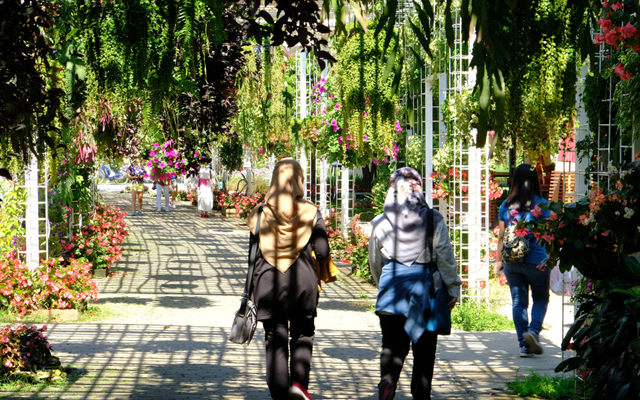
Chiang Mai hopes to court more Muslim visitors to the city (pictured: Muslim tourists at Royal Park Rajapruek in Chiang Mai)
“Chiang Mai has the potential to be a key Thai destination for Muslim visitors,” he added.
Senior lecturer Ismah Osman of Malaysia’s Universiti Teknologi Mara said the city is on the right track to welcoming the fast-growing number of Muslim travellers, with more hotels and services catering to market demand.
Dullah Jehdeng, owner and managing director of Nanyeeya Entertainment Travel, said Chiang Mai is emerging as one of the top destinations for Muslim travellers from South-east Asia, especially Malaysia, due to the rising availability of services.
“Chiang Mai already has a strong Muslim culture and we have many places that serve diverse Muslim food, and many halal and Muslim-friendly hotels,” he said.
The city is home to 12 Muslim-owned hotels and THAT is working with tourism-related organisations to educate them on how to meet the needs of Muslim customers. Daily flights connecting Chiang Mai to Kuala Lumpur have also boosted inbound numbers from Malaysia.
Chiang Mai is also home to a strong Chinese Muslim community, several Muslim communities and historic mosques. There is a surplus of halal food, influenced by the Chinese, Burmese and Thai Muslim residents in the area, said Jehdeng.
A halal chef competition, which took place in Chiang Mai on August 1, helped to further raise the Thai city’s profile. Destinations are also being developed to serve Muslim visitors. One such example is Ping Luang village, which is home to a Chinese Muslim community. The community-based tourism project will be ready to welcome guests next year.
Halal tourism, catering to Muslim travellers, is the fastest-growing segment of the global tourism market.
South-east Asia will welcome over 18 million Muslim visitor arrivals by 2020, accounting for 15 per cent of total visitor arrivals in the region, according to the Mastercard-CrescentRating Global Muslim Travel Index 2018.
IATA has launched the Billing and Settlement Plan (BSP) in Myanmar as of September 1, 2019, which is expected to ease the reporting of ticket sales and remittance for participating travel agents and settlement of their sales to airlines.
Prior to the implementation of the BSP, agents in Myanmar had to interact directly with each of the respective airlines to report and remit their ticket sales – an inefficient and time-consuming exercise. The introduction of the BSP will streamline and standardise the process and format for sales reporting and remittance by agents to the airlines.
IATA has launched the Billing and Settlement Plan in Myanmar as of September 1, 2019
With the BSP, both airlines and travel agents will receive only one sales report, said IATA. Travel agents will only need to make one payment for all their sales to the airlines via the BSP by a pre-determined date. Airlines will then receive one consolidated payment from the BSP.
Conrad Clifford, IATA’s regional vice president for Asia-Pacific, said: “Aviation is a growing sector in Myanmar. As the country continues to develop and with more international airlines operating services in Myanmar, it is timely to introduce the BSP. Not only will it bring efficiencies in the interactions between airlines and travel agents, it will also modernise and support the growth of Myanmar’s travel and tourism sector.”
About five airlines and 12 travel agents are participating in the Myanmar BSP during the start-up phase, with more expected to join in the coming months.
Clifford added that on top of introducing the BSP, IATA has also opened its first office in Myanmar in April. “Through this office, we hope to enhance our partnership with the various aviation stakeholders to support Myanmar’s aviation development through the implementation of global standards and industry best practices,” he said.
In the next 20 years, air travel in Myanmar is expected to grow by an average of eight per cent annually, ahead of the global average of 3.9 per cent. By 2038, Myanmar is expected to be an air travel market of 37 million passengers, close to five times the current numbers.
The Ascott expects to cement its position as “the largest serviced residence operator in Singapore” as it launches a record four openings in the city this year and introduces a pair of new brands in Singapore.
Ervin Yeo, Ascott’s regional general manager for Singapore, Malaysia and Indonesia, said: “We are on a strong growth trajectory, with our presence in our home market of Singapore expanding by over 60 per cent in the past two years. We have a record opening of four properties this year and another four are expected to open by 2021.”
Ascott's new openings in Singapore
1 of 3
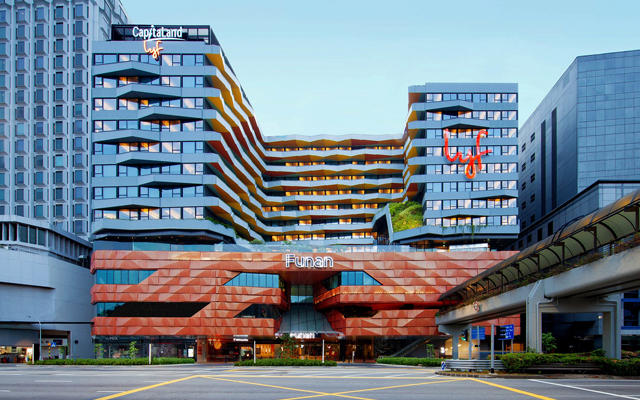
lyf Funan Singapore
Citadines Rochor Singapore
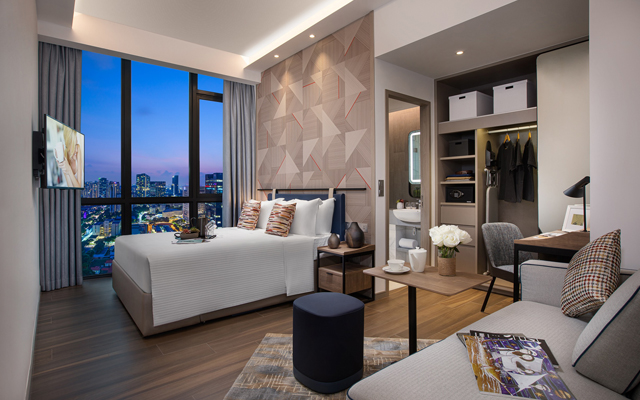
Citadines Balestier Singapore studio premier apartment
He added: “With the government’s pro-business policies as well as exciting initiatives to rejuvenate the city and attract investors and tourists, we see strong demand for international-class lodging properties. We will further step up Ascott’s presence in Singapore through strategic acquisitions, partnerships, management contracts, franchises and leases.”
“We are expanding our product offerings in Singapore with new-to-market brands including the ‘lyf’ co-living brand and Citadines Connect, a line of business hotels with select services. Ascott is also managing Huazhu Hotels Group’s first hotel outside of China under its Ji Hotel brand.”
Citadines Connect City Centre Singapore, secured under a franchise agreement, is slated to open in 2021 as the brand’s first property in Singapore. Located a stone’s throw away from Dhoby Ghaut MRT station and Plaza Singapura near Orchard Road, Citadines Connect City Centre Singapore will increase Ascott’s Singapore portfolio to a total of 17 properties across over 3,100 units.
Meanwhile, Ascott’s four property openings in Singapore this year will add 846 units to the lodging scene. The first amongst the four properties to open is lyf Funan Singapore, followed by Citadines Balestier Singapore and Ji Hotel Orchard Singapore in September, while Citadines Rochor Singapore is slated to open in December.
lyf Funan Singapore, Ascott’s first property under the millennial-oriented co living brand, is located in the heart of Singapore’s Civic & Cultural District as part of the Funan integrated retail and commercial development.
Citadines Balestier Singapore sits atop a three-storey retail podium with proximity to the Novena MRT station, while Citadines Rochor Singapore is part of an integrated development, which includes the Tekka Place retail podium, and the Rochor MRT station right at its doorstep.
Ji Hotel Orchard Singapore is situated within walking distance to Dhoby Ghaut MRT Station and CapitaLand’s Plaza Singapura mall.
To meet rising demand for short-stay accommodation, lyf Funan Singapore, Ji Hotel Orchard Singapore and Citadines Rochor Singapore will have the flexibility of taking in daily stays under full hotel licenses.
Besides Citadines Connect City Centre Singapore, Ascott is slated to open Citadines Raffles Place Singapore, lyf Farrer Park Singapore and lyf one-north Singapore in the next two years.
China’s online hotel reservation market continues to grow rapidly, with huge potential in the rise of online rates as compared to developed markets such as Europe, the US and Japan, according to the latest research from Trustdata’s Mobile Big Data Monitoring service.
Monthly active users reached 100 million in 2Q, while room nights reserved in 1H were up 20 per cent year-on-year, based on data from the report.
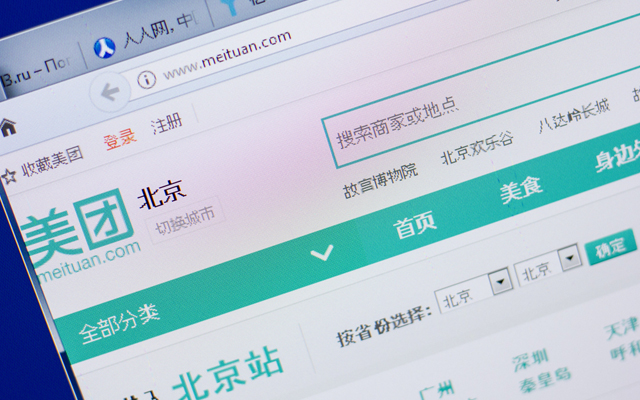
China’s online hotel reservation market continues to grow rapidly, with Meituan the forerunner in terms of room nights reserved in 1H2019
China’s per capita GDP is expected to exceed US$10,000 in 2019, accelerating the increase of new tourists and boosting the demand for hotel reservations.
The report also showed that the age composition of Chinese online hotel reservation users has changed, with post-90s and post-00s becoming the main consumers, while the potential for post-2000s are huge.
Young users born in the 1990s and 2000s, who carry less financial burdens and have strong willingness to spend online are driving the growth of online hotel reservations.
It added that young users’ needs and scenarios for online hotel reservations are becoming increasingly diversified and personalised.
Online hotel reservations have continued to penetrate in country-level markets in 1H2019, with “small town areas” registering multiple growth and 70 per cent of new users from third- and lower-tier cities.
Other performance insights from the report include:
In 1H2019, Meituan led the industry in terms of room nights reserved, accounting for 47.3 per cent of the market, more than the total share of Ctrip, Qunar and eLong combined. Coming in second place is traditional OTA Ctrip.
Meituan and Fliggy led the industry in terms of the number of young users, with post-90s and post-00s accounting for more than 50 per cent of users.
Ctrip ranked first in user retention, while Tongcheng-eLong and Meituan ranked second and third.
Qunar ranked first in terms of daily opens, followed by Tongcheng-eLong and Meituan.
OTA players around the world form a four-pole competitive landscape, and leisure travel is the key area of battle. Similar to Expedia, Ctrip has been developing for 20 years and focusing on business travel. Meituan, though young, is similar to Booking in nature, focusing mainly on the leisure and vacation market.
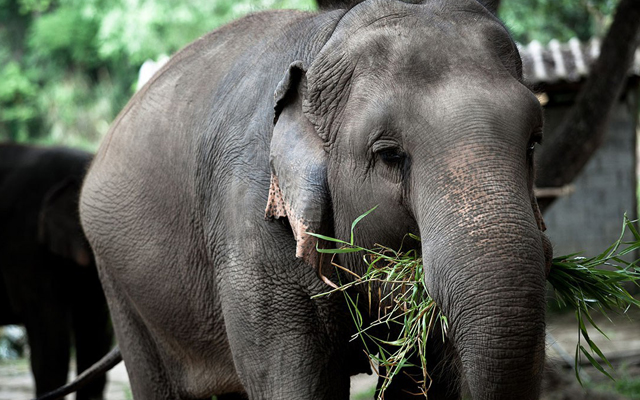
Elephant tourism in Thailand continues to undergo some disapproval and there’s been a call for all captive elephants to be released into the wild. While such suggestions may be made with the best intentions, and maybe commendable, how valid are they?
“In an ideal world, all elephants would be free in nature. However, due to human population increases and habitat destruction, the reality is there is not enough appropriate habitat to support current wild populations of Asian elephants, let alone reintroduce the existing population – upwards of 15,000 in Asia – of captive elephants.
TAT: proper measures should be taken to better handle elephant tourism in a sensible way
“Furthermore, it is a complex process to reintroduce captive elephants back into the wild. In addition to the lack of habitat, released captive born elephants can increase the human-elephant conflict, as they are used to interacting with and are not afraid of humans. Additionally, captive elephants may carry diseases that, if contact is allowed, can potentially spread to wild populations.
“Captive elements can serve as a means of maintaining important populations as ‘insurance’ against environmental or human-caused changes. Up-close and personal contact with captive elephants, especially when accompanied by educational materials, can also help inspire the public to care for elephants and their habitats.”
That’s the answer provided to the questions “Should all elephants be free?” and “Can captive elephants be reintroduced into the wild?” on the ACEWG website (www.acewg.org) in a section dedicated to FAQs on elephants in tourism.
The group was formed in 2015 by a group of elephant specialists, veterinarians, researchers, camp managers and conservationists to address the situation for elephants in the tourism industry in South-east Asia. It recognises the urgent need to create more awareness about and address both the problems and the possible solutions.
But this needs to be done with more research “to scientifically guide the development of protocols to appropriately address welfare concerns and to further improve management systems.”
Boycotting elephant tourism is not the answer, ACEWG insists and it’s not alone in this stance. This approach, it says, can often have a reverse effect and do more damage than good. It can undermine elephant camps that are behaving responsibly and providing good welfare to their mahouts and elephants.
ACEWG is behind an ambitious new audit programme that, to gain certification, requires elephant camp operators to submit to detailed, regular inspections on everything from the elephants’ diet and medical care to training and salaries for mahouts.
The group’s FAQs on elephants in tourism touches on various issues. The use of what’s called a bull hook or hook, for example. Consisting of a stick with a curved hook at the end, this is used to guide an elephant and also allows the mahout to get an elephant’s attention in an emergency or potentially dangerous situation in which the animal may panic. When elephants and humans are in a close and unrestricted contact scenario, the bull hook serves the purpose of ensuring safety for both. It is simply too dangerous to not have a bull hook present and at hand in case of an emergency.
The bull hook can, however, be misused or used purely to punish. Mahouts must be trained properly, so they are capable and confident in their ability to safely handle an elephant.
Another point that’s consistently raised is the chaining of elephants. This is an important part of managing elephants in a traditional hands-on system in South-east Asia where cement or steel structures are very expensive and financially not viable. Chains are the simplest and safest tool to keep these large animals to a specific area. They are a safe and quick way of control if needed and are also used to safely restrain an elephant during husbandry and veterinary procedures.
Again, as with the bull hook, chains must be used properly and appropriately to avoid injury. A sufficient length to a chain allows an elephant to interact with other elephants but also to find space alone should it want to. Using a long chain to tether an elephant at night rather than fencing it in means the animal can be moved more easily between fresh browse areas. Still, elephants shouldn’t be kept on chains for prolonged periods; they also need to have free movement.
Elephants are sometimes seen swaying back and forth, giving off the appearance of “dancing”. This is not necessarily a sign of distress. It is a behaviour known as stereotypy, which develops in response to conditions that restrict normal behaviour and which could include a barren environment, scheduled or restricted feedings or frustration.
On the other hand, there is also certain behaviour that can be related to happiness. Exploratory or playful behaviour is a good sign that an elephant has good welfare. Look for elephants that touch and comfort each other, engage in play during bath time, care for their calves, and vocalise a variety of greetings.
Elephant performances, if done properly using positive training techniques, are not bad for elephants. Ethical, well-managed and properly scripted animal presentations can have benefits for the animal’s health as they provide a form of exercise and mental stimulation. There are certain activities or “tricks” that elephants should not be allowed to do, such as walking on hind legs or sitting upright as this isn’t only unnatural behaviour but can negatively affect the animal’s wellbeing and physical health.
The amount of walking a wild elephant does each day depends on the quality of their habitat. Elephants in captivity are usually provided adequate food and water, and may not walk much if they don’t have to. Thus, it is important they are provided ways to exercise daily, like participating in trekking or other activities, for their physical well-being as well as to alleviate boredom and reduce aggression.
As to how much weight an elephant can carry on its back, if the working hours are limited and terrain is suitable, two people in a saddle – which is less than 10 per cent of the elephant’s body weight – will not be an undue stressor for the animal. A saddle should be properly cushioned and not apply pressure to the spine.
Common health problems of elephants are often linked to poor husbandry with injuries from poorly fitting saddles, pressure sores, arthritis and feet problems like nail cracks and wounds from the overuse or incorrect use of the bull hook being clear indicators of poor management.