Royal Caribbean International’s Spectrum of the Seas has arrived in Hong Kong, attended by over 600 invited government officials, industry stakeholders and loyal guests.
Officiating guest Edward Yau Tang-wah, secretary for commerce and economic development said the Hong Kong government has been joining hands with the Hong Kong Tourism Board and the trade in promoting the development of cruise tourism in Hong Kong.
Spectrum of the Seas' arrival in Hong Kong
1 of 2
Spectrum of the Seas
Royal Caribbean Cruises' Michael Bayley
With accommodation for 5,622 guests and 2,147 staterooms, Spectrum of the Seas set off on its maiden voyage to Asia from Europe just a month ago. Highlights of the new cruise include a first-at-sea virtual reality, bungee trampoline experience, suites-only area, Ultimate Family Suite and a Sichuan specialty restaurant.
Guests can also now utilise the new Royal app to plan and manage their cruise holiday while on board. The app enables access to the guest’s suite, controls amenities inside the suite, and allows guests to make specialty and dining reservations, reserve shore excursions and shows, access their bill in real-time, and save daily activities to their calendar.
From December 2019 to January 2020, Spectrum of the Seas will offer six cruises from Hong Kong. The seven-night Japan & Philippines Cruise departing on December 22, 2019 and January 2, 2020 will visit Ilocos in the Philippine where guests can enjoy the beaches and explore historic Vigan City, home to Spanish baroque colonial architecture.
There is also the four-night Best of Chan May Cruise, departing on December 18 and 29, 2019.
From November 2020 to January 2021, Spectrum of the Seas will return to Hong Kong for nine homeport sailings. In addition, there will be two special Olympic-themed sailings in 2020 in celebration of the great sports event. Departing from Shanghai on July 25 and August 2 respectively, Spectrum of the Seas will bring guests to Tokyo during the Summer Olympics and stay overnight to indulge in the exciting Olympic sports enthusiasm.
From left: China Eastern Airlines' Dong Bo, former SkyTeam Alliance board chair Michael Wisbrun, SkyTeam's Kristin Colvile and Korean Air's Walter Cho
SkyTeam, the global airline alliance, has announced Walter Cho, chairman and CEO of Korean Air, as the new chairperson of its alliance board.
The appointment was endorsed last week at a meeting of the SkyTeam Alliance Board, which comprise CEOs of the 19 member airlines and oversees SkyTeam’s global strategy.
As a founding member, Korean Air has been instrumental in shaping SkyTeam over the last 20 years.
From left: China Eastern Airlines’ Dong Bo, former SkyTeam Alliance board chair Michael Wisbrun, SkyTeam’s Kristin Colvile and Korean Air’s Walter Cho
Walter Cho will replace the chairperson of the alliance board, Michael Wisbrun, who has held the position for more than three years.
Apart from steering a fleet modernisation programme and negotiating a Trans-Pacific joint venture with Delta Airlines, he is also recognised for his expertise and experience in the IT field. Cho successfully implemented key IT initiatives of the airline, including the advanced enterprise resource planning, the new passenger service and the next-generation cargo system (iCargo).
He also made a pioneering decision to migrate Korean Air’s IT system to Amazon Web Services cloud.
SkyTeam has also introduced an executive board to its governance structure.
Earlier this month, Dong Bo, chief marketing officer, China Eastern Airlines was appointed the chairperson of this board.
Created to support SkyTeam’s focus on customer experience enabled by technology, the executive board is made up of senior business leaders from each of the member airlines who will be actively involved in implementing the alliance’s strategy.
Since joining China Eastern Airlines in 1997, Dong Bo has been deputy general manager of the Human Resources department, general manager of the cabin crew service department, secretary (then general manager) of ground handling department, chief service officer, chief marketing officer and general manager of marketing & sales committee.
“SkyTeam is entering the next generation of its life, these two appointments reflect our members’ commitment and broader engagement in creating the leading alliance of the future, with a significant focus on digitally connecting airlines to create an effortless and seamless customer experience, enabled by proprietary technology,” said Kristin Colvile, SkyTeam’s CEO and managing director.
While Hilton clinched the lead in terms of value of top performing brands in a recent ranking, it is also playing catch up with Marriott in the luxury space.
According to Brand Finance’s latest hotel sector report released in May, the value of Hilton brands that made the top 50 ranking this year was at US$14.7 billion – over US$1 billion ahead of Marriott’s US$13.4 billion portfolio. Hilton achieved overall brand value growth of 41 per cent, while Marriott saw a 27 per cent decrease, making way for Hilton in the top spot. Hilton has six brands in the top 50, compared to Marriott’s 13.
Brand Finance's Hotels 50 2019 report
1 of 3
Most valuable brand portfolios
Top brands by value
Brand value change
Brand recognition and innovation are driving Hilton’s performance, Daniel Welk, the group’s vice president, luxury and lifestyle, Asia Pacific, told TTG Asia on the sidelines of ILTM Asia Pacific.
“We’re not saying we’re the biggest hotel company in the world, just the most recognisable and trusted throughout the globe. It’s rankings like this that allow us to hang our hat on (that claim),” said Welk.
“We’re (akin to a) 100-year-old start-up. Everyone at Hilton believes that innovation is in our DNA. Today we are leading digital technology by (pioneering a) mobile app that allows room selection, digital key (and more).”
The Hilton Hotels & Resort flagship, already the most valuable brand on the ranking, this year extended its lead over Marriott, after growing 17 per cent in value to US$7.4 billion. This was largely driven by strong revenue increase over the last year, according to Brand Finance.
Moreover, the independent brand-valuation company found the top three fastest growing brands all coming from Hilton’s portfolio, led by Homewood Suites (brand value up 99 per cent to US$800 million), followed by Double Tree (up 79 per cent to US$2.1 billion) and Hampton (up 78 per cent to US$3.2 billion).
Hilton rules the roost in the report
On the other hand, Marriott is holding strong in luxury. Notably, the group’s only two brands in the top 10 growth ranking were both from the luxury category (W and Luxury Collection).
Travel agents polled at ILTM Asia Pacific said the giant’s luxury brands continue to score high on brand trust and recognition, despite Brand Finance partly attributing Marriott’s decline in brand value to a recent cyber security incident.
Buyer Vikram Kajaria of Makson Travels said: “Hilton’s Waldorf Astoria aside, Marriott’s luxury brands such as the Ritz-Carlton and St Regis are more trusted and recognised among high-end Indian travellers.”
Nevertheless, Hilton’s luxury portfolio is on a steady climb. Welk said “incubating new brands” is another way the group is working to stay ahead in luxury. After recent debuts, Hilton today counts four of its 17 brands in luxury and lifestyle.
Hilton recently debuted the Canopy brand before bringing it to Asia with an opening in Chengdu this year. It also introduced LXR late last year, a new soft brand of individual properties, each distinct from the other, but all carrying the promise of uncommon and personalised experiences.
Asia-Pacific represents an important region as the world’s two most valuable hotel groups pursue growth in the luxury sector.
“The whole centre of gravity in the hospitality world is moving to Asia-Pacific. Throughout the region, we have in excess of 20 luxury and lifestyle hotels in the pipeline. There are 24 hotels (in the region) across the three brands – Waldorf Astoria, Conrad and Canopy by Hilton,” Welk shared.
Rival Marriott is also making big investments in the Asia-Pacific luxury space. It announced last week that there will be 13 new luxury projects to open in 2019, a feat considering the size of the high-end sector, according to Bruce Ryde, vice president, luxury brand management, Asia Pacific.
Ryde added that the hotel giant is rolling out a “luxury countdown process”, an internal initiative that originated with a Ritz-Carlton, to all its luxury brands. “It’s where senior people and luxury resources descend on a hotel eight to 10 days out (from its opening) to envelop the team at the property with (passion) and brand speak. This is so we give the hotel the best possible start in the luxury space.”
New and upcoming luxury hotel openings the St Regis in Hong Kong, while the Ritz-Carlton is set to launch in Xi’an (China), Perth (Australia) and Pune (India).
Brand Finance also pointed out that Marriott’s recent announcement to enter the longer-stay market to take back share from Airbnb could drive its brand value back up in the coming year.
Aerial view of tourists from Russia and other countries on a basket boat tour of the Mangrove Palm forest in Cam Thanh village, Hoi An
It’s boom time for Russian arrivals in Asia-Pacific countries, which ForwardKeys attributes to a doubling in seat capacity on direct flights from Russia to select destinations in the region.
Direct flights from Russia to Asia-Pacific more than doubled as airlines increased their seat capacity substantially. Overall seat capacity was up 37.6%, with the highlights being a 124.8% increase in seats to Thailand and 153% to Vietnam.
Aerial view of tourists from Russia and other countries on a basket boat tour of the Mangrove Palm forest in Cam Thanh village, Hoi An
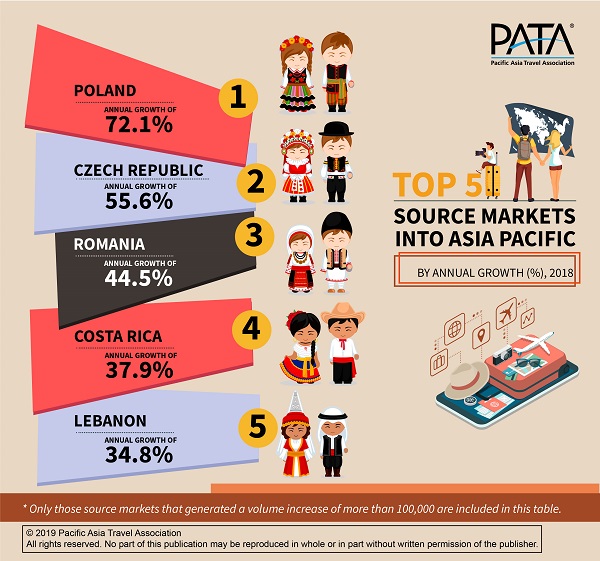
Total international arrivals in Asia-Pacific were up 3.8% from May 2018 to April 2019. However, Russia’s 54.5% increase meant Europe was the top growing origin continent, up 6.3%.
ForwardKeys notes the extent of Russia’s sharply renewed enthusiasm for Asia-Pacific after reviewing historical figures. The volume of arrivals rocketed towards the end of last summer, according to ForwardKeys’ data.
Growth in Russian leisure travellers (up 62.8%) dramatically outstripped business travel (up 27.5%) and they’re staying for 16 nights on average. In line with general trends towards shorter lead times, the Russians are booking fewer days in advance, 65.8 days, down from 78.1 days.
ForwardKeys vice president, insights, Olivier Ponti, said: “For the Asia-Pacific region, Russia is now the ninth top origin country – by share – outside of Asia-Pacific itself. It’s due to a combination of increased seat capacity on direct flights, high-profile political visits and astute marketing… as well as agile capacity meeting demand.”
Aerial view of The Shigira, the all-inclusive luxury brand under Nanseirakuen Resort
Some 300km south of Okinawa, a small island known mainly to the Japanese is rising up on the maps of foreign tourists, buoyed by the arrival of its first international airport, international branded hotel and cruise passengers.
Miyako Island, nearly 160km2 in size, is the largest of six islands administered by the city of Miyakojima. This January, neighbouring Irabu Island welcomed what’s believed to be the first international branded hotel in Miyakojima with the opening of Iraph Sui, a Luxury Collection Hotel by Marriott.
And in March, a new international airport opened on Shimoji Island (connected by bridge to Miyako Island), set to receive its first inbound scheduled service when HK Express commences flights there in July.
Aerial view of The Shigira, the all-inclusive luxury brand under Nanseirakuen Resort
Iraph Sui is expecting a more international mix of guests with HK Express and Korean Air chartering flights to the new airport. The domestic to international guest ratio is currently 9:1, according to Yoshiko Sato – director of marketing at Iraph Sui, a Luxury Hotel, Okinawa and Suiran, a Luxury Collection Hotel, Kyoto.
Meanwhile, the biggest tourist accommodation in the Miyako Islands, Nansei Rakuen Resorts, which offers 1,000 keys across seven brands, sees 97 per cent of demand coming from domestic origins.
Now turning its attention to inbound guests, it marked its first-time participation at ILTM Asia Pacific this year.
While only one foreign airline has been scheduled to service the island thus far, Mio Yamamuro, the resort’s executive managing director, believes that awareness is the big missing link in the island’s international ambitions.
“We don’t see many non-Japanese here – at least not yet. The problem is that international travellers don’t know about the destination and our resort. But through our ILTM appointments, we have been showing off the island and our resort and everyone has been amazed. They never thought there’d be such beautiful beach resorts in Japan.”
What many international travellers also don’t know is that “it’s a quick change in Naha” to get to Miyako Island.
Between Naha and Miyako, there are 13 domestic flights a day, which translates to “more or less one flight every hour”, Yamamuro emphasised. “It is really no hassle to get here for those transiting in Naha.”
Apart from Hong Kong, which will soon get scheduled flights, she remarked that South Korea and Taiwan are also promising due to the easy transfers from Naha. There are seven or eight services connecting each country to the Okinawa airport. The flight from nearby Taiwan to Naha takes only an hour, and the connecting flight to Miyako Island just 55 minutes.
Overall, Yamamuro admitted that Miyako is less inbound ready than some other comparable destinations such as Ishigaki, Okinawa.
“We are probably not as international as other beach destinations in Japan. The lack of foreign language signage, not just on our property but also around town, is a challenge. But this is something we have been coping with. As more cruises come in, we’ve been adding more signage in Chinese. We should be ready to cater to guests of different nationalities.” Yamamuro noted.
However, what sets Miyako Island apart from Okinawa beach haunts like Ishigaki is the ease of exploring the small island. “It’s just three hours to drive around the island and up to two hours to get from the airport to tourist resorts. For our guests, it’s 15 minutes to arrive from the domestic airport and 45 minutes from the international airport,” she shared.

The growing cruising market and 2020 Tokyo Olympics are also presenting new opportunities for Miyakojima properties.
Yamamuro said: “We see a lot of non-staying guests who arrive on cruises to dine at our 22 restaurants. We want to convert them into staying guests… There will be a lot of tourists coming to watch the games in Tokyo next year. We see a good opportunity to have them fly down to enjoy a couple of days on the island before heading back home.”
At Iraph Sui, Sato expects there could also be some “indirect business opportunities” materialising from the Tokyo Olympics. With the games affecting the commute in Tokyo, some companies might allow employees to work remotely, hence raising business opportunities for the hotel.
From left: Bunga Wangsa Sedjati's Rio Imam Sendjojo, Jatim Park Group's Ronny_Sendjojo and Traveloka's Christian Suwarna
Indonesian travel platform Traveloka has signed a strategic partnership cooperation with Jawa Timur Park, an Indonesian tourism developer based in Batu, Malang, East Java.
Marking the first collaboration between Traveloka and Jawa Timur Park Group, the collaboration will see Traveloka and Jatim Park Group work together on regional marketing initiatives; online booking facilities for all activities in East Java Park; product development; and bundling of park with Traveloka flights and hotels to offer a complete vacation package.
From left: Bunga Wangsa Sedjati’s Rio Imam Sendjojo, Jatim Park Group’s Ronny_Sendjojo and Traveloka’s Christian Suwarna
Ronny Senjojo, spokesperson for Jatim Park Group, said the partnership will help to promote Indonesia’s attractions to foreign markets, “the first time” it is doing so through “online marketing”.
Christian Suwarna, CEO of Traveloka Experience, said: “Traveloka… is a potential platform for the Jatim Park Group to provide information about the destination for the foreign market. We hope that with the (making) of this information accessible to the South-east Asian market, (it) can further increase the the interest of local and foreign communities to visit this recreational park.
“We hope this collaboration can also contribute positively to Indonesian tourism especially in Batu and Malang.”
Currently, Jawa Timur Park Group has 12 theme parks located in East Java and West Java, complete with four hotels and resorts.

The Badaling section of the Great Wall in Beijing will limit the number of visitors to 65,000 a day from June 1, according to a report from the Beijing Youth Daily.
Apart from the limit, authorities will also impose a registration system for ticket purchases starting next month, which aims to encourage visitors to book in advance online. Tourists can book tickets seven days in advance through www.badaling.cn.
Great Wall of China at sunset
The Badaling section of the Great Wall – the wall’s most popular section – is located in Yanqing County, 60km north-west of Beijing. Last year, the section received more than 9.9 million visitors, and authorities fear that should crowd numbers not be controlled, the structure may suffer damage.
The Badaling Great Wall has also currently set up a three-tier warning system for visitors. The yellow warning will be issued when the number of visitors reaches 39,000, orange warning for 52,000 and red warning for 65,000.

Aside from the Badaling Great Wall, the Palace Museum and the National Museum of China have imposed daily limits, at 80,000 and 30,000 respectively.
Mohd Rafee Bin Ibrahim and Sunway's Calvin Ho (middle two) shake on the partnership
Sunway Theme Parks and Zoo Melaka last week kicked off their MoU signing on animal conversation with the exchange of two animals between the companies.
To mark the beginning of this strategic partnership, one female giraffe from Zoo Melaka will be transferred to Sunway Theme Parks’ establishment – Sunway Lost World Of Tambun – under the breeding loan with the hope that the giraffe will breed more giraffes and increase the number of giraffes in the world. In return, Sunway Theme Parks through its establishment, Sunway Lagoon, will be loaning the White Tiger to Zoo Melaka.
Mohd Rafee Bin Ibrahim and Sunway’s Calvin Ho (middle two) shake on the partnership
This is a start of long-list planned animal transfers that will take place throughout this year until next year. All animal transfers will be done in the spirit of animal conservation, and with the hope of breeding new bloodlines.
The transfer of the giraffe to Sunway Lost World of Tambun is set to take place this month and the journey will be made through the North South Highway. Meanwhile, the arrival of White Tiger to Zoo Melaka is targeted to be after the Hari Raya Aidilfitri break.
Avani Hotels & Resorts has appointed Javier Pardo as vice president of operations.
In his new role, Pardo will oversee the operational and financial performance for the brand, and will also lead new brand initiatives.
Based in the company’s regional office in Bangkok, Pardo will report directly to Robert Kunkler, COO of Minor Hotels.
Pardo brings almost two decades of hospitality experience across Europe to the table, with his last posting being director of operations and commercial director for the NH Hotel Group.