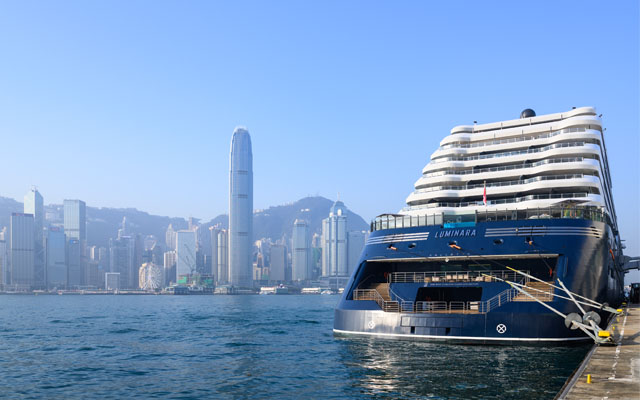
The Hong Kong Tourism Board (HKTB) welcomed the inaugural arrival of The Ritz-Carlton Yacht Collection’s Luminara, marking the luxury yacht’s deployment from Hong Kong as a turnaround port.
Over the coming months, the yacht will operate Asia-Pacific itineraries with Hong Kong as the embarkation and disembarkation point. The deployment highlights Hong Kong’s appeal for cruise tourism and its ability to attract high-end international visitors.
Luminara docked at Ocean Terminal, Tsim Sha Tsui, marking its first Hong Kong call and the start of its Asia-Pacific cruises
Luminara entered Victoria Harbour and docked at Ocean Terminal in Tsim Sha Tsui on the morning of January 13, following the launch of its Asia-Pacific itineraries from Singapore in December. HKTB marked the occasion with a water salute, dragon and lion dances, and a welcoming ceremony and luncheon on board attended by secretary for culture, sports and tourism Rosanna Law, commissioner for tourism Angelina Cheung, HKTB executive director Anthony Lau, and representatives from The Ritz-Carlton Yacht Collection.
Luminara, the third and newest superyacht from The Ritz-Carlton Yacht Collection, will operate turnaround trips between Hong Kong and Singapore or Tokyo from January through mid-April 2026, with port calls including Osaka, Bangkok, Incheon, Halong Bay, and Ho Chi Minh City.
Launched in July 2025, the yacht spans 242 metres with a gross tonnage of 46,750 and accommodates up to 452 guests across 226 suites with private terraces. Luminara features five dining venues, seven bars, and an expansive marina providing direct access to the water, supporting an intimate and unhurried way of exploring the region.
Law commented: “I am delighted to welcome the maiden call of a luxury cruise vessel from a leading international brand to Hong Kong as the new year begins. This demonstrates that Hong Kong not only attracts large and well-known cruises but has also drawn super-luxury vessels targeting high-end international visitors, testifying to Hong Kong’s diversity in cruise tourism.
“Looking ahead, the Tourism Commission and HKTB will continue to fortify Hong Kong’s position as Asia’s Cruise Hub and work closely with industry partners to drive the development of cruise tourism in Hong Kong.”
Ernesto Fara, president and CEO of The Ritz-Carlton Yacht Collection, said: “Our Asia-Pacific itineraries invite guests to experience the region in a more intimate and unhurried way, pairing marquee cities with more secluded islands and offering opportunities for overnights that allow for deeper exploration ashore and by water.
“Expanding into Asia-Pacific marks an important step in how we continue to thoughtfully grow in the region and around the world.”
Andaz One Bangkok, Thailand
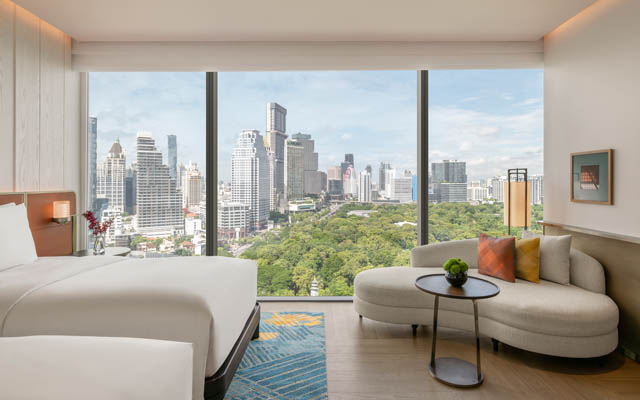
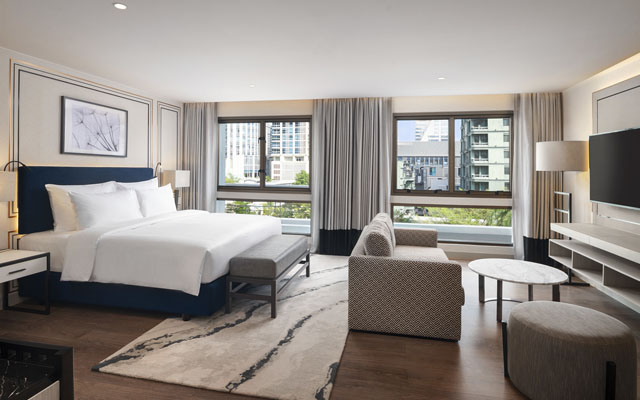
Andaz One Bangkok has opened within the One Bangkok district on Wireless Road, featuring 244 rooms and suites ranging from 38m² to 197m², many overlooking Lumphini Park.
Facilities include a 24‑hour lounge, outdoor infinity pool, and fitness centre. Dining options include Jǐng for Chinese cuisine, Andaz Terrace for Asian‑influenced dishes and afternoon tea, and Piscari on the 23rd floor for Mediterranean fare with rooftop terrace and speakeasy.
The property connects directly to MRT Lumphini Station and is close to shopping, cultural venues and business districts. Its location beside Lumphini Park gives access to green space while remaining in the centre of Bangkok, with both airports reachable via nearby expressways.
Okinawa Harborview Hotel
Okinawa Harborview Hotel, Japan
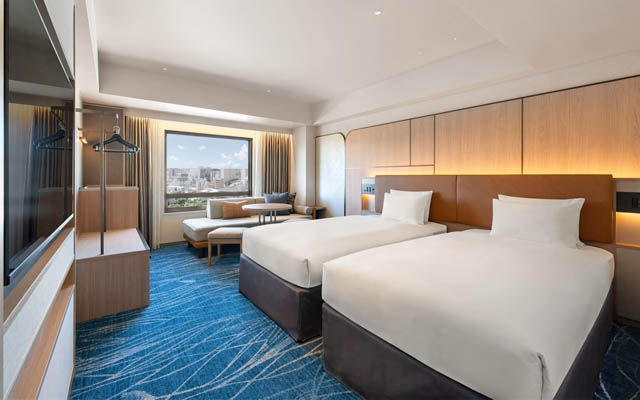
Okinawa Harborview Hotel in Naha has completed major renovations to its guestrooms, club lounge and dining facilities. All rooms have been refreshed, including Standard Twin and Club categories such as Executive Twin and Deluxe Twin, with lounge access benefits.
The expanded top‑floor Club Lounge operates until midnight, serving meals and drinks with views over the city. A new restaurant, Teppanyaki Izumizaki, highlights local produce and Ryukyu traditions alongside premium beef and seafood.
The hotel is located about 10 minutes by car from Naha Airport and within walking distance of Yui Rail stations, Kokusai Street and the Prefectural Office, offering convenient access to shopping, dining and day trips.
The Amnis, a Luxury Collection Hotel
The Amnis, a Luxury Collection Hotel, Taiwan
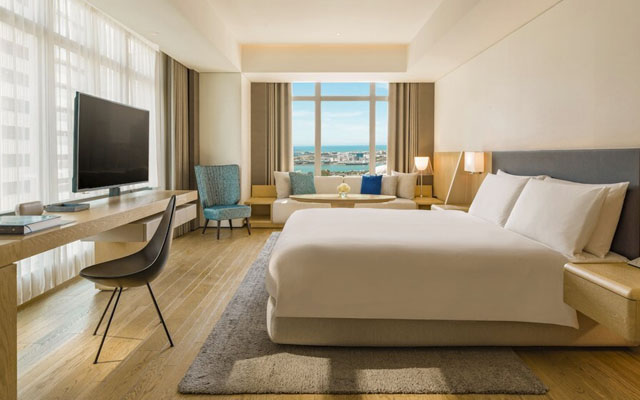
The Amnis, a Luxury Collection Hotel, Kaohsiung marks the brand’s debut in Taiwan.
The hotel offers 147 guestrooms starting at 60m², designed with natural materials, large windows and soundproofing to provide privacy and views of the harbour.
Facilities include a semi‑outdoor pool, sauna, steam room and fitness centre. Dining options range from teppanyaki and kaiseki at Ukai‑tei Kaohsiung to sake at Dassai Bar and all‑day service at In‑Jade Lounge. Guests can also join guided visits to ALIEN Art Centre and daily locally inspired culinary experiences.
Located in the Asia New Bay Area, the property is close to Kaohsiung Music Center, Exhibition Center, and the Main Public Library, with convenient links to Kaohsiung Station, MRT and the airport.
Radisson Hotel Chateau de Bangkok
Radisson Hotel Chateau de Bangkok, Thailand
Radisson Hotel Chateau de Bangkok has reopened in the Ploen Chit district, reintroducing one of the city’s longstanding landmarks. The property boasts 178 guestrooms and suites, many with skyline views, and some equipped with kitchenettes for extended stays.
Dining options include Larder & Lounge for café fare, Château Botanique for Thai‑French cuisine, and View Pool Bar on the rooftop with city vistas. Wellness facilities on the 12th floor feature a fitness centre, spa room and outdoor pool.
Event spaces include the Crystal Lotus Hall for up to 250 guests, alongside smaller meeting rooms. Located near BTS Ploenchit station, the hotel provides convenient access to shopping, dining, temples, palaces and Bangkok’s business districts, with both airports reachable within 40 minutes.
InterContinental Chiang Mai The Mae Ping has appointed Bijayasinee Sirivisutra as cultural ambassador, a newly created role.
Based in Chiang Mai, she is responsible for developing guest experiences connected to Lanna heritage, managing cultural artefacts within the hotel and strengthening links with the local arts community.
Bijayasinee was born and raised in Chiang Mai and has a background in Lanna dance and Thai art. Her professional experience includes roles in Thai media and entertainment, luxury hospitality and more than a decade working as a travel writer across Thailand.
The Philippines’ focus on new destinations and experiences is driving an exciting, vibrant evolution in its inbound tourism, successfully refreshing the country’s global appeal, allowing it to shine and increase its competitive edge among regional neighbours.
The industry’sembrace of responsible tourism is translating into action, showing a strong national commitment to sustainability, safety, and security, thus protecting its natural and cultural assets for future travellers.
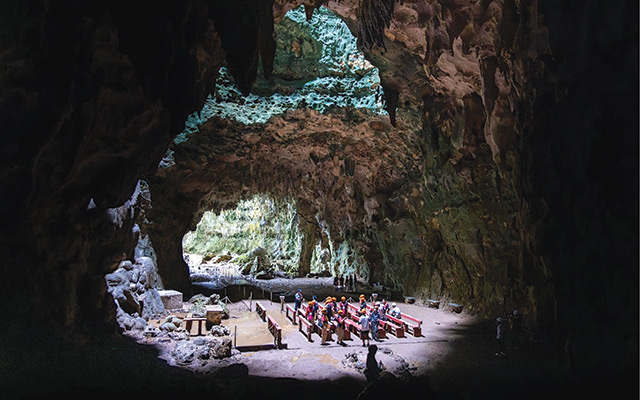
Callao Cave in Cagayan, part of the Philippine Experience Program
To expand traveller interest beyond the popular spots – Boracay, Cebu, Bohol, and Palawan – and the standard sun, sea, and sand offerings, the Department of Tourism (DoT) and the private sector are actively collaborating to discover new destinations and develop a variety of fresh tours and products.
One way the DoT is showcasing its new offerings is through the Philippine Experience Program (PEP). Its initial efforts included completing 12 tourist caravans that showcased 32 provinces, 31 cities, and 51 municipalities nationwide. These immersive journeys – covering living cultures, history, heritage, arts, and wellness – are now available as DIY itineraries and packaged tours through tour operators, NTOs, and digital booking platforms.
Philippine Travel Agencies Association’s executive vice president, Jaison Yang, said: “We recently organised a fam tour to Zamboanga and Basilan in Mindanao, regions historically known for conflict and unrest. For the first time, an NTO visited these areas, allowing our members to witness first-hand the significant progress the government has made in restoring peace and establishing readiness for tourism.”
At press time, Yang shared that there is an ongoing fam tour to Batanes, the northernmost part of the country, which he said had “breathtaking beauty, rolling hills, and the distinct culture of the Ivatan people”.
The PATA Philippines Chapter is also actively supporting the revival of tourism at Pagsanjan Falls, a major tourist attraction before the pandemic, and the surrounding towns of Pagsanjan, Cavinti, and Lumban.
According to chairman Pat Alberto, PATA Philippines is working to revitalise the towns’ tourism by providing tangible support. They have donated boats for the rapids guides, established an education scholarship, and are promoting local handicrafts and flavours through the creation of new tour itineraries.
As for Gregor Zajc, general manager of Blue Horizons Travel and Tours, his company is shining the spotlight on natural destinations, such as the Barracuda Lake in Coron, Palawan, where divers can experience descending through alternating hot/cold layers of fresh and saltwater. Another is Suyac Island in Negros Occidental, celebrated for its pristine surroundings and successful community-led conservation.
Over in Manila, when asked for his thoughts on responsible tourism, Nils Rothbarth, general manager of Lanson Place Mall of Asia told TTG Asia: “Lanson Place has been thoughfully-designed from the building phase onward, using materials that help maintain climate concerns, keep costs and emissions to a minimum, and feature insulated, sun-reflecting windows and the latest technology in air conditioning and building management systems.”
The hotel is currently preparing for its audit for the Green Key Certification, an internationally-recognised sustainability accreditation issued by the Foundation for Environmental Education.
Festivals in the Philippines are usually a colourful spectacle
Cebu, already a top national destination and set to host the 2026 ASEAN Tourism Forum, is not resting on its laurels.
The province has launched new destinations and activities that extend beyond the city into lesser-known regions. These include sightseeing, gastronomy, and heritage tours of Argao and Liloan. For adventure seekers, offerings now feature hiking to Osmeña Peak, a jungle walk to Mainit Hot Spring in Malabuyoc.
Demonstrating leadership in responsible tourism, 14 Cebu hotels have secured A-grade sustainability ratings from the US-based Lever Foundation. Their commitment includes transitioning 30 to 50 per cent of their menus to plant-based options by end-2025.
While responsible tourism usually emphasises environmental factors (like reducing carbon emissions, managing food waste, and conserving energy), other components are equally vital. Demonstrating this broader commitment, the local government of Bohol has proactively halted all whale shark feeding and interaction activities in three municipalities pending further environmental assessments.
With air travel essential for connecting the Philippine archipelago, airports are also playing their part in promoting destinations across the country.
Clark International Airport is actively marketing Clark to international travellers. Simultaneously, Aboitiz InfraCapital Laguindingan Airport Corp. (ALAC) has forged a partnership with the Tourism Promotions Board and Philippine Airlines to successfully reintroduce Bukidnon and Cagayan de Oro (CDO) to top DMCs for community-based tourism.
“While parts of Mindanao have faced caution from travellers due to past security concerns, not all areas reflect this reputation. Areas like Bukidnon and CDO are known for their relatively safe environments, captivating natural landscapes, rich cultural diversity, and unique traditions, giving them tremendous tourism potential,” an ALAC spokesperson said.
China’s State Administration for Market Regulation (SAMR) has placed online travel giant Trip.com Group under investigations for alleged anti-monopoly conduct.
The announcement comes just weeks shy of China’s Spring Festival holidays, a peak travel season when millions of Chinese nationals will take celebratory domestic and international trips.
Trip.com Group is under investigations for alleged anti-monopoly conduct in China
In response, Trip.com Group said on January 14 that it will “actively cooperate with the investigation” and that business operations will not be disrupted.
The SAMR’s probe has caused the company’s shares on Hong Kong Stock Exchange to plummet 17.05 per cent on January 15 – its largest single-day decline since November 8, 2018, according to Dow Jones Market Data.
Trip.com Group has headquarters in both Shanghai and Singapore.
SAMR had previously initiated a similar investigation into Alibaba in December 2020, which resulted in a record RMB18.2 billion (US$2.8 billion at that time) fine for monopolistic practices.
Charles Fisher has been appointed general manager at Four Seasons Hotel Hong Kong. In his new role, he is responsible for leading the hotel’s operations, teams and strategic direction.
He brings more than 20 years of experience with Four Seasons, having most recently served in the same role at Four Seasons Hotel Tokyo at Marunouchi.
Starting his career at Four Seasons Hotel London at Park Lane, Fisher’s career has since included senior roles at The Pierre in New York, Four Seasons Resort Nevis, properties in Singapore and Chiang Mai, Four Seasons Resort Lanai, and Four Seasons Resort Orlando at Walt Disney World Resort.
The government is offering free safety and induction training to 10,000 tourism workers nationwide, preparing them to meet health and safety standards as Malaysia manages rising visitor numbers under the Visit Malaysia 2026 (VM2026) campaign.
The training programme, Safety Induction for Tourism Industry (SITI), is provided by the Human Resources Ministry in collaboration with the Tourism, Arts and Culture Ministry and will be delivered through the National Institute of Occupational Safety and Health. A budget of 2.65 million ringgit (US$652,725) has been allocated, and the programme is open to frontline tourism workers, including tour guides, hoteliers, drivers, and caterers.
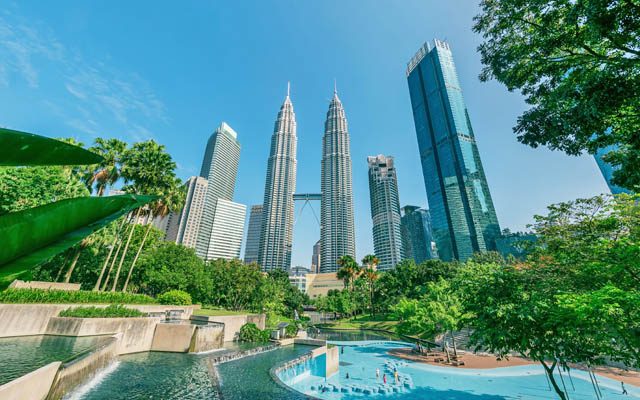
Malaysia introduces a free safety induction programme for tourism frontline staff under the Visit Malaysia 2026 campaign; Petronas Twin Towers in Kuala Lumpur, pictured
A New Straits Times report quoted human resources minister Ramanan Ramakrishnan, as having said: “Safety and health cannot be compromised, especially in the service industry. Tourists may have varying expectations when it comes to service, but when it comes to safety, there must be no room for compromise.”
The one-day programme will comprise seven hours of training and serve as a basic induction on requirements under the Occupational Safety and Health Act 2022. Areas that will be covered in the programme includes occupational safety and health laws, hazard identification specific to the tourism sector and risk control.
Upon completion, participants will receive a digital safety passport in the form of an e-card, which includes 24-hour insurance coverage for two years.
Online registration will open on January 25 on the National Institute of Occupational Safety and Health website.
Ramanan shared: “If the response is encouraging, we will review the programme and consider expanding it further.”
PATA has extended its preferred partnership with data analytics company Euromonitor International, a provider of global business intelligence, market analysis, and consumer insights.
The collaboration aims to strengthen PATA’s ability to deliver in-depth insights into traveller behaviour, market competitiveness, and investment potential across the Asia-Pacific region.
The partnership aims to deliver deeper market insights and guidance for tourism stakeholders across Asia-Pacific
Euromonitor International will contribute analytical articles to accompany the PATA Asia Pacific Destination Forecasts 2026–2028 reports. Each report will feature a four- to five-page article presenting data-driven global economic insights, complemented by a forecast webinar for members and industry professionals to explore the analysis and its implications.
The partnership is intended to support destinations and businesses in making evidence-based decisions, enhancing regional competitiveness, and promoting sustainable and inclusive industry growth.
PATA and Euromonitor International also plan to explore additional collaboration opportunities to deliver greater value to members and the broader tourism sector.
PATA CEO Noor Ahmad Hamid said: “The core purpose of PATA has always been to ensure that practical, expert-centric insights are accessible to members and the broader industry in the Asia-Pacific region. Partnering with Euromonitor International advances this commitment to the next level, enabling us to deliver even greater context and clarity in understanding the forces shaping travel across our region that further support strategic tourism planning.”
He added: “We are pleased to begin this collaboration with Euromonitor International. Their global market expertise complements PATA’s regional focus, and together we aim to provide a clearer view of where the industry is heading over the next few years.”
Stephen Dutton, global travel insight manager at Euromonitor, commented: “Euromonitor’s partnership with PATA will thrive the fast-growing travel market. Through this collaboration, PATA and Euromonitor will help clients navigate complex market opportunities, unlock growth potential and foster transparency through shared insight that supports a sustainable and equitable way in travel.”
Norwegian Cruise Line (NCL) has introduced a refreshed brand identity built around its 1990s tagline, It’s Different Out Here, positioning the update as a return to the principles that shaped the brand’s development.
The revised platform reflects the cruise line’s history, including the introduction of Freestyle Cruising, which removed fixed dining and entertainment schedules. NCL was among the first to operate weekly Caribbean cruises, establish a private island at Great Stirrup Cay in the Bahamas, and cater to solo travellers, alongside other onboard developments. The updated positioning emphasises flexibility, choice and time spent with family and friends.
Norwegian Cruise Line rolls out a refreshed brand identity centred on flexibility and guest choice; photo by Norwegian Cruise Line
Developed with Arnold Worldwide, the brand refresh shifts focus away from scale and onboard attractions towards how cruising fits into travellers’ lives. The identity places emphasis on presence, choice and how guests experience their time at sea, rather than on amenities alone.
The rollout includes a multimedia advertising campaign that introduces a revised visual system and tone. The creative approach centres on the guest perspective and uses simplified design to reinforce themes of freedom and flexibility. Digital and social channels will play a central role in communicating the updated positioning, including across Asia-Pacific markets.
The brand update coincides with a significant year for the cruise line, which is preparing to add Norwegian Luna to its fleet in March and introduce further developments at Great Stirrup Cay, including the opening of Great Tides Waterpark later this year.
“It’s Different Out Here is more than a tagline – it’s our commitment to delivering true freedom and flexibility to our guests across Asia, on every sailing,” said Ben Angell, vice president and managing director, Asia-Pacific, NCL.
“In a market where travellers are seeking experiences that feel more personal and less prescriptive, NCL stands apart by creating holidays that feel effortless and tailored around the individual, not a fixed schedule.”
Amadeus has been selected as a key technology provider by the Lufthansa Group as the airline seeks to accelerate its digital transformation. The group plans to implement a range of Amadeus Nevio modular solutions to support personalised services and more efficient operations.
Amadeus Nevio, a next-generation modular platform, will provide nine airlines – including Austrian Airlines, Brussels Airlines, Lufthansa and Swiss – with flexible core technology, allowing each carrier to transform at its own pace. The platform includes Delivery Management, which is expected to redefine the passenger experience through data-driven systems that support personalisation and smoother operations. Delivery Management is designed to work seamlessly with Amadeus Nevio Offer and Order Management.
Amadeus Nevio solutions will support Lufthansa Group’s digital transformation and more personalised passenger services
The Lufthansa Group intends to combine its own content with partner offerings to create more personalised services across the entire journey. Amadeus Product Catalogue and Stock Keeper will help expand the group’s offerings and provide an accurate view of availability, supporting tailored offers and improved customer satisfaction.
Central to the transformation is the adoption of orders based on IATA’s standard. Amadeus Order Management manages the traveller’s full journey – including flights, ancillaries and third-party services – within a single record, replacing traditional tickets and Passenger Name Records and supporting modern airline retailing.
Lufthansa Group is expected to be the first airline group to implement Amadeus Delivery Management, enabling features such as a digital Journey Pass and fulfilment tracking. These tools will allow passengers to be recognised at key points in the journey while supporting disruption management and personalised services.
Tamur Goudarzi Pour, executive vice president strategy at the Lufthansa Group, said: “We are excited to partner with Amadeus to advance the development and implementation of an innovative order technology and to further improve the travel experience for our customers.”
Decius Valmorbida, president of travel at Amadeus, added: “Lufthansa Group and Amadeus share a long track record of collaboration that has been instrumental in shaping airline technology. The planned development of Amadeus Delivery Management marks an industry first, especially for servicing across the group, representing a promising step toward more seamless, end-to-end travel experiences.”



 Bijayasinee was born and raised in Chiang Mai and has a background in Lanna dance and Thai art. Her professional experience includes roles in Thai media and entertainment, luxury hospitality and more than a decade working as a travel writer across Thailand.


 Starting his career at Four Seasons Hotel London at Park Lane, Fisher’s career has since included senior roles at The Pierre in New York, Four Seasons Resort Nevis, properties in Singapore and Chiang Mai, Four Seasons Resort Lanai, and Four Seasons Resort Orlando at Walt Disney World Resort.