TTG Asia
Asia/Singapore Saturday, 7th February 2026
Page 2712

Changi Airport posts busiest-ever year

0

SINGAPORE Changi Airport handled over 45 million passengers for the first time ever last year.

The airport egistered 46.5 million passenger movements and 302,000 aircraft movements in 2011, an increase of 10.7 per cent and 14.5 per cent over the year before, respectively.

December 2011 was also the airport’s busiest ever month with 4.53 million passenger movements, 11.4 per cent more than in 2010. There were 27,700 aircraft movements during the month, an jump of 16.0 per cent compared to December 2010.

Strong travel demand in Asia-Pacific was the key growth driver for Changi Airport in 2011. South-east Asia and North-east Asia were the two best performing regions registering double-digit growth, while traffic to and from South Asia and South-west Pacific also enjoyed positive growth.

Jakarta, Hong Kong, Kuala Lumpur, Bangkok and Manila occupied the top five positions among Changi Airport’s top 10 routes. Among the sectors with at least half a million passengers, Taipei, Manila, New Delhi, Melbourne and Hong Kong registered the strongest percentage growth.

In 2011, seven new carriers including Air Macau, Hong Kong Airlines, Finnair, TransAsia Airways, IndiGo and Lao Airlines joined the airport’s portfolio of airlines.

Korean Air introduces Danang services

0

KOREAN Air launched twice-weekly direct flights between Seoul (Incheon) and Danang on January 19.

Danang, the flag carrier’s third destination in Vietnam, will be served by a Boeing B737-800 aircraft with 145 seats.

Korean Air currently operates 18 flights a week between Seoul and Vietnam, including seven-weekly services to Hanoi and 11-weekly services to Ho Chi Minh City.

TAT launches certification programme for India trade

0

THE TOURISM Authority of Thailand (TAT), Mumbai office has launched an online training and certification programme for members of the Indian travel trade.

The Amazing Thailand Champion Agents programme aims to train and certify up to 1,500 tour operators and travel experts throughout India from now till end-2012.

Sethaphan Buddhani, director, TAT Mumbai office, said: “The programme will enable travel (experts) and tour operators to familiarise themselves with the various wonders of Thailand such as heritage, culture and cuisine, in addition to other aspects such as wellness, adventure and leisure opportunities for their clients.”

“We will also highlight various destinations within Thailand that provide an opportunity to increase the length of stay and quality of experience,” he added.

To take part, trade members in India need to visit www.thaitravelmart.com and register their company. Upon registration, they should proceed to the e-learning section, where they are required to study and participate in an online test covering four modules: General Information, Seven Wonders of Amazing Thailand, Destinations and Special Information.

Upon successful completion of the programme, the travel expert will be certified as an Amazing Thailand Champion Agent. Those securing the highest scores will be offered the opportunity to visit Thailand on an educational tour.

Swiss-Garden to manage Malacca hotel

0

SWISS-Garden International (SGI) Hotels, Resorts & Inns has been appointed to manage the Swiss-Garden Hotel Melaka, which is scheduled to open in 2014.

Offering an inventory of 306 rooms in a 32-storey tower, the hotel is part of a mixed use development project comprising a retail mall and serviced apartments. Facilities at the hotel include a grand ballroom that can accommodate up to 1,000 guests, and an infinity pool.

Located in the central Malacca district next to a monorail station and fronting the Melaka River, the hotel is within walking distance of Jonker Street and the city’s heritage precinct.

Swiss-Garden International vice president of business development and sales & marketing, Francis Lee, said: “The Swiss-Garden Melaka is an ideal avenue for our brand expansion, as the demand and growth opportunities for hotels and service apartments in Malacca have escalated.”

SGI currently manages and operates 10 hotels, resorts and serviced apartments in Malaysia and Australia, with a total inventory of 2,000 rooms.

Reporting by N. Nithiyananthan

Thailand firmly back on track

0

IT’s almost business as usual in Thailand, as the hysteria propagated by the international media over the kingdom’s end-2011 flooding gradually ebbs away.

Numerous Thai hoteliers whom TTG Asia e-Daily spoke to reported that room and occupancy rates had mostly returned to levels prior to the flooding.

On the other hand, some travel experts like Alex Tan, area sourcing director, South-east Asia & China, Gullivers Travel Associates, said that some discounting could still be expected.

Tan explained: “In Bangkok, which suffered the most from the floods and ensuing negative publicity, some properties are still trading at rates slightly below the norm. Depending on the property and where it’s situated, this varies between 10 and 25 per cent.”

However, though room and occupancy rates in Thailand have mostly recovered, European bookings are still underperforming.

Amari Watergate Bangkok, part of the Onyx group, has seen its bookings from Europe plunge by 10 to 20 per cent so far this year compared to 2011, according to its director of sales & marketing, Khajohnsak Ngiempaisal.

“November to March is usually the peak period for Europeans but the market is relatively muted now,” he said. “Europeans usually book their holidays at the end of the year and many did not do so (last year) because of the negative media coverage at the time. Moreover, a number are bypassing Bangkok and flying directly to beach resorts like Phuket.”

According to Tommy Lai Chi-On, area director of sales Thailand-leisure, Anantara, Asian markets such as ASEAN, China and India are more resilient than Europe in times of crisis.

“Asia is a solid market,” he said. “Even during the floods, there was still a steady stream of guests from Asia, especially FITs who have been to Thailand before. They kept the occupancy and room rates afloat during a very difficult time.”

– Read more in TTG Asia, February 10 issue

Cambodia’s cultural heritage a big draw

0

CAMBODIA is emerging as a cultural destination where visitors expect more interaction with local people and culture, according to a report by SNV, a non-profit, international development organisation based in the Netherlands.

The Responsible Tourism Market in Cambodia report revealed that out of 1,200 visitors to Cambodia interviewed by SNV, 81 per cent said learning about culture and history ranked as their top priority, followed by 74 per cent who wanted to try local cuisine, and 62 per cent who wanted to meet and interact with local people.

SNV’s study also revealed that visitors would pay a premium for travel that included responsible elements.

Seventy-six per cent of respondents were willing to pay more for a tour that contributed to a community or environmental project, 68 per cent were willing to fork out more for a hotel or guesthouse that actively contributed to the local community or environment, and 63 per cent were willing to pay extra for accommodation with an active energy and environmental policy.

SNV Cambodia senior advisor for tourism, Trevor Piper, said the report’s findings come at a perfect time for the Cambodian travel industry.

“Over the past few years, the growth in the market for sustainable packages has become clearer,” he said. “Tour operators see the opportunity to respond to this market trend, while at the same time helping communities that have in the past seen limited benefit from the millions of tourist dollars that pour into Cambodia each year.”

International tourism on a high

0

INTERNATIONAL tourist arrivals grew by 4.4 per cent to 980 million in 2011, up from 939 million the year before, according to the latest UNWTO World Tourism Barometer.

Tourist arrivals to Europe reached 503 million (+6.0 per cent) in 2011, accounting for 28 million of the 41 million additional international arrivals recorded worldwide. Central and Eastern Europe, as well as Southern Mediterranean destinations (+8.0 per cent each) recorded the best results.

Arrivals to Asia-Pacific (+6.0 per cent) were up by 11 million in 2011, reaching a total 216 million international tourists. South Asia and South-east Asia (both +9.0 per cent) benefited from strong intraregional demand, while growth was comparatively weaker in North-east Asia (+4.0 per cent) and Oceania (+0.3 per cent), partly due to the temporary decline in the Japanese outbound market.

Among the top ten tourist destinations, receipts were up significantly in the US (+12 per cent), Spain (+9.0 per cent), Hong Kong (+25 per cent) and the UK (+7.0 per cent).

The top spenders were led by emerging source markets – China (+38 per cent), Russia (+21 per cent), Brazil (+32 per cent) and India (+32 per cent) – followed by traditional markets, with the growth in expenditure of travellers from Germany (+4.0 per cent) and the US (+5.0 per cent) above the levels of previous years.

UNWTO forecasts international tourism to continue growing in 2012, although at a slower rate. Arrivals are expected to increase by three to four per cent, reaching the one billion mark by year-end.

Shangri-La appoints GM for Penang resort

0

shangri-la-appoints-gm-for-penang-resort
Elaine Yue

SHANGRI-La Hotels and Resorts has appointed Elaine Yue as general manager of Shangri-La’s Rasa Sayang Resort and Spa, Penang.

Most recently the general manager of Shangri-La Hotel, Chiang Mai, Yue becomes the first-ever female general manager of the Penang resort.

Yue has previously served twice in Malaysia, first as resident manager of Shangri-La Hotel, Kuala Lumpur, and subsequently as general manager of Traders Hotel, Penang in 2006.

Khiri Travel introduces luxury Myanmar tour

0

KHIRI Travel has launched a private jet tour targeted at high-end clients who want to experience the cultural and natural attractions of central Myanmar.

The four-day, three-night ‘millionaires’ tour from Bangkok uses a six-seat Cessna Citation CJ3 private jet. For a six-person group, the entire trip costs US$8,500 per pax and includes visa on arrival, transfers, deluxe accommodation and most meals. The fee increases to US$11,350 per pax if four persons travel, and US$22,000 per pax for two persons.

“This is an exceptional trip for people who want a very distinctive, active and culturally rewarding holiday with the convenience of starting and finishing in Bangkok,” said Edwin Briels, general manager of Khiri Travel Myanmar.

The tour begins with the flight from Bangkok to Bagan. Guests then embark on guided bicycle rides among remote ancient temples in Bagan, as well as a boat ride on the Irrawaddy River.

Guests then fly to Heho near Inle Lake in central Myanmar’s Shan hill country. There, they visit an elephant and wildlife sanctuary, where there are opportunities to ride (and wash) elephants with local mahouts and villagers.

The trip then moves to Inle Lake, where guests ride a boat to see the floating gardens and ‘pagoda forest’ of Indein, as well as floating markets frequented by Shan and Pa-O tribes in traditional costume. Throughout the boat ride, there are opportunities to see the legendary leg rowers of Inle Lake.

The trip then proceeds with a bicycle ride on the east bank of Inle Lake through Shan and Intha villages. Guests can stop and chat with villagers, or with monks in a local monastery. After having lunch on a rice barge in the middle of Inle Lake, guests fly back to Bangkok .

Khiri Travel is offering the ‘millionaires’ trip to central Myanmar between May 1 and September 30, 2012.

Australian luxury defined

0

The presence of passionate and innovative entrepreneurs is helping to define luxury travel in Australia, opening a whole new world for platinum nomads to romp-and-roll
27012012_luxury-travel

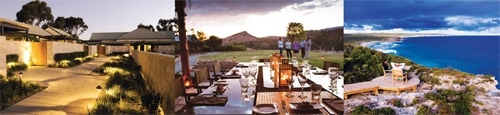
From left: The Louise, Arkaba Station and Southern Ocean Lodge

Luxury travel planners could be forgiven if they found the experience of searching for luxurious places in Australia akin to the proverbial needle in a haystack.

To begin with, these resorts were few and far between a few years ago – literally, too, considering the vast distances in the continent. An idea of what constitutes luxury travel in Australia, therefore, was as remote as its outback.

But all that has changed as unique, high-end independent properties started popping up, their critical mass and defining traits helping to shape a firm idea of Australian luxury tourism. And in a move designed to make themselves more known and accessible to luxury travel planners, the owners of 16 such resorts have come together under a new grouping, Luxury Lodges of Australia (albeit the only thing that is a ‘lodge’ about them is their small roomcount).

The portfolio of Luxury Lodges of Australia throws up the Who’s Who of Down Under properties whose name on their own whispers a certain cache at home. The Louise, for example, has etched its mark as a vineyard retreat in the Barossa Valley, its restaurant Appellation a gourmand’s best-kept secret. Or take the Southern Ocean Lodge in Kangaroo Island – dramatic architecture springing out of the wilderness.

Or the Wolgan Valley Resort & Spa bordering the Greater Blue Mountains World Heritage region, sister to Emirates Hotels & Resorts’ conservation-inspired Al Maha Desert Resort & Spa in Dubai. Or the Lake House, a country garden accommodation in Daylesford that serves haute cuisine.

No two properties are alike, yet each is so alike in one huge area: a special location or setting that, combined, documents Australia’s rich and diverse natural attractions – the outback, desert, mountain ranges, ocean reefs, vineyards, etc – and its ability to deliver the experiential and extraordinary to a discerning clientele.

“Australia has changed in the last eight years,” explained Penny Rafferty, former general manager of The Louise who now heads Luxury Lodges of Australia as its executive officer. “Half of these properties did not exist eight years ago.”

“The presence of innovative entrepreneurs who are seriously passionate for the region they are in is what drove the change,” she said.

American Jim and Helen Carreker, owners of The Louise, for instance, transplanted the European model of destination dining – memorable food and wine experience complemented by luxurious accommodation – into the Barossa Valley, while owners such as James and Hayley Baillie of the Southern Ocean Lodge are passionate about creating luxury icons in places of unique natural significance.

“The one thing they have in common is their individual passion, and recognising how special each region is and the appeal it would have for platinum nomads. And they put their money where their mouth is.

“Australia has never had this critical mass of unique products before and that’s why we’re able to create Luxury Lodges of Australia,” said Rafferty.

The alliance is funded by the owners to serve as the central point of reference for travel planners selling Australia, not as a booking engine.

A suite of tools on the website (www.luxurylodgesofaustralia.com.au) helps travel planners connect the dots, and even the seasoned ones would appreciate the immediate answers to mind-boggling distances, destination experiences and other details, given the diversity and remote regions each property is located.

Tools include eBrochures of the members in seven languages, narrated videos, hi-res images, property fact sheets, getting between lodges and family-friendly lodges.

“Australia is enormous; the scale takes one by surprise. But with tools like Plan Your Trip, we’ve done all the hard work to make sure your planning will be easy and seamless,” Rafferty said.

Last month, Luxury Lodges of Australia made its first overseas debut in Singapore, holding a training day for staff of luxury travel companies in the city, a session that followed an earlier visit by several of the owners with the bosses of the agencies.

The alliance will also be present at key luxury travel trade shows this year.

“If you’re a 10-room property in a global market, you can’t change the perception. Australia has always been perceived as a fantastic product, mainstream, safe; and majority of people don’t get pass the east coast, except the really intrepid travellers and backpackers.

“But these properties are changing all that and, with Tourism Australia’s focus on the high-end in 2012, we should be able to bring the perception of Australia in line with the product,” Rafferty said.

This article was first published in TTG Asia, January 27  issue, on page 10. To read more, please view our digital edition or click here to subscribe.