TTG Asia
Asia/Singapore Saturday, 14th February 2026
Page 2139

New Philippines campaign music to young ones and ‘young once’

0

THE Philippine Tourism Promotions Board (TPB) officially launched Visit the Philippines Year 2015 in Singapore at Conrad Centennial Singapore on Tuesday evening, marking the first unveiling of the campaign outside the Philippines.

Key to the campaign is the first-ever MTV Music Evolution event, brainchild of Viacom International Media Networks Asia’s MTV and the Philippine TPB.

Scheduled to take place in Manila in 2Q15, the concert will explore the evolution of a music genre by bringing together iconic regional or local artistes in that field. Hip hop will be the first genre of study.

The Philippines’ tourism secretary Ramon R Jimenez said: “Through our partnership with MTV, young people from around the world will now have the opportunity to share in this passion and experience why and how the music culture is even more fun in the Philippines.”

Said Paras Sharma, vice president-MTV, Comedy Central & Digital Media (Asia), Viacom International Media Networks Asia: “MTV Music Evolution in Manila reinforces the Philippines’ image as a choice destination for youth travellers by using music as a key platform, something which we’ve done with Malta, Scotland, Malaysia and Northern Ireland.”

He added that the MTV Music Evolution’s audience is expected to be in the “tens of thousands”. Details on the venue and artist line-up will be announced later.

Asked if this event indicates the NTO’s emphasis on the youth market, Domingo Ramon C Enerio III, COO of the Philippine TPB, replied: “We would like a lot more youth travellers coming in – not just the young ones but also the ‘young once’.”

Besides partnering major tour operators specialising in youth travel and offering incentives for tour operators and travel agencies to experience MTV Music Evolution in Manila, the TPB is already working on a “big partnership with STA Travel” for a separate project, Enerio shared.

“There are so many music and art festivals lined up that we can now use to sharpen the focus on the youth market,” he added, citing the country’s biggest outdoor electronic dance music party, Life Dance Philippines, which happens annually every January in Cebu, as an example.

The Philippines is aiming for 8.6 million arrivals in 2015 and, besides the youth market, will also focus on South Korea and the US.

Read more stories in TTG-ITB Asia Daily

Mandarin adds residences along Bangkok’s Chao Phraya River

0

MANDARIN Oriental Hotel Group has announced an agreement to brand and manage the 146-unit The Residences at Mandarin Oriental, to be developed as part of a mixed-use project on the Chao Phraya River, known as ICONSIAM and scheduled for completion in 2018.

ICONSIAM will comprise world-class retail, a spectacular waterfront promenade with a variety of exceptional attractions, and private apartments.

Mandarin Oriental, Bangkok, located across the river, will provide management services for the development, as well as amenities for individual residents.

Residents will also have access to leisure facilities including an exclusive sky lounge with an extensive library, meeting rooms, and secluded dining space; a private Residents Clubhouse with an outdoor infinity-edge lap pool as well as a children’s pool; a fitness centre with golf simulation, games and media rooms; other F&B outlets; and a car park.

Putting the house in order

0

Singapore has imposed stricter rules on the conversion of shophouses to boutique hotels in historic districts. Paige Lee Pei Qi finds out how the new measures affect hoteliers and travel consultants

stoy1-putting

Even as boutique hotels in Singapore continue to find new fans, hoteliers seeking out new developments in prime areas will have to hold their horses following restrictions implemented by the Urban Redevelopment Authority (URA) in July.

These new measures seek to prevent the proliferation of tourist accommodation in areas not intended for hotel use, which in turn affect hoteliers looking to convert existing shophouses in historic precincts such as Chinatown and Little India. This policy will be reviewed in two years.

Within the Central Area, proposals for new hotels, boarding houses and backpackers’ hostels, including any change-of-use proposals, will generally not be allowed within certain areas inside the Outram, Rochor, Downtown Core and Singapore River Planning areas.
For other parts of the Central Area, URA will evaluate such proposals individually, considering the planning intention for the locality and the potential traffic impact that the individual proposal will generate. Outside the Central Area, all proposals will generally not be allowed.

According to URA, the move seeks to ensure such (hotel) developments “do not dominate and displace other commercial activities” in these areas.

Boutique hotel owners told TTG Asia that the regulation would further fuel their expansion abroad. Two-year-old homegrown brand Hotel Clover currently has four properties under its name, and the fifth one will be opened next year, according to CEO, Teo Kok Hwee.

Admitting that this new measure has halted his expansion plans in Singapore, Teo will instead cast his sights on overseas markets like Thailand, Malaysia, China and Indonesia.

He said: “I can no longer have my hotels in these historic areas, which is a pity, but it is fortunate that Hotel Clover has already built its name in Singapore.”

Wang Tjang Yuin, director of luxury boutique hotel Wangz Hotel, also expressed his disappointment at the new ruling, especially when combined with challenging labour situation in Singapore. He remarked: “We have placed any expansion plans within Singapore on hold and are focusing on developing countries around the region instead.”

This is a pity, however, as many interviewed noted that travellers are showing a greater interest in accommodation options offering a unique experience that  hotel chains cannot give.

Small Luxury Hotels of the World (SLH) area & development director for Asia Pacific, Victor Wong said: “Having hotels built among other shophouses located in historic areas gives travellers a nostalgic feel and a back-in-time experience, since most shophouses date back to a century or more. This proves to be a refreshing experience in a very modern city like Singapore.”

The Naumi Hotel and The Scarlet Singapore on Seah Street and Erskine Road respectively – under the SLH umbrella – were themselves converted from shophouses in historic areas.

Likewise, Loh Lik Peng, director, Unlisted Collection, said heritage has been  a key selling point for its three luxury boutique hotels in Singapore: New Majestic Hotel, Hotel 1929 and Wanderlust. He said: “Our guests love being in a historic and interesting local ethnic location such as Chinatown or Little India, and they love staying in heritage buildings.”

“We have placed any expansion plans within Singapore on hold and are focusing on developing countries around the region.”
Wang Tjang Yuin, director, Wangz Hotel

More leeway please
SLH’s Wong opined that there should be flexibility in exercising this rule. He said: “The new regulation seeks to prevent a hotel overcrowding situation within a single area to ensure the diversity and charm of the different districts – which is a fair consideration.

“However, I also think there should be room for evaluation on a case-to-case basis regarding new hotels’ application in the restricted zones.”

Mary Sai, executive director, Knight Frank, said: “It is a very clear-cut signal from URA that they want to protect these areas for the residents because the proliferation of hotels means that residents may be deprived of their own amenities like coffeeshops or supermarkets.

“In the past, it would be refreshing to see a boutique hotel in the neighbourhood, but now it is becoming too much that enough is enough.”

According to Sai, while the demand for shophouses may be dampened by the new rules, owners of shophouses already approved for hotel use will find their assets rise in value over time because of the difficulty in getting hotel sites.

She said: “The added value is subjective because it depends on various factors like location, size, number of rooms, etc. But the asset value goes up by approximately 30 per cent.”

For existing approved hotels and boarding houses on sites zoned for hotel use, any proposed intensification of the Gross Floor Area (GFA) will continue to be subject to evaluation.

Expansion of existing approved boarding house and backpackers’ hostel uses that are on Temporary Permission will be considered individually, up to the total GFA of the existing building that it occupies. Further renewal of the permission will only be allowed if they have not caused any adverse traffic impact and disamenity to the surrounding users.

Agreeing with the need to protect  historic neighbourhoods, Unlisted Collection’s Loh said: “There has been a rash of poorly thought-out conversions recently, and they have very poor quality spaces and fit in poorly with the rest of their neighbourhood.

“I think for a district to thrive there needs to be variety, and having a concentration of hotels will only make the area touristy and irrelevant for locals.”

However, Loh shared that the new measures would have minimal impact on his business. He elaborated: “Given the prices of property in Singapore now and the very acute labour situation, there is no realistic prospect for me to purchase any shophouses for (hotel) conversion.”

Similarly, inbound operators were generally unfazed by the new developments.

Siam Express, managing director, Jaclyn Yeoh said: “Demand for luxury boutique hotels is limited to  the West European market, and mainly FIT traffic. Due to the small size of this market and their low inventory, the quantitative impact is negligible.”

However, she conceded that special interest groups may be lost due to the dearth of variety in the market.

Luxury Tours & Travel Singapore’s director, Michael Lee, added: “Boutique hotels are a niche market that appeals more to the younger and solo FIT travellers. It is a good addition to have but it is not really our core audience.”

This article was first published in TTG Asia, October 24, 2014 issue, on page 4. To read more, please view our digital edition.

Raising the standards

0

Mimi Hudoyo examines Indonesia’s quest to certify its tourism professionals and businesses in the run-up to the ASEAN Economic Community (AEC)

oct24_analysis3

Indonesia is trying to get its tourism businesses certified to ensure that they achieve certain standards as the country prepares to compete regionally, especially with greater economic integration coming in the form of AEC 2015.

According to local laws,  all professionals working in the industry must attain competency standards, while products, services and management of tourism businesses have minimum business requirements to meet.

Indonesia’s outgoing minister of tourism and creative economy, Mari Elka Pangestu, said: “In 2013, travel to ASEAN grew 12 per cent, the highest growth worldwide, to 92.7 million. Out of this, 46 per cent was intra-ASEAN traffic. This region has a lot of potential.”

Citing the latest World Economic Forum Competitiveness Index on Travel and Tourism, Mari added: “Indonesia’s position is 70th out of 140 countries. Singapore, Thailand, Malaysia and Brunei are ahead of us.

“In terms of human resources, Indonesia ranks 38th. The position is not bad, but…it is our homework to move up.”

How the standards work
Currently, 24 out of 56 standards for the industry have been established, covering areas like accommodation, restaurants, tourist attractions, tour operators and travel agencies. The target is to finalise 28 standards by this year and the rest in 2015.

Spelling out the regulations at a recent workshop organised by the Association of the Indonesian Tours & Travel Agencies (ASITA) Jakarta Chapter, Agus Priyono, director of tourism industry, Ministry of Tourism and Creative Economy, said a tour operator must be a legal entity and sell more than one tour package, with at least one of them being a package the company creates. A travel agency can be a one-person operation selling tickets and accommodation.

He explained: “Although it is a one-person operation selling products online, a travel agency must have an office, even if it is at home, as long as the office is a separate area from household activities.

“This means that OTAs that do not have a land address are not recognised as travel agencies.”

Another stipulation is that those working in both tour operators and travel agencies must hold competency standards.

Agus said: “This is a gradual process. If we impose the law requiring companies to employ certified staff fully, no tourism-related company will be able to pass the certification process.”

Major tourism enterprises must be audited and certified within the next two years, while SMEs are given four years to comply with the government regulation, according to Agus.

He added that there is, in fact, a growing demand for certification beyond Indonesia. “The new China law, for example, states that only certified guides can lead tours from the country,” he pointed out.

Implementation obstacles
While the government is pushing for the implementation of the regulations, it acknowledges several challenges.

The number of business certification agencies and auditors as well as the number of professional certification agencies and assessors are still limited. Also, there seems to be a lack of urgency among industry players to engage in the certification process for both their staff and companies.

Agus said: “In the hotel industry, for example, there are 16,000 hotels to certify in the country. However, there are currently only 60 auditors and they will only be able to audit 3,000 hotels in one year.

“Other than encouraging business certification agencies to increase the number of auditors, we are also encouraging them to appoint auditors in secondary destinations.”

As for manpower, the certification programmes supported by the ministry have turned out 64,000 professionals this year.

“While this is higher than our targeted 50,000, the number is still small compared to the (industry’s) 10 million workforce,” Mari noted.

Herna Danuningrat, president of Citra Netratama Tours & Travel and advisor of ASITA Jakarta, said: “Travel-related associations have been conducting training and inviting members to take part in the professional certification process, but the industry bosses are concerned that their staff will later be hijacked by other companies. Also, for this programme to succeed, we need the government to finance it.”

Rudiana, board member of ASITA Jakarta, raised the same point. “The government needs to assist small companies, with subsidised or free trainings and upgrading,” he said.

Herna added: “While ASITA Jakarta has 130 registered members, there are more people selling travel without legal entities that we have to compete with. While tour companies are required to go through audits and be certified, we need law enforcement to curb illegal operators, especially those operating online.”

Sebastian Ng, managing director of Incito Travel and board member of ASITA South Sulawesi, agreed. “ASITA South Sulawesi has received several complaints from travellers who booked and paid a tour from an OTA scammer. When things go wrong, people turn to ASITA even though it is the government’s mandate to stop this from happening,” he said.

Speeding up the process
A suggestion is for bigger companies to become certification agencies as well, working alongside the tourism academy and professional certification agencies.

“Major hotels, for example, need a huge number of staff for their own properties. They can send human resource development staff to be certified as assessors for their internal certification,” Mari said.

Sumarna Abdurahman, vice chairman of the National Professional Certification Agency, said: “The way to make the programme work is not through law enforcement but encouragement of industry participation with government incentives.

“In Australia, for example, the government funded the industry (association) to create the standards. It then brought the standards to the educational institutions, with the government giving funding support to schools that use the standards in their curriculum. Similarly, some incentives were given to industry members that met the standards.

“Within 15 years, the system worked so well that the government did not need to give incentives.”

Indonesia’s Ministry of National Development Planning has plans to roll out something similar although this is still being discussed, according to Sumarna. The idea is to maximise the use of the government’s education trust fund for accelerating professional certification.

This article was first published in TTG Asia, October 24, 2014 issue, on page 3. To read more, please view our digital edition.

Sri Lanka to launch maiden luxury cruises from Colombo

0

ROYAL Asian Cruises (RAC) has announced that it will homeport two luxury liners in Colombo with trips starting in 4Q2015.

These two liners will also be Sri Lanka’s maiden luxury cruises, and will mainly depart from Colombo on short sailings around the Indian Ocean ports such as Maldives and Kochi, along with longer 10- or 11-night round-trip sailings to Singapore.

Rupa Ray, manager of tours, Singapore-based Jesal Brothers Tours and Travel, said: “Sri Lanka is a growing source market and increasingly Singaporeans are exploring the emerald isle. A round-trip luxury cruise between Colombo and Singapore will be a hot selling ticket.”

Meanwhile, RAC has also made an investment of US$200 million and will acquire two more cruises by 2016. According to its chairman, Mano Sinnarajah, there are plans to acquire up to five ships by 2018 with a total investment of US$720 million.

Mobile-alone strategy so yesterday

0

TRAVEL companies would do well to create an overarching data strategy, instead of merely focusing on mobile.

This was one takeaway from the morning sessions at Web In Travel conference yesterday, taking place as part of Travelrave Singapore.

Asia-Pacific is the global leader when it comes to mobile bookings with over 20 per cent, according to Criteo’s Travel Flash Report for 1H2014.

Turochas Fuad, co-founder & CEO of vacation rentals site Travelmob, which currently has a mobile-optimised website and an iPhone app, backed this observation. “About 45 per cent of our web traffic and 25 per cent of transactions are coming from mobile,” he said.

Likewise, Booking.com’s mobile business is nothing short of impressive – growing from a US$1 billion business in 2011, to US$3 billion in 2012, and US$8 billion in 2013, said Gillian Tans, COO, Booking.com.

However, when asked about Expedia Worldwide’s mobile approach in Asia, John Kim, chief product officer, said: “We don’t talk about mobile, we talk about data. The platform we are building is a data platform and we have been able to syndicate that all across the world no matter what the device. The mobile device provides contact and data that may be otherwise lost on the desktop experience.”

This same data strategy can eventually be extended to wearables to harvest the same information, he added.

Timothy Hughes, vice president marketing, Agoda, shared that his proudest achievement in the last one year is making non-desktop devices “the core of Agoda’s business”.

“It’s not about having a mobile strategy and if you have a mobile strategy, you’ve already missed the boat. It’s about making non-desktop devices the core of your business and building the rest around it,” he explained, adding that the move has altered the way Agoda approaches contracting and marketing.

Read more stories in TTG-ITB Asia Daily

Dusit International sets foot in Vietnam

0

DUSIT International has announced its expansion into Vietnam with the signing of its first Dusit Thani hotel in the country on October 20, to be developed as part of the Cam Ranh Flowers Resort.

Planned for opening in late 2016, the hotel is about 15 minutes’ drive from Cam Ranh International Airport and 20 minutes from Nha Trang.

Its 266 rooms comprise deluxe, suite, and bungalow categories. There will also be 56 residential villas and 117 apartments available for purchase or rental.

Guests will be able to enjoy the signature Devarana Spa as well as a sports centre with swimming pools.

Chanin Donavanik, managing director and CEO of Dusit International, said: “Our launch into Vietnam marks an exciting milestone for Dusit International. Cam Ranh is an up and coming beach lover’s resort destination.

“The peninsula and natural harbours there offer visitors calm waters surrounded by mountains and great weather conditions.”

Outrigger in big drive to build expert agencies

0

ARMED with more resorts now in various locations than just Hawaii, Outrigger Resorts will aggressively recruit travel agencies to its side, launching its rewards programme in Asia-Pacific in mid-2015 in multiple languages.

Outrigger Expert Agents earn points that are redeemable for cash when they book clients into an Outrigger property or complete an Outrigger destination online training course. Clients will also enjoy a welcome amenity in the agency’s name and gifts specific to the geographic market.

This reward programme has existed since 2009 and currently has 8,000 members, but primarily agencies in the US, Canada and Australia. Outrigger’s vice president sales & marketing Asia-Pacific, Mark Simmons, said the chain is looking to bolster the number of its expert agency consultants globally to 15,000 in 12 months and 18,000 in 18 months, 30 per cent of whom will be agencies from Asia-Pacific.

In this region, China and Australia are key markets and Outrigger is further massaging their growth with the opening of new offices in Beijing and Sydney this year. China, Hong Kong, Australia, Singapore, India, Japan and South Korea will be among the markets where “the big bang” to get expert agency consultants will happen, said Simmons.

“Travel agencies and wholesalers contribute 50 per cent, and in some cases 80 per cent, of business. We don’t see this going away, and this is why we are launching this programme and forging strategic relationships in which we do joint marketing and give brochure support. The OTAs are also another channel, so our approach is two-pronged,” said Simmons.

He pointed out that a resort product needs agency specialists as invariably the clients are couples, honeymooners, families and the likes for whom other vital components must be packaged.

“We also have more products now in destinations that are aspirational for Asian clients,” added Simmons.

Outrigger has been buying up properties in Asia-Pacific and gaining several management contracts in the region. It now has three resorts in Thailand, two in Fiji, four in Australia and one in Mauritius. Among five properties it fully owns in Asia-Pacific are the Outrigger Laguna Phuket Beach Resort and a new resort debuting in the Maldives in 2015.

In the pipeline too is a resort in Hainan, opening in 2016, and another in Vin Huy (Hoi An, Vietnam), opening in 2017. It parted company with Bali recently “due to product issue”, said Simmons, but added “we’ve got a few properties cooking in Bali”, as well as in “the Philippines, Japan, Micronesia, Australia and Thailand”.

The expansion is a far cry from just a few years ago when Outrigger is synonymous only with Hawaii, where it has no fewer than 35 resorts. With a more global footprint and with Hawaii itself an aspirational destination for Asians, Simmons believes travel agencies and wholesalers will quickly latch on to Outrigger to increase their revenues.

Read more stories in TTG-ITB Asia Daily

Keeping a watchful eye

0

Austerity measures continue to bite the corporate travel market, which has become more prudent in spending and is driving a harder bargain in the wake of the global financial crisis
24oct_report1
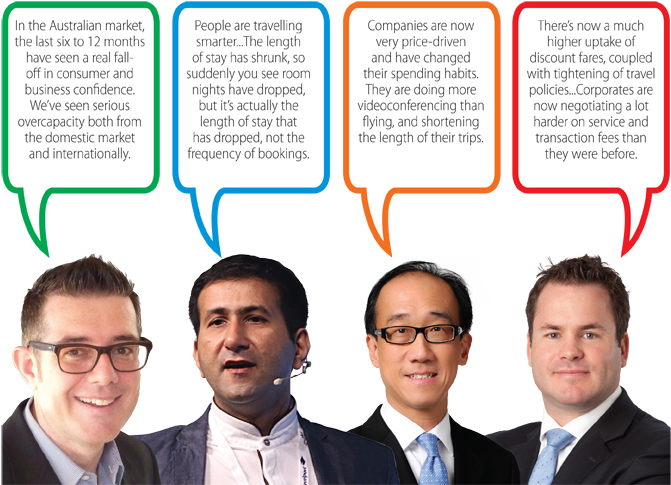
David Orszaczky, head of sales and commercial planning, Qantas Australia
Puneet Mahindroo, director, revenue management, APAC, Four Seasons Hotels and Resorts
Tommy Tam, managing director, Arrow Travel Hong Kong
David Fraser, executive general manager, Greater China, Flight Centre
Not pictured: John Chapman, Chief commercial officer, JetAsia Airways Thailand

Although corporate travel has gradually recovered since the global financial crisis (GFC), the sector remains cautious of their spending, disclosed participants of this Roundtable at Travelport’s APAC Customer and Partner Conference, moderated by Andrew Kelly, regional director Australasia, Association of Corporate Travel Executives.

Has the corporate travel market recovered from the GFC?

ORSZACZKY After the GFC, people were predicting the death of corporate travel and if growth in business travel demand could be sustained. Qantas did a lot of research in the Australian market to try and understand what it would mean for long-term future demand and to have substitutes like video conferencing, and concluded that travel is an essential part of doing business. We also looked at people’s choice drivers and adapted our proposition to suit the changing market.

On the back of the mining resources boom we’ve seen several waves of growth. However, in the Australian market, the last six to 12 months have seen a real fall-off in consumer and business confidence. We’ve seen serious overcapacity both from the domestic market where things are quite competitive and internationally.

In summary, we’ve done quite well in the Australian market since the GFC. We see a more subdued economic outlook ahead and the impact it’s having on corporates and how they adjust costs.

MAHINDROO The corporate segment has always been the more resilient travel segment. A number of interesting things has happened. People are travelling smarter – they’re doing day trips, shorthauls. On longhauls they arrive at their destinations in the morning, freshen up and go for their meetings straightaway. The length of stay has shrunk, so suddenly you see room nights have dropped, but it’s actually the length of stay that has dropped, not the frequency of bookings.

The next thing I think is a nice refreshing change for us at Four Seasons is that corporate and leisure travel are being combined. If someone’s flying on towards a weekend – a Thursday or Friday – those kind of travellers tend to extend their trips. It’s no longer corporate, it’s corporate and leisure travel.

TAM In our area of business, we have recovered. Companies are now very price-driven and have changed their spending habits. They are doing more videoconferencing than flying, and shortening the length of their trips.

For Hong Kong-based business travellers, there are a lot of convenient flights, e.g. Beijing, Shanghai. They can stay one night and come back.

What other trends are you seeing in the corporate market?

FRASER There’s been a shift from pre-GFC behaviour. There’s now a much higher uptake of discount fares, coupled with tightening of travel policies. Previously MNCs had quite generous regional travel policies – first and business class for three- and four-hour flights – but that’s certainly changed. From our business point of view, corporates are now negotiating a lot harder on service and transaction fees than they were before.

ORSZACZKY There’s a point to be made about visibility. The veil has been removed with all online pricing. The conversations we’re having with corporates in our market are absolutely becoming more price-sensitive and they are looking to take cost out, whether it’s through volume or price or a combination of both. We try to bring the conversation back to value rather than purely price.

For example, in the mining sector, the largest driver of corporate travel growth in Australia, it’s the interest in saving 10, 20 or 30 dollars more per ticket and getting the whole team there three hours late, which costs a million dollars in lost productivity. It’s hard to have that conversation with the procurement manager, but a little more balanced when you have it with the business owners and managers.

One thing I see with TMCs is that they really understand the drivers of the business behind those decisions so it’s not just purely price, and then you become more of an advisor about value.

With the growth of OTAs that supply direct to customers, do you believe there will always be a need for TMCs?

TAM Yes. They may supply information and price directly to customers, but we’re matching OTAs – we have to match them. There’s still room to survive.

FRASER We’ve had to move from something very commoditised, a ticketing agent in the past, to about travel tracking data. That’s what we see now and that will change again in the future. The good (consultants) will survive and prosper, and the rest will fall away.

There’s now a trend of airlines unbundling and selling ancillaries. What impact is that having on servicing the needs of corporate travellers?

CHAPMAN You need to come up with a different product offering for the corporate travel segment, something with more flexibility that you wouldn’t offer to the leisure traveller. That’s been the big trend. I’ve seen airlines come up with packages that would appeal to corporate travellers, e.g. AirAsia X and its lie-flat bed.

FRASER There’s not too much of that trend in the Hong Kong and China markets at the moment, but more broadly we need to be more involved with that.

Metasearch engines like Google Flight Search and Skyscanner are playing a larger role. Would their influence be contained to more price-sensitive leisure markets or also extend to corporates?

MAHINDROO We’re seeing a lot of impact, and when it comes to structured, managed travel for larger corporations, the GDS allows you to compare corporate prices and that’s why GDSs talk about rate parity. It’s not about metasearch but price transparency. You can see how corporate prices vary from what’s available publicly.

ORSZACZKY I would say that metasearch engines are definitely more for unmanaged markets that are more price-sensitive.

MAHINDROO There are tools available today that show what segment of business is really growing. Last time, 90 per cent of business travel was managed but today in more matured cities, that’s 65 per cent, closer to how it stands in North America where it’s 50-50.

FRASER The other part of why metasearch engines are taking off is that the information corporate travellers need are all there. They can pull it off sites like Kayak and be as informed as travel agencies, so the pressure is now on TMCs/travel consultants to show that they are the absolute experts. We’re not in the position of power where we have all the information.

With your knowledge of the travel industry, will GDSs play an important role in the future?

TAM The GDSs have a lot of resources they can develop; (they can also) provide travel consultants with more apps, software to let them communicate with suppliers. A good example is Roomsandmore that uses aggregated force to negotiate with hotels and airlines.

ORSZACZKY At a very general level, as long as you’re relevant, innovative, flexible and listening to what partners and customers needs, then there’s a future.

Another point – it’s not either-or, it’s a combination – is letting customers choose how they want to interact, and letting customers and partners build strategies on that.

CHAPMAN Travel agencies need to be able to differentiate themselves from others and package their products and market them across their own channels. I think Travelport’s done quite a good job of filling that gap (so there’s still a role for GDSs).

MAHINDROO GDSs have been looked at as a transaction platform, but it’s no longer about that. It’s about a merchandising and sales process, making it easier and faster.

As a hotelier, one of the biggest challenges is how to put the most relevant product in front of those that facilitate travel, whether for corporate travellers or those that combine leisure and corporate, and how to distinguish products on the channel, which requires a significant amount of merchandising, getting the banner ads going, showcasing the service-oriented facilities, etc.

That’s one area where we feel GDSs can make a change going forward. We’ve heard GDSs are dying, but last year GDS volumes hit a maximum high. I rest my case.

FRASER Content is still important through GDSs, direct connects or APIs. Increasingly, working and partnering with us on new solutions and technology will enable our businesses to meet the demands of our business.

This article was first published in TTG Asia, October 24, 2014 issue, on page 14. To read more, please view our digital edition

Malaysia DMCs swallow GST in the face of soft demand

0

INBOUND tour operators in Malaysia are not raising rates substantially for the new contracting period in 2015 despite the recent 10 per cent hike in fuel prices and the introduction of the six per cent Goods and Services (GST) tax beginning April 1 next year, both of which are expected to add to their costs.

Several Malaysian inbound consultants that TTG-ITB Asia Daily spoke to said they were willing to lower their profit margins by absorbing some of the tour package costs to remain competitive.

“The market has been very soft for us in 2014 due to the two airline tragedies and the numerous kidnapping cases reported in Sabah,” said Mona Abdul Manap, sales and marketing manager of Kuching-based Planet Borneo Tours.

“Prices will be maintained for the next contracting period as we want to spur demand for existing packages as well as new packages we will introduce (next year).”

While KL Tan, general manager of Borneo Trails Tours & Travel in Sabah, will raise his contract rates by three to four per cent, they will be matched with value-added services such as the addition of more products in the tour itinerary.

Likewise, Ganneesh Ramaa, manager at Luxury Tours Malaysia, said his company “will not increase (rates) too drastically” for fear of losing business.

“We will introduce new niche products next year so we do not compete with other (agencies). These will include photography tours, bicycle tours and tours targeted at disabled Europeans tourists (those on dialysis or the hearing impaired).”

Buyers at ITB Asia are also expecting next year’s rates from their Malaysian suppliers to hold steady and not dampen demand for the destination.

Angela Wong, Singapore-based global accounts director of Helmes Briscoe, said: “Many Malaysian (consultants) are maintaining ground rates. Some hotels are increasing rates slightly, but it is still at an acceptable level.”

M Raja Arunmozhi, proprietor of Bengaluru-based Spaceline World Travel, said: “Malaysian hoteliers and groundhandlers have maintained contract rates over the last two years to win business due to the depreciation of the Indian rupee against the US dollar.”

MakeMyTrip.com vice president-international markets, Deepak Rawat, commented: “We are still negotiating rates with hoteliers – some hoteliers said they will maintain the same rates as 2014. A slight increase in rates will not have an impact on demand from the Indian market.”

Read more stories in TTG-ITB Asia Daily