TTG Asia
Asia/Singapore Friday, 10th April 2026
Page 1780

IHG brings accommodation support to new Shanghai convention centre

0

hotel_exterior_night_shoot_%e9%85%92%e5%ba%97%e5%a4%96%e8%a7%82%e5%a4%9c%e6%99%af%e5%9b%be

INTERCONTINENTAL Hotels Group (IHG) has opened the only luxury hotel located within National Exhibition and Convention Centre (NECC), Shanghai’s latest MICE venue.

The 536-room InterContinental Shanghai NECC boasts its own collection of events space which totals 2,200m2. These venues are suitable for high-level meetings, banquets and galas. Other facilities onsite include four F&B options.

The hotel sits five kilometres away from Hongqiao International Airport and Hongqiao Railway Station, and is a three-minute walk to Metro Line 2 on the Shanghai subway network. Nearby attractions include Qibao Ancient Town, Zhujiajiao Watertown, Hongqiao Hub and Shanghai Outlets Mall.

Bhaya’s luxury cruises flaunt new enhancements

0

halong_bay
One of Bhaya Group’s newly renovated luxury level vessels

FOLLOWING two months of renovations, Halong Bay cruise operator Bhaya Group has unveiled upgraded rooms and facilities on its two luxury-level vessels, collectively known as The Au Co.

The redesign of the ships’ 64 cabins is complemented by a revamp of onboard facilities, including a new reception area, spa, restaurant, cocktail bar, library and private cinema.

The boats are now fully-equipped to take travellers on 3D2N itineraries encompassing activities such as mountain biking on Cat Ba Island and luxury dinners in Virgin Cave. Previously, The Au Co was able to visit the more remote parts of Halong Bay for one-day excursions only.

“Every year, the twin ships undergo refurbishment lasting at least a month, but after four years in operation, we were looking to offer our passengers something different – an onboard experience that captures both traditional Vietnamese and modern luxury styles,” said Bhaya Group managing director, Ly Thuy Huynh Nhu.

bhaya_the_cabins_room
A cabin room

Guests can get the local experience onboard through taichi sessions, traditional dance performances in the evening and Vietnamese cuisine.

And to minimise engine noise and disturbance to passengers, the exhaust pipe has been moved from the top to the rear of the vessel.

Along with the refurbishments, the boats also underwent a scheduled annual maintenance for all onboard safety equipment.

[PERSPECTIVES] Maximising value through better-managed travel procurement

0

FOR procurement professionals, cost savings and tailoring organisation requirements according to compliance considerations have always been a priority. Yet, beyond just clinching discounts for their company, procurement professionals have started to take on more strategic roles within their businesses, one of which includes travel management.

With a broad range of responsibilities to juggle each day, procurement professionals often outsource travel management functions to travel management companies, some of which include evaluating and negotiating with travel service providers.

While these partnerships generally work well, if left unattended or managed poorly, there is a risk of standards slipping in the travel programme. According to data from a report released by HRS in early 2016, hotels are a key area where these standards may slip.

Furthermore, research by the Chartered Institute of Procurement and Supply indicates that a well-documented, well-implemented and well-monitored policy can reduce travel costs by at least 10 per cent and up to 30 per cent. With these savings in mind, procurement managers stand to maximise the value they are getting from the money spent on travel by closely monitoring the following key areas:

Finding the best value
When it comes to hotels, pricing can be confusing and inconsistent. Whenever someone books accommodation, they most probably would have gotten a different price for the same hotel by booking via another channel.

Travellers therefore often assume that open booking allows them to secure the best value for their accommodation. According to an internal survey conducted during the 2016 Corporate Travel Forum in March, 78 per cent of travellers believe that open booking provides them with better rates, while another 69 per cent do it out of habit.

However, lower rates do not necessarily equate to best value. Findings from the same survey reveal that over 50 per cent of open booking rates do not include breakfast or Wi-Fi connectivity; more than 60 per cent of open bookings are not accompanied by a flexible cancellation policy; 23 per cent involve a more tedious travel expense process; and 57 per cent of firms do not know where their travellers are, thereby compromising on duty of care.

Streamlined MICE solutions can help companies save time and costs spent on tedious research, and one way of optimising the procurement procedure is through HRS’ Intelligent Sourcing – a five step process in which we source, negotiate with and constantly refresh companies’ hotel portfolios based on their individual travel data. This provides not only the ideal value-for-money ratio, but also full transparency and predictability as compared to dynamic, volatile daily rates.

Ultimately, procurement professionals need to be convinced that their travel partner fully understands all the various rates that exist, is able to benchmark these against their data, and has the flexibility to clinch the best available rate.

Ensuring a simple payment solution
From our conversations with procurement professionals, we found that payment and expenses processes are a common source of frustration. As travel should be quick and easy to manage for both employees and procurement managers alike, time-consuming payment processes can be a serious problem, but it is one that can be avoided.

Some companies use more than one option for managing payment. For instance, some require employees to pay on personal cards or company cards and then expense back, while others use a bill-back system where the travel partner pays the hotel bill and then invoices back to the company the cost of the room as well as other additional costs.

These methods lack transparency, and can be complicated and expensive. To alleviate these pain points, procurement professionals can partner hotel specialists that offer digitised payment solutions. One example is an automated process that collects and integrates all booking, payment and invoice data, dramatically streamlining the expense process.

Moving beyond chain hotels
Many travel procurement managers are hesitant to incorporate independent hotels into their travel inventory due to security concerns and the fear of compromising on duty of care. This echoes the sentiment expressed by business travellers themselves, with 75 per cent of survey respondents saying that they prefer the safety of a chain hotel, in comparison to 21 per cent who would select independent hotels, according to a survey conducted by the Guild of Travel Management Companies in June.

However, in a market where hotel chains are becoming more consolidated and with younger travellers looking for more variety in their accommodation options, relying on a few players may not necessarily be the best strategy. In order to build market intelligence, procurement managers need to source more widely and talk to the entire market. This brings about cost savings opportunities too, given that hotel chains tend to absorb higher overhead fees when managing their brand distribution – as opposed to smaller, independent chains.

We are witnessing the slow shift towards independent hotels across Asia-Pacific, a region with a high proportion of millennial travellers. HRS data shows that the hotel market in the region already has an independent hotel supply at approximately 80 to 90 per cent.

With independent hotels slowly becoming the reality of business travel, HRS works to offer more choices with its portfolio of business-grade independent hotels.

Providing access to 180,000 independent hotel properties that fit into the framework of business travel programmes both big and small, travel managers are able to seek alternative options for their hotel programmes. So long as sourcing can be done at the same quality and consistency, there will be a time when reliability surpasses the brand as the primary decision-maker of which business hotel to stay in.

At the end of the day, procurement professionals who fully understand how to add value to their current travel programme and work with the right partners will be able to attain the best possible quality, value, payment solutions and advice for their business.

The result?

Even greater savings to their bottom line.


kimi_jiang_vp_apac_at_hrs

Kimi Jiang is the vice president, Asia-Pacific, of Hotel Reservation Service. HRS is a global hotel solutions provider with more than 40,000 corporate customers worldwide. Her core responsibilities include leading the organisation’s regional expansion across markets like Great China, Japan, Singapore and India. Jiang also initiated the HRS Corporate Travel Forum – an industry event for travel management in China and Japan.

By Kimi Jiang

Grand Hyatt Tokyo preps for Olympics with upgraded event spaces

0

grand-hyatt-tokyo

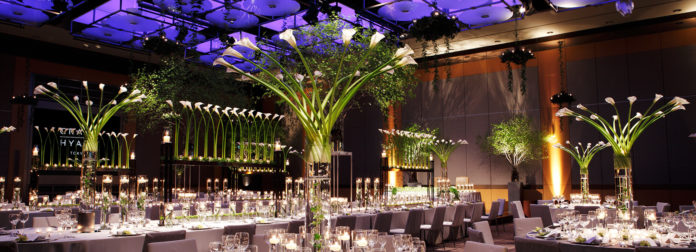
THE Grand Hyatt Tokyo, in the Roppongi district of central Tokyo, has completed a major renovation of its events venues.

Part of a broader drive by the hotel chain to enhance its MICE capabilities throughout Asia, Grand Hyatt Tokyo’s renovation focused on unifying the second floor of the hotel with a cohesive residential design, and expanding and enhancing the Thyme banquet room on the fourth floor. A Poggenpohl show kitchen was also added.

Moreover, there is now direct access to the property’s outdoor garden, while facilities have been spruced up with new technology such as SiliconCore’s high-resolution 192-inch LED display screens. This cutting-edge technology prevents day-time screen glare, making the Coriander room an ideal venue for day-time events and meetings.

“As the host country of the 2020 Olympics and Paralympics, Japan will draw attention from around the world and international visitors will continue to increase,” said Hiroyuki Yamada, director of event sales.

“This means that as we get closer to the Olympics, demand for leisure, MICE and onsite visits of corporations will increase as well,” he told TTmice e-Weekly.

“This is a great opportunity and we hope to see a positive impact on the hotel business and the overall economy.”

The Grand Hyatt Tokyo has hosted events ranging from large-scale movie premieres and financial conferences to luxury car shows and press events.

“Hyatt as a group has a tremendous commitment to MICE. In the past 13 years that we have been in the business, we have been able to consistently renovate our facilities to adapt to the trends and ever-changing demands,” Yamada said, stressing that the hotel intends to “aggressively grow MICE bookings” in the future.

“Our team travels strategically to different parts of the world to generate new business, and we work with Roppongi Hills and local organisations – such as Destination Marketing Roppongi – to achieve a common goal of increasing our MICE business on a larger scale,” he added.

Yamada concluded: “We have had a lot of interest from companies coming to Japan and we would like to establish our position as a leading hotel that can constantly offer creative, innovative and unique personal experiences.”

Garuda Indonesia inflight cuisine

0

Rachel AJ Lee is transported to the Indonesia archipelago with every delicious spoonful of local food she had at the meal presentation

What
Garuda Indonesia recently created new menus – based on the unique and diverse Indonesian traditional dishes found across the country – for all three of its travel classes. This is part of the airline’s ongoing improvements and expansion plans. This new menu was presented at dnata Singapore, Garuda’s inflight catering partner in Singapore.

Why
In 2014, Garuda Indonesia was awarded the 5-Star Airline award by Skytrax, and is only one of seven five-star airlines in the world.

Vindex V. Tengker, vice president inflight services, Garuda Indonesia, told TTG Asia that his goal was “to maintain the five stars, and ensure both food and service are up to that level”.

As travellers are becoming more well-travelled, their expectations for airline food has also increased. Vindex feels that travellers equate their airline experience to a “hotel in the sky”, and a way to provide a wholesome experience is by serving restaurant-quality food.

Aside from the food, flight attendants are also trained to be waiters and waitresses 38,000 feet above ground.

Vindex said: “We have restaurant professionals who come in to teach our flight attendants how to present the food, introduce the items and its origins, and make wine recommendations.”

gadogado
Gado gado

Menu
As I walked into the tasting room, I was offered a glass of mung bean juice. This green drink – made from blending cooked mung beans with condensed milk and a bit of fresh milk – was creamy and sweet; the thickness of it reminded me of an avocado smoothie. This drink is only served in first class, and I was told it is a favourite of both current president Joko Widodo, and his predecessor Susilo Bambang Yudhoyono.

While three different meals were created by the airline for first, business and economy, the meal I had was the Indonesian option provided to business class. The airline also serves a Western alternative onboard.

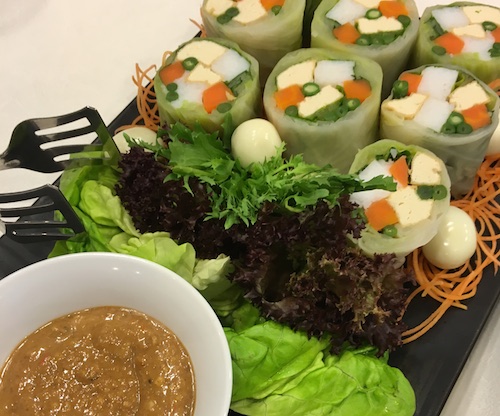
We started off with two appetisers: gado gado, a mixed vegetable roll served with peanut sauce; and rujak buah, a mixed fruit salad. The roll was cold on the inside, and had to be eaten along with a large dollop of peanut sauce as it was rather bland. The mixed fruit salad, however, was an interesting mix of sweet, sour and spicy.

There were three main courses that I sampled, accompanied with a scoop of fragrant nasi kuning (turmeric rice). There was the rendang daging sapi, an aromatic dry beef curry; theayam bakar bumbu rica rica, tender pieces of roasted marinated chicken in rica rica sauce; andikan kappa saus woku, pan-fried snapper in woku sauce.

ikan_kappa_saus_woku-1
Ikan kappa saus woku

Overall, all three dishes were piquant and delicious. What stood out for me was the generous slab of boneless snapper in the woku sauce (a seasoning sauce found in North Sulawesi) – the white meat was flaky, and absorbed the savoury sauce well.

The dessert of the day was three different flavours of mousse cakes – chocolate, blueberry and mango. I tried all three but felt that the chocolate was the best.

It is also worth noting that Garuda Indonesia has two chefs – one each for first and business class – onboard their international longhaul flights. These chefs check that the food is heated to the correct temperature, ensure the taste is consistent, before they plate and present the dish to the passenger.

When asked about economy class meals, Vindex stressed that the menus have also been changed, and these passengers were not forgotten as the economy class accounts for 70 per cent of Garuda’s domestic business.

He elaborated: “There are also a lot of people travelling shorthaul in economy who are there due to company regulations, so we have to ensure that we take care of them too, (as they have the ability to move up in classes).”

Verdict
The dishes evoked a happy gastronomic memory of when I first had a taste of Indonesian cuisine during a visit to the country years ago. The restaurant-quality food also makes me wish that I could afford to fly business class instead.

Qantas adds new codeshare services with Jet Airways

0

qantas

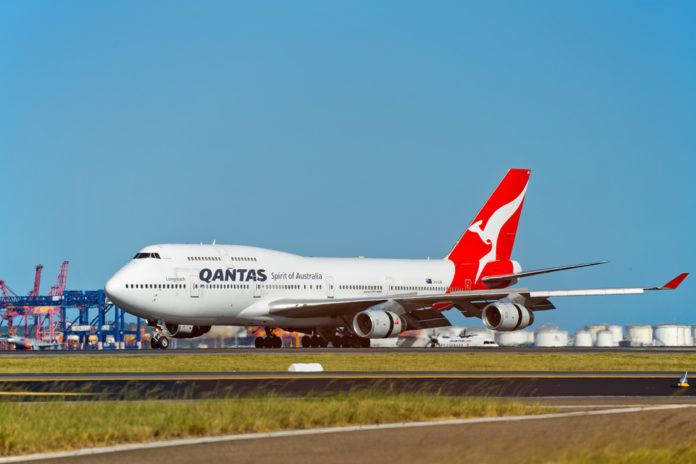
AUSTRALIA’s flag carrier is adding new codeshare services with India’s Jet Airways from key gateways in South-east Asia and North Asia.

Jet Airways flights between Singapore and Chennai as well as from Hong Kong to New Delhi with be available from October 1. Meanwhile, flights from Bangkok to Mumbai and New Delhi will takeoff from October 15.

Tickets for travel between these destinations have went on sale since September 7 through Qantas’ website and GDSs.

Qantas already offers codeshare agreements with Jet Airways between Singapore and Mumbai, Singapore and New Delhi, as well as Hong Kong and Mumbai.

The newly added routes raises the codeshare services between the two carriers from 28 to 77 services a week.

China is world’s first trillion dollar aviation market: Boeing

0

boeing-787

CHINA is expected to place orders for 6,810 new airplanes with an estimated value of US$1.025 trillion over the next 20 years.

According to Boeing’s China Current Market Outlook, this makes China the world’s first trillion dollar aviation market.

“As China transitions to a more consumer-based economy, aviation will play a key role in its economic development,” said Randy Tinseth, vice president of marketing, Boeing Commercial Airplanes.

“Because travel and transportation are key services, we expect to see passenger traffic grow 6.4 per cent annually in China over the next 20 years.”

Boeing predicts China will need 5,110 new single-aisle airplanes through 2035, accounting for 75 per cent of the total new deliveries.

Both LCCs and FSCs have been adding airplanes and expanding new point-to-point services to cater for both leisure and business travel demand from a rising middle class in China and throughout Asia, added the aircraft manufacturer.

Meanwhile, Boeing forecasts that the widebody fleet will triple in size, requiring 1,560 new airplanes. This reflects a continued shift from very large airplanes to efficient new small and medium widebody crafts

Worldwide, it projects investments of US$5.9 trillion for 39,620 new commercial airplanes to be delivered over the next 20 years.

Switzerland looks to South-east Asia for continued growth

0

swiss_tourism500
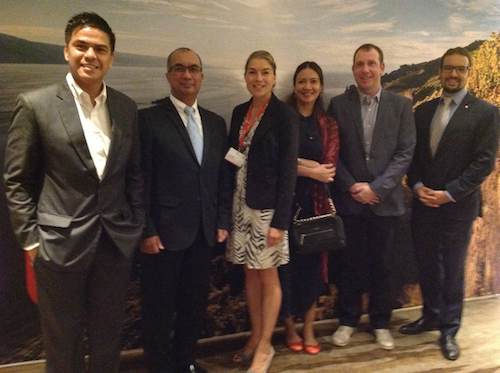
(From left) JP Cabalza, managing director, Cencorp Travel; Edwin Villanueva, general manager, Light Miles Travel; Tanja Dubas, head of sales and marketing, Lausanne Tourism and Convention Bureau; Shan Dioquino David, president/general manager, Corporate International Travel and Tours; Gregor Zajc, general manager, Blue Horizons Travel and Tours; Ivan Breiter, Switzerland Tourism, director of South-east Asia

A GROWING number of Swiss tourism organisations are taking a fresh look at South-east Asia, a prime source market for Switzerland.

Asians are staying longer, coming in bigger groups and offer huge potential for FIT, family and incentive travel, said Ivan Breiter, Switzerland Tourism director for South-east Asia, during a roadshow by Vaud Lake Geneva Region that made its way to the Philippines for the first time.

Breiter said the matured markets of Singapore and Malaysia are stable while Thailand is seeing huge growth. Indonesia and Vietnam meanwhile are seeing slight increments.

He added that the Philippines is one of the fastest-growing markets, having surged over 300 per cent in overnight stays during the past three years. Growth is expected to be sustained as the Swiss embassy in Manila has reduced the visa processing period from five days to between two to three days.

Francois Michel, vice president and marketing director, Vaud Lake Geneva Region, said they have included the Philippines in this year’s South-east Asia roadshow as it is its fourth biggest South-east Asian source market with high growth potential.

Coming to Manila for the first time too are representatives from Lausanne Tourism, newly-opened Royal Savoy hotel in Lausanne, Montreux-Vevey Tourism, Clinique La Prairie in Montreux, and Highlights Lake Geneva Region.

European agents welcome 2018 as EU-China Year for Tourism

0

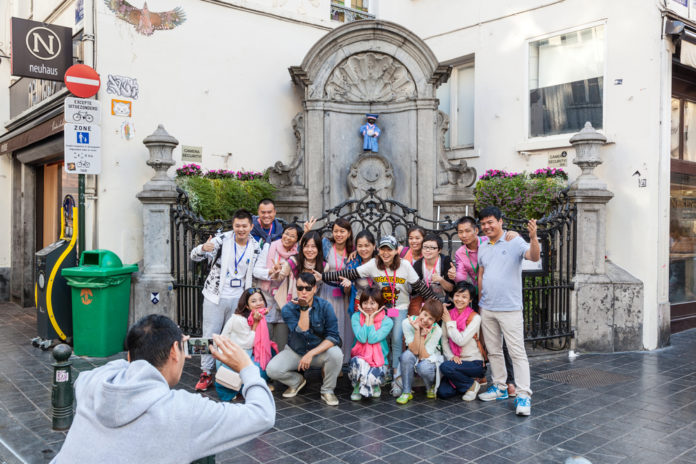
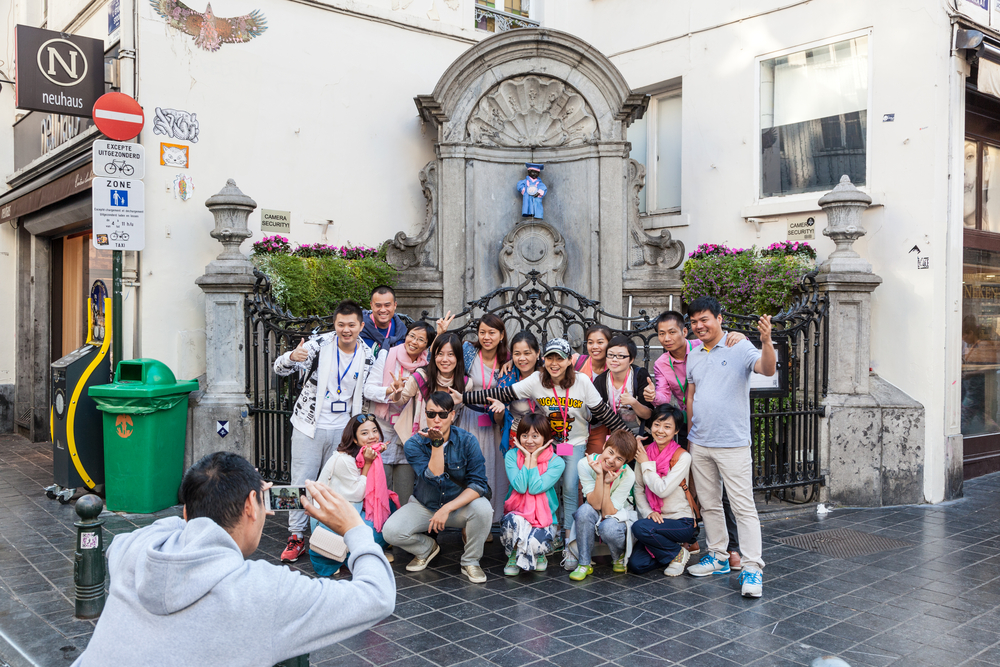
chinese-tourists-brusselsChinese tourists taking a picture at the Manneken Pis statue in Brussels, Belgium
THE European Tour Operators Association (ETOA) has thrown its support behind the designation of 2018 as the EU-China Year for Tourism.

Said ETOA CEO Tom Jenkins: “China remains one of the most important future markets for European tourism, and that there is a designated year for tourism co-operation is of course to be welcomed.

“How Chinese visitors are welcomed and accommodated, how their expectations can be met is one of the central topics that the industry has to address: this initiative will help them do so.”

Added European Travel Commission (ETC) executive director Eduardo Santander: “The EU-China Tourism Year is a great opportunity for the European tourism industry to explore the Chinese market, but also learn how to attract Chinese visitors and offer them the best experience.”

A first meeting with EU tourism stakeholders on the 2018 EU-China Tourism Year programme will take place in the ETC headquarters in Brussels this month, while a discussion with a high level Chinese delegation is scheduled for October 25 in Beijing.

European destinations drew 10.1 million Chinese visitors in 2015, accounting for a 13 per cent share of all outbound travel from China.

The EU-China Year for Tourism was first declared by Jean-Claude Juncker, president of the European Commission and Li Keqiang, premier of the state council of China, at the opening of the EU-China summit on July 12.

JTB to offer luggage-free travel service

0

luggage-at-airport

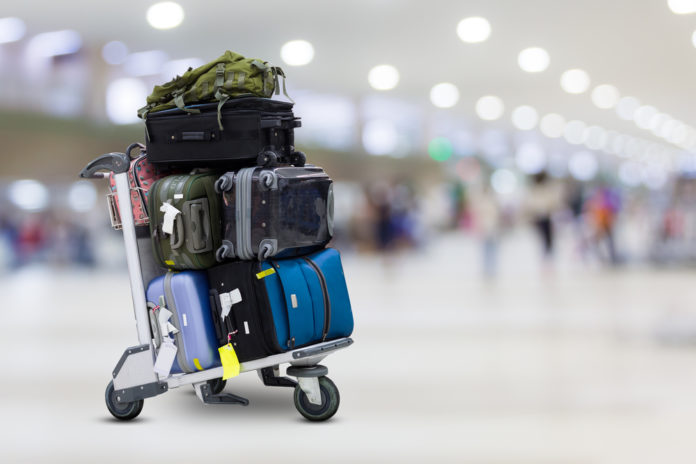
JTB has teamed up with a technology firm and a delivery service to provide foreign visitors with luggage-free travel.

With an eye on the 40 million overseas tourists who are expected to arrive in Japan in 2020, JTB is working with Panasonic and Yamato Holdings to make it easier for visitors to travel within Japan without having to worry about their baggage.

To date, tourists who wish to send their luggage ahead of them have encountered difficulties, primarily because parcel delivery companies require a lot of paperwork, all in Japanese.

The companies have combined to overcome that hurdle by enabling travellers to provide information in advance on the hotels where they will be on staying each evening of their trip.

After arriving in Japan, the new arrivals drop their luggage off at a counter at the airport, where the bags are then delivered to their hotel. When they check out, the luggage is again picked up and sent on to the next destination. The cost for transporting an item of luggage will depend on its weight and size.

Travellers are able to update or alter destinations via a website.

A two-month trial period commenced on September 1 and the companies intend to launch the full service by the end of March 2017.

At present, six hotels in Tokyo are taking part, but the consortium aims to extend the service to 5,000 hotels with links to JTB across Japan by 2020.