A recent survey conducted by the ASEAN Tourism Association (ASEANTA) and Pear Anderson has revealed that 48 per cent of South-east Asian travel businesses believe that the prospects for their business in 2Q2026 are worse than they had originally anticipated at the start of the year, due to the US-Israel-Iran war impact.
The report showed that inbound operators in particular were pessimistic about future enquiries, with 74 per cent of inbound travel businesses much gloomier about prospects than at the start of the year, compared to 50 per cent of outbound travel businesses.
Singaporean travel businesses were the most pessimistic overall, with two-thirds (67 per cent) expecting enquiries in 2Q2026 to be worse than what they expected at the start of the year, compared to 64 per cent in Malaysia, 54 per cent in Indonesia, 50 per cent in the Philippines, and 43 per cent in Thailand.
Almost three-quarters (72 per cent) of outbound travel businesses reported at least some postponements and cancellations for trips to the Middle East, 70 per cent to Europe, and 58 per cent to other regions, demonstrating that the impact on travel was beyond connectivity.
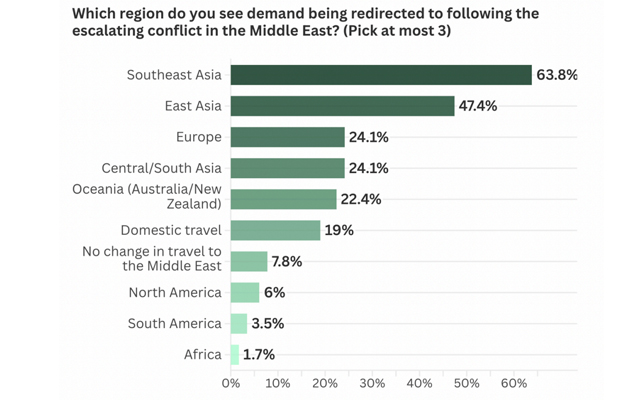
As for a potential redirection of outbound travel flows, 64 per cent of businesses believed that South-east Asia would see the benefit, followed by East Asia (47 per cent) and Europe and Central Asia (24 per cent).
Thai travel businesses were the most confident that Europe would see a growth of interest (56 per cent), likely due to the higher number of direct flights to Europe already operating to Thailand, while the Philippines saw a greater chance of travel interest being redirected to domestic (30 per cent).
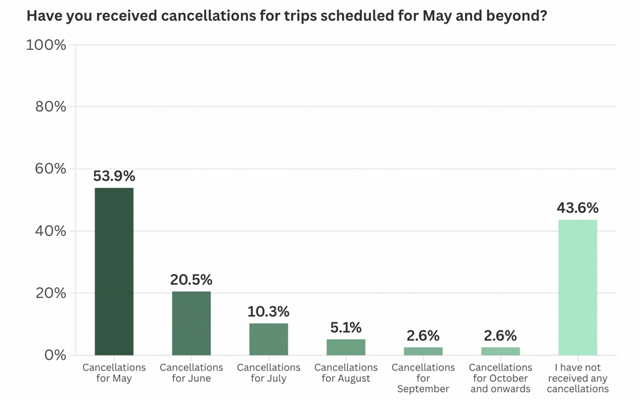
For inbound travel businesses, 54 per cent have received cancellations for May, with the number sharply decreasing for cancellations received in June (21 per cent), and just three per cent seeing cancellations from October and onwards, a sign that travellers are taking a wait-and-see approach.
Sixty-two per cent of businesses saw some trips postponed or cancelled from Middle Eastern travellers, with a higher number (67 per cent) for travellers from Europe, signalling the significant role that Middle East transit hubs play to facilitate inbound travel into South-east Asia.
Fuel price increases, leading to higher airfares, as well as fuel shortages in general remain of concern for South-east Asian travel businesses, who noted their impact on inbound operations in-destination, and their potential knock-on impact on traveller purchasing power in the medium-term.
“The high percentage who believe that travel will be redirected to South-east Asia confirms that we must work together as one ASEAN to support our tourism and travel ecosystem,” said Eddy Soemawilaga, president of ASEANTA.
“Travel businesses commenting on the current situation were quick to point to the overall resilience of the South-east Asian travel industry, and that they believed traveller demand would recover once the situation stabilises.”
“There is no denying that travel businesses, whether outbound or inbound, are suffering at the moment,” stated Hannah Pearson, director at Pear Anderson. “While on the face of it the lack of transit flights to the Middle East is immediately impacting flows both in and out of the region, ASEAN has an opportunity to present itself as an alternative transit hub between Australia and Europe, potentially opening up more direct flight routes – and new opportunities.”