Thailand’s reinstatement of visa-free entry for Indian travellers has been welcomed by the inbound trade, but operators say two months of policy uncertainty have already cost the market its Indian high season. FITs diverted to Vietnam and Malaysia over concerns about the proposed visa fee, while wedding groups delayed payments pending greater certainty over travel costs.
The cabinet reinstated the 30-day visa exemption on July 14, 2026, pending publication in the Royal Gazette, reversing a May 19 decision to move India to a 15-day visa on arrival costing 2,000 baht (US$60). The policy never officially came into effect. Tourism and sports minister Surasak Phancharoenworakul attributed a decline of nearly 20 per cent in Indian arrivals to the confusion. India delivered 2.48 million visitors in 2025, making it Thailand’s third-largest source market.
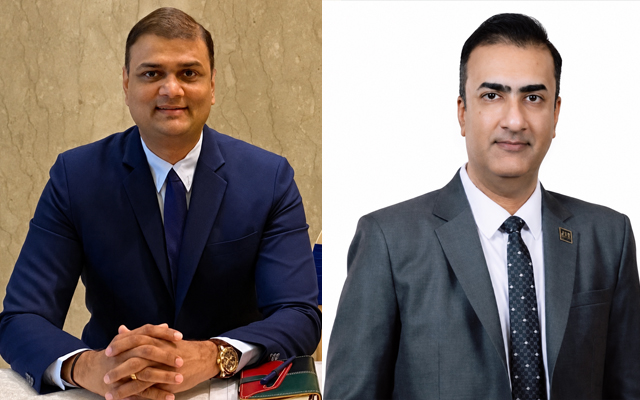
From left: Shreyash Shah and Vathanachai Chatrirath described the impacts of uncertainty over visa free access to Thailand for the Indian market
Vathanachai Chatrirath, vice president of the Association of Thai Travel Agents and owner of Thai Travel DMC, described the Indian market as “very price sensitive” and said the proposed 2,000 baht fee equated to around 6,000 rupees (US$62) per traveller.
“One family of four travelling would have to pay 24,000 rupees, which is a significant impact to valuable budgets that they could have spent for their vacation,” he said.
Leisure business shifted as uncertainty over the policy lingered, said Akash Pawar, founding member for strategy and new initiatives at Mumbai-based Media Hermits Limited.
“It is still unclear for us, and the budget issues make it a little difficult. Clients then prefer other destinations,” Pawar noted. Leisure groups postponed or switched to other destinations, although weddings were less affected, he added.
Shreyash Shah, commercial director at Destination Hospitality Management, noted the impact at his company was greater on weddings, where contracting for the November-to-March high season typically takes place six to nine months before arrival.
“The impact was quite noticeable in the wedding segment, more than FITs. At (one of the properties that we contract for), we have five weddings on hold right now. Everything was done, all the nitty-gritty on the confirmation, but we never received payment,” Shah underscored.
The revised 30-day visa-free period — down from the 60-day policy introduced in 2024 — is not a concern, he added. Indian weddings typically last three to seven days, while even travellers from the Middle East and Europe rarely stay beyond 10 days.
Higher airfares compounded the uncertainty. Shah said low-cost carriers had suspended flights to India until October because of the Middle East conflict, pushing fares up by around 30 per cent during India’s summer holiday period.
As a result, travellers who might otherwise have diverted to Thailand from the Middle East opted for domestic holidays, Malaysia or Vietnam. Malaysia continued to offer visa-free entry and uninterrupted AirAsia services, while Vietnam charges US$25 for a single-entry visa and US$50 for a multiple-entry visa.
Shah said the Tourism Authority of Thailand and the Ministry of Foreign Affairs should actively communicate the policy reversal through social media, trade media and webinars with Indian travel associations.
“They have to be more proactive to get the business back,” he stated.
He expects arrivals and group business to recover as flight capacity increases and fuel surcharges ease, with airfares already about 10 per cent lower.
“There is no deadline saying they are going to cancel this 30-day visa, so it is optimistic,” Shah concluded. “This will impact the first quarter of 2027, where we can bring business back to pre-uncertainty levels.”
The Singapore Tourism Board (STB) has signed its first strategic partnership with Indonesian carrier TransNusa to strengthen air connectivity between Indonesia and Singapore. The collaboration will leverage TransNusa’s expanding domestic network and operational hubs in Jakarta, Bali and Manado to attract travellers from beyond Indonesia’s major metropolitan gateways.
TransNusa currently operates three daily flights between Jakarta and Singapore, two daily services from Denpasar, and an extensive network across eastern Indonesia.
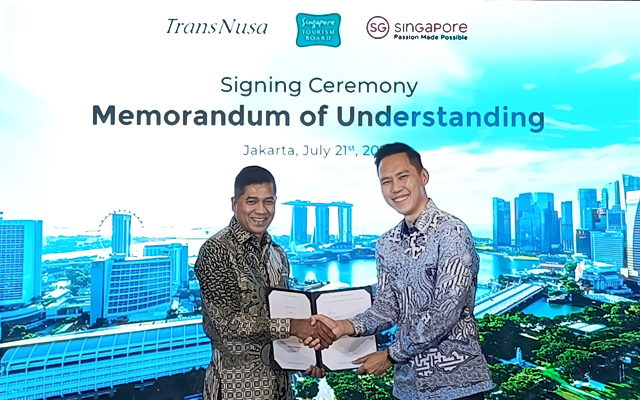
TransNusa and the STB will jointly promote fares and fly-cruise packages while expanding access to Singapore from secondary cities across Indonesia; photo by Dhini Oktavianti
Speaking at the signing ceremony in Jakarta, Terrence Voon, STB’s executive director for Southeast Asia, said the carrier’s growing presence made it a natural partner.
“We’ve observed that very closely over the past year, with increasing flights to Singapore and increasing frequencies from both Jakarta and Denpasar. This reflects the strong and growing demand for travel to Singapore among Indonesian travellers.”
The one-year partnership will focus on promotional fares and fly-cruise packages developed with StarCruises. The packages combine flights with a short stay in Singapore before passengers embark on a regional cruise.
Voon said the initiative aims to make travel more affordable while introducing new experiences “not just in Jakarta but beyond”.
To drive regional traffic, TransNusa plans to connect secondary cities through its main hubs before onward travel to Singapore.
Bernard Francis, aviation group CEO of TransNusa, said the airline aims to build more than just a point-to-point market between Indonesia and Singapore. Leveraging its network across eastern Indonesia, including destinations such as Waingapu, Wakatobi, Lombok and Bima, TransNusa plans to use its hubs as gateways to connect travellers from across the region to Singapore.
The Malaysia Budget & Business Hotel Association (MyBHA) has signed three memoranda of understanding (MoUs) with Thai tourism and business organisations to strengthen bilateral tourism cooperation in conjunction with Visit Malaysia 2026 (VM2026).
The agreements were signed with the Thai Travel Agents Association, the Thai Medical and Wellness Tourism Association and CHG Global Organization during the Visit Malaysia 2026 Seminar & Networking Session organised by Tourism Malaysia Bangkok.
Michiel: the tourism industry today requires strategic partnerships rather than isolated efforts
In a statement, MyBHA president Sri Ganesh Michiel said the partnerships support the objectives of VM2026 while creating new business opportunities between the two countries.
“These partnerships establish a long-term framework for collaboration between Malaysia and Thailand that will create greater business opportunities, increase tourist arrivals, strengthen industry networking and enhance the competitiveness of both countries’ tourism and hospitality sectors.”
According to Michiel, the agreements will connect MyBHA member hotels with Thai travel agencies, positioning Malaysia’s budget and business hotels as preferred accommodation providers for Thai visitors while creating reciprocal opportunities for Malaysian travellers visiting Thailand.
Under the MoUs, the organisations will collaborate on tourism exchanges, business networking, joint promotions, exhibitions and conferences, market intelligence sharing, research and advocacy, and initiatives to support the sustainable growth of the tourism and hospitality sectors in both countries.
“The tourism industry today requires strategic partnerships rather than isolated efforts. Through these agreements, we are creating a sustainable ecosystem where hotels, travel agencies, wellness providers, investors and business organisations can work together to generate mutual economic growth,” Michiel added.
Fairmont Hotels & Resorts will expand its presence in Japan with the opening of Fairmont Niseko, a 165-room luxury resort scheduled to welcome guests in early 2028.
Developed in partnership with J-Will Partners, the property will be set within 3.6 hectares of forest between Mount Yotei and Mount Annupuri, providing access to Niseko’s ski slopes, golf courses and outdoor attractions.
Fairmont Niseko will open in early 2028, offering 165 rooms between Mount Yotei and Mount Annupuri
Facilities will include two restaurants, a spa and wellness centre, kids’ club and onsen.
Fairmont Niseko will become the brand’s second property in Japan, following the opening of Fairmont Tokyo in 2025.
The development comes as access to Niseko continues to improve. The planned extension of the Hokkaido Shinkansen, due for completion in 2038, will connect Kutchan Station with Sapporo Station in about 25 minutes. Growing international services at New Chitose Airport are also expected to support inbound tourism to the region.
Omer Acar, CEO, Fairmont Hotels & Resorts, said: “Niseko’s international renown for its exceptional powder snow makes it one of the world’s premier luxury ski destinations, attracting enthusiasts from across the globe.
“Fairmont Niseko will be an exciting new landmark, marking our second property in Japan following the opening of Fairmont Tokyo last year.”
Accommodation type remains the most-used search filter on Agoda, but travellers across Asia are increasingly prioritising booking flexibility when choosing where to stay, according to the online travel platform.
Based on accommodation searches between January 1 and April 15, 2026, Agoda found that accommodation type accounted for 19% of all filter use across 10 Asian markets. Free cancellation and pay-at-hotel options were also among the platform’s 10 most-used search filters, reflecting growing demand for greater flexibility and control over travel plans.
Agoda search data shows travellers across Asia are increasingly prioritising flexible booking and payment options alongside accommodation type
The data also indicates that travellers are refining searches based on practical features, including bed types, parking facilities and proximity to public transport, suggesting accommodation choices are increasingly influenced by individual travel needs.
Agoda said the findings highlight the importance for accommodation providers of clearly presenting property information, amenities and booking policies to improve visibility and conversion.
The findings suggest accommodation providers may benefit from offering flexible cancellation policies and payment options, maintaining accurate property listings, and tailoring content to the preferences of different source markets.
The analysis is based on Agoda accommodation searches made by travellers from India, Indonesia, Japan, Malaysia, the Philippines, Singapore, South Korea, Taiwan, Thailand and Vietnam.
Andrew Smith, senior vice president, supply, Agoda, said: “Search filters can reveal what travellers want to know before they book whether that’s the right accommodation type, greater flexibility or confidence in the quality of a stay.
“For accommodation providers, these insights can be a roadmap for meeting evolving traveller expectations. Properties that make their value proposition clear, highlight the amenities guests care about most, and reduce booking friction will be better positioned to increase visibility, encourage conversion in an increasingly competitive market.”
Villa Le Corail, A Gran Meliá Hotel in Nha Trang has introduced Wellness by the Sea, a new collection of treatments at Song Spa aimed at improving sleep, restoring balance and easing fatigue.
The programme is built around Song Spa’s philosophy of wellness inspired by the life cycle of a coral reef, with guest experiences following four stages: grounding, awakening, blooming and legacy. It combines four elements – gentle movement, mindfulness, relaxation and nutrition that supports better sleep.
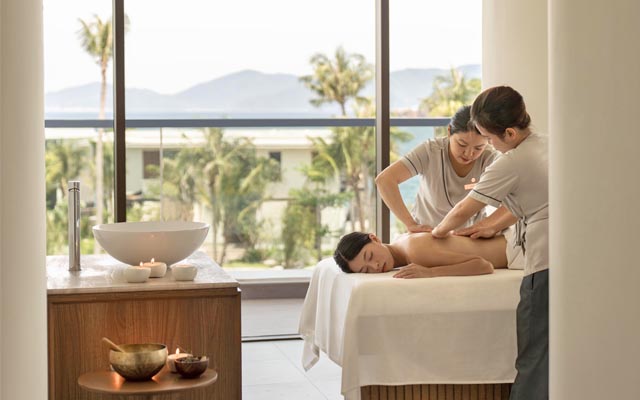
Villa Le Corail’s new Wellness by the Sea programme combines sleep-focused therapies, thermal wellness and mindfulness, while supporting coral restoration in Nha Trang Bay
Guests can choose between two programmes. The three-hour Sleep & Serenity Ritual is offered in the morning, afternoon or evening, combining Yin Yoga, sound therapy, aromatherapy and a herbal tea ritual. Sessions are tailored to help guests recover from travel, reduce stress, improve focus or prepare for sleep, depending on the time of day.
For a more comprehensive experience, the six-hour Sleep Recovery Journey includes stretching and breathwork, access to a Turkish Hammam, Japanese-style hot seawater onsens and a cold plunge pool, followed by a 90-minute treatment incorporating Vietnamese techniques. The programme also includes meals designed to support sleep and concludes with Yoga Nidra.
Villa Le Corail has also linked the programme to its marine conservation efforts. In partnership with marine biology organisation Avatar, one coral fragment is planted on the resort’s house reef for every wellness treatment booked.
The Sleep & Serenity Ritual is priced from 4,500,000 dong (US$171), while the Sleep Recovery Journey starts from 6,500,000 dong.
In 2026, the province of Udon Thani – located on a plateau 187m above sea level and home to the Phu Pan mountain range and the Songkhram River – is bridging ancient and modern civilisation while leading tourism growth in Thailand’s north-east.
Udon Thani’s greatest claim to fame is its archaeological heritage, most notably the UNESCO-recognised village of Ban Chiang. The historic settlement is widely regarded as one of the world’s earliest Bronze Age civilisations, dating back more than 5,000 years.
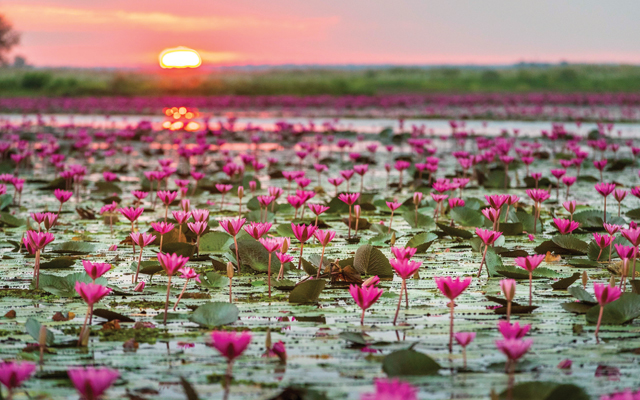
Udon Thani’s famed Red Lotus Sea at Nong Han Lake with its pink tropical water lily blooms (Nymphaeaceae) was recently the backdrop for the TAT’s Feel All the Feelings, Seeking Thailand’s Wonders campaign; Photo by Tourism Authority of Thailand
Today, driven by a combination of cultural interest and preparations for the upcoming World Horticultural Expo, the province is developing into a major tourism destination.
Udon Thani is also strengthening its international connectivity through expanded aviation links.
The province has launched direct charter flights from Chinese cities including Yiwu, Wuxi, Kunming and Guangzhou, bringing in groups of visitors each week. Udon Thani International Airport has expanded its ability to handle the increase in traffic, while future route development is targeting Singapore.
As a result, Udon Thani now ranks first in the Isan region for international tourism revenue, generating 933 million baht from foreign visitors. The province has welcomed more than 1.36 million visitors year to date, generating 3.5 billion baht in tourism revenue.
“To capitalise on this momentum, the TAT (Tourism Authority of Thailand) Shanghai office has secured long-term flight programmes to maintain continuous international arrivals, carrying this influx directly into the upcoming Udon Thani International Horticultural Expo. Ultimately, this sustained tourism growth is translating into tangible economic benefits for local residents, community enterprises, and OTOP entrepreneurs who are now directly accessing a lucrative international market,” said Kanokwan Dungsrikaew, director of TAT Udon Thani Office.
Momentum in early 2026 has also been supported by the Tourism Authority of Thailand’s Feel All the Feelings, Seeking Thailand’s Wonders campaign.
The campaign, led by Amazing Thailand ambassador Lalisa Manobal – popularly known as Lisa, a singer and actress based in South Korea – has driven increased interest in secondary destinations.
One of the main beneficiaries has been Udon Thani’s Red Lotus Sea at Nong Han Lake, known for its pink tropical water lilies. Traditionally popular with domestic visitors, the attraction has seen a significant shift in visitor demographics. Between December 2025 and January 2026, it welcomed more than 50,300 visitors, with international tourists accounting for 48.27 per cent of arrivals. This was the first time international visitor numbers approached domestic levels, prompting TAT to forecast at least 120,000 visitors during the latest blooming season, which runs from early December to the end of February.
Udon Thani is also known for its local textiles, particularly Pha Khid silk. Visitors can explore the Ban Na Kha fabric market or Chanruen Nakha tailor to purchase traditional Isan attire. Both locations are around 30 minutes by road from Udon Thani International Airport.
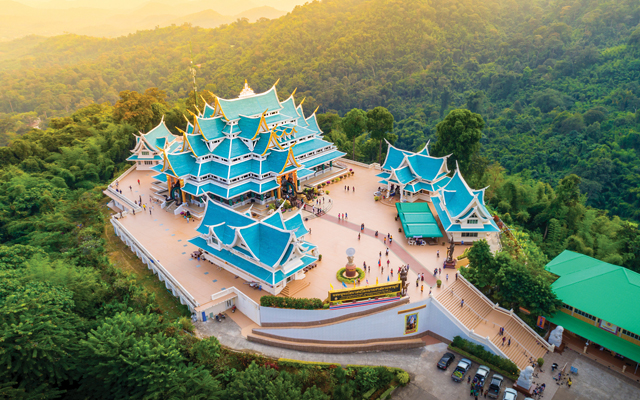
Wat Pa Phu Kon is known for its aqua-blue roofs and a 20m reclining Buddha carved from white Carrara marble imported from Italy
Events such as the annual Udon City Fest and the May 2026 Mind the Gap art festival further showcase the province’s cultural scene.
Attention is now turning to the Udon Thani International Horticultural Expo 2026, which will run for 134 days from November 1, 2026, to March 14, 2027.
Operating under the theme Diversity of Life: Connecting people, water, and plants for sustainable living, the Expo is projected to generate more than 32 billion baht in economic value and attract up to 3.6 million visitors.
As of May 2026, infrastructure development at the Nong Daeng wetlands site was 71 per cent complete. Beyond the event itself, the project is intended to leave a long-term legacy through a public park, corporate and international gardens, and business events facilities.
To support the Expo, the Thailand Convention and Exhibition Bureau has launched the Udon Thani: Gateway to a New World programme, bringing together airlines, hotels and local tourism partners to create integrated travel packages for international visitors.
Inbound travel partners have also developed products targeting different traveller segments.
These include the Thai Ecotourism and Adventure Travel Association’s Green Wonder Journey, Udon Plus Circle by the Domestic Travel Business Association, and the Thailand Incentive and Convention Association’s Meet the World at Udon package. The programmes are designed to support bookings and encourage longer stays in the Isan region.
Centara Udon, one of the city’s key accommodation and business event venues, is expected to play a role during the Expo period.
The 259-room hotel, which opened in 2009 and underwent renovations in 2023, will host the IV International Symposium on Tropical and Subtropical Ornamentals in January 2027, alongside the Expo.
Prolonged build timelines and high borrowing costs are pushing South-east Asian hotel owners away from new builds and towards converting existing assets
Horwath HTL’s data shows conversions are concentrated in more developed markets versus earlier stage growth markets
Collection and soft brands are absorbing the resulting deals, as owners push for franchise and performance-linked fee structures that keep control while opening access to global distribution
From left: Bryan Chan and Armand Steinmeyer explore what’s behind South-east Asia’s capital pivot toward hotel conversions
Hotel conversions are claiming a growing share of South-east Asia’s development pipeline, as high debt costs and stretched construction timelines push owners away from new builds and towards faster, cheaper transformations of existing assets.
Asked to name the top three trends in the region’s hotel development scene, executives at four hotel groups, IHG Hotels & Resorts, Radisson Hotel Group, Centara Hotels & Resorts and Accor, each placed conversions in first or second place on the list.
At IHG Hotels & Resorts, conversions accounted for about 30 per cent of openings in 2019 and reached 50 per cent last year, according to Bryan Chan, the group’s vice president of development for South East Asia and Korea.
“Conversions are increasing, reflecting a shift in owner priorities towards assets that deliver minimum downtime, higher returns and lower costs,” Chan said.
The capital case for conversions
Chan noted the momentum was strongest in the premium segment, where independent owners compete against global loyalty networks.
“The premium segment is one in which we see some of the strongest momentum, supported by the demand for high-quality, value-for-money stays. This creates significant opportunities to convert either independent hotels into branded assets, or non-hotel real estate such as underutilised office spaces into hotel assets,” he explained.
The strategy is concentrated in voco, which Chan shared is now IHG’s fastest-growing premium brand, with nine hotels open in South-east Asia and eight more in the pipeline.
“Its appeal lies in its cost-effective conversions and new builds that combine operational efficiency and distinctive guest experiences,” Chan added. “This includes the most recent opening of voco Kuching, a conversion of a former independent hotel into a mixed-use destination, integrating the voco hotel with East Malaysia’s largest seniors wellness centre.”
Horwath HTL’s pipeline tracking shows the same pattern reshaping deal flow beyond the region’s gateway cities.
“New-builds still dominate our secondary-city deal data however it is declining from around 80 per cent in 2019 to around 60 per cent in 2025 and Q1 2026. Conversions have been steadily eating into new-build’s share of secondary-city deals for six straight years,” said Matt Gebbie, Horwath HTL’s director for Pacific Asia.
At Bangkok-based Centara Hotels & Resorts, chief development officer Andrew Shaw ranked conversions as the top trend in the region’s development scene, saying the capital environment had forced a re-evaluation of long-term construction projects.
“Conversions are taking priority over ground-up development,” Shaw said. “With debt and construction costs still high, and development timelines stretching, new-build projects are becoming harder to justify. Rebrandings, renovations and adaptive reuse projects are more attractive because they can be delivered faster and with less capital risk.”
The country split
Horwath HTL’s deal tracking shows the shift is far from uniform across Asia-Pacific.
Gebbie explained: “The conversions are more in the developed markets. If you are looking at Australia, Malaysia, New Zealand and even Thailand, there is a heavier proportion of conversions than there are in countries like Pakistan, Cambodia, the Philippines and Vietnam.”
Across the full 2019 to 2026 period, new builds still dominate in Pakistan (92 per cent), Cambodia (81 per cent), the Philippines (78 per cent), South Korea (76 per cent) and Vietnam (73 per cent).
Mature and leisure-led markets sit at the opposite end, with conversions and adaptive reuse taking close to half of all activity in the Maldives (42 per cent new build), New Zealand (50 per cent), Australia (52 per cent), Malaysia (52 per cent) and Thailand (55 per cent). A middle group holds a clearer new-build majority: China (71 per cent), Indonesia (69 per cent), India (68 per cent) and Japan (60 per cent).
Narrowing the window to 2024 to 2026 sharpens the divide. Australia’s new-build share falls to 34 per cent, with conversions taking 56 per cent of deals, and Thailand and Japan both drop to about 41 per cent. China, India, Indonesia and Vietnam hold in a band of 60 to 63 per cent, which Gebbie attributes to their position as earlier-stage growth markets.
Within secondary cities, conversions remain the smaller share of deals but the faster-growing one, rising from about 18 per cent in 2019 and 2020 to about 25 per cent by 2024 and 2025 once adaptive reuse is counted alongside them. That growth is concentrated in China’s already-built secondary cities, among them Hangzhou, Suzhou, Chengdu and Nanjing, where owners are repositioning older stock into international brands.
Space, yield and second winds
According to Armand Steinmeyer, vice president of development for South-east Asia at Radisson Hotel Group, the region’s hotel development conversation now splits into two for owners and investors.
“There are two conversations: greenfield versus the existing. With existing assets, it is about changing the programming and ensuring the hotel is evolving to demand. It boils down to how these assets can perform better,” he said.
That question of performance has moved beyond the traditional rooms-led model.
Steinmeyer elaborated: “It is not just about building a hotel and selling rooms any more. Today it is a bit more complicated. People look at how you can unlock value, and the owner-operator dynamic reflects that. There is greater sophistication in the market, with more variables.”
Converting an existing building into a branded hotel also forces operators off their standard architectural prototypes.
“Greenfield is theory; conversions are reality. It demands a lot of creativity. Just a conversion in itself is good, but bigger questions remain for how to change a property’s identity and give it a second wind,” Steinmeyer reflected.
That discipline has changed how Radisson Hotel Group measures a property: “We have a new metric with square metre yield – the software matters more now. In fact, it is healthy that we have brought it back to how we use space effectively,” he said.
He added that flexibility now runs through the group’s brand standards.
“As a developer-operator, we have to constantly reinvent ourselves and reinvent how space is used. Brands can be adjusted to make something come alive. That is how you can bring relevance,” he shared.
The trend is also spreading beyond hotel-to-hotel deals.
“Conversions of existing hotels are growing, but our adaptive reuse data – meaning non-hotels converted to hotels, whether they are apartments or offices – is also rising from a small percentage, particularly in China. This adaptive reuse sector never really got ticked before in our surveys, but it is increasingly prominent now,” Gebbie noted.
The soft-brand route
The rise in conversions is feeding growth in collection and soft brands, which let owners keep a property’s identity while plugging into an international operator’s distribution and loyalty platforms.
“Owners are prioritising flexibility, speed to market and capital efficiency. As a result, conversion of existing properties is becoming more prominent. Collection brands, like MGallery Collection and Emblems Collection, are particularly suited to this trend, as they allow hotels to retain their individual identity while benefiting from the support of a larger network,” stated Xavier Grange, Accor’s global chief development officer for Sofitel, Emblems and MGallery.
Grange added: “This model is gaining traction as it provides a balance between independence and access to distribution, loyalty ecosystems and operational expertise.”
Shaw noted that the pressure on brand relationships extends to contract terms.
“With hotel management agreements coming up for renewal across the region, owners are becoming more assertive. They want fee structures that are better aligned with NOI (net operating income) and bottom-line performance, rather than simply rewarding top-line growth. This is why performance-linked incentive fees, soft brands and franchise models are gaining appeal. They allow owners to retain control while still accessing global distribution and loyalty platforms,” Shaw stated.
Gebbie highlighted that the same flexibility is what makes the most complex conversions possible.
“Using the collection brands certainly makes adaptive reuse a distinct possibility. For the hard brands with a lack of flexibility, adaptive reuse is far more difficult. Collection brands make rebranding an office building into a hotel much easier,” he said.
“Brands aren’t sterile; brands should never be fixed in stone – because a brand is something that people live in; it’s something that they embrace. That is an opportunity to showcase it in a conversion,” Steinmeyer concluded.
Tourism Western Australia is reinforcing its long-standing economic partnership with Singapore, citing strong trade figures, record visitor arrivals, and growing investment opportunities across energy transition, hospitality and infrastructure.
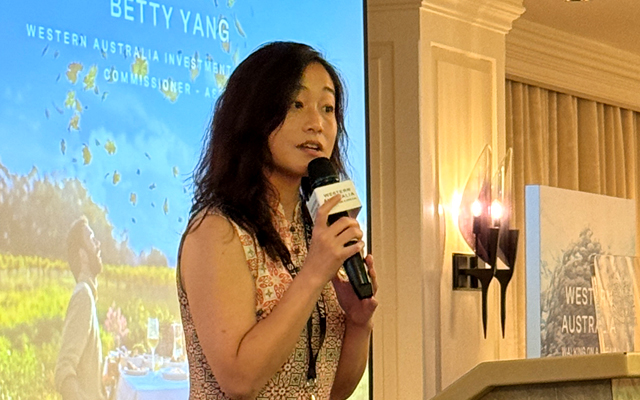
Speaking at the Western Australia Tourism Investment and Trade Evening at Raffles Hotel Singapore on Monday, Betty Yang, Western Australia’s investment and trade commissioner for ASEAN, highlighted the deep historical and commercial ties between the two regions. She noted that around the time Raffles Hotel was first built, Western Australia was already trading with Singapore, exporting sandalwood and agri-food in exchange for spices, rice and tea.
Western Australia’s Betty Yang speaking at the Western Australia Tourism Investment and Trade Evening at Raffles Hotel Singapore; photo by Rachel AJ Lee
Yang said: “Today, Singapore is Western Australia’s fifth-largest trading partner with two-way trade valued at around A$12 billion (US$7.8 billion) – representing about 35 per cent of Australia’s total trade with Singapore.
“Singapore is also one of the largest sources of investment into Australia and Western Australia… Our government appreciates the importance of this long-standing and trusted relationship, and is committed to strengthening it.”
The economic relationship is underpinned by the two regions’ proximity, shared time zone and direct air links. It is further strengthened by a strong diaspora, with nearly 30 per cent of Australia’s Singaporean community living in Western Australia.
The state also welcomed a record 1.1 million international visitors in the year ending March 2026, generating more than A$3.3 billion in visitor spending. Singapore remains Western Australia’s second-largest international visitor market, contributing more than 126,000 visitors travelling for self-drive holidays and to visit friends and relatives.
Strong visitor demand has supported Western Australia’s accommodation sector, making it one of Australia’s best-performing hotel markets, with occupancy rates consistently between 80 and 95 per cent. To meet projected demand over the next decade, the state estimates it will require 3,000 to 3,500 new hotel rooms across Perth and regional destinations, including Margaret River, The Kimberley and Coral Coast.
Highlighting the commercial value of face-to-face engagement, Natalie Goddard, commercial operations manager at Sea West, said: “Events like these allow you to meet new people, have different discussions, and that kind of engagement directly leads to good business.”
Alex Ng, director of business development at Business Events Perth, added: “(Events like these are) about building connections that create long-term opportunities and exploring where Singapore and the ASEAN region’s expertise, capital, and global outlook align with Western Australia’s growth ambitions.”
Wyndham Hotels & Resorts is evolving its Wyndham Rewards loyalty programme with lifestyle partnerships and exclusive experiences designed to strengthen customer engagement before, during and after a hotel stay.
Recent initiatives include a partnership in China with IMAX centred on Toy Story 5. Through the campaign, Wyndham Rewards members could take part in online activities to earn points, movie vouchers, exclusive merchandise and other perks. The campaign also featured a private IMAX screening in Shanghai for members and partners.
From left: IMAX’s Kyle Tsao and Wyndham Hotels & Resorts’ Eyvonne Lin at the exclusive Toy Story 5 premiere in Shanghai
Another initiative gives Wyndham Rewards members the opportunity to bid for a Melbourne Marathon Getaway package, which includes entry to the half marathon and a two-night stay at Ovolo Melbourne South Yarra, a Wyndham Hotel.
According to Eyvonne Lin, vice president of marketing and commercial performance, Asia Pacific, Wyndham Hotels & Resorts, the Melbourne Marathon is a hugely popular event that is swiftly sold out within days.
“We know that people find it very difficult to access this event, so we brought it onto our Wyndham Rewards Experiences platform to give our members a chance to bid for the activity,” she said.
Lin told TTG Asia that activities offered through Wyndham Rewards take into consideration travellers’ growing appetite for unique and popular destination experiences.
Activities must also offer bragging value.
“Customers prefer to engage with brands that are aligned with how they feel. The brand that they buy from must give them pride and the ability to talk about the value they enjoy; it must match and lift their social status,” she added.
The programme has partnered with lifestyle brands such as Singapore Airlines’ KrisFlyer and, for a limited period, Harley-Davidson.
As well, Lin shared that Wyndham is developing experiences that appeal to younger travellers to support the programme’s long-term growth while helping hotel owners attract a new generation of guests.
In 2025, Wyndham Hotels & Resorts became the official hotel partner of the Dreamland Music & Art Festival in Shanghai. Guests staying at participating hotels during the festival had the opportunity to receive exclusive souvenirs.
“The strategy behind Wyndham Rewards is very clear. We want to be relevant before the stay, during the trip, and after the guest leaves. This strengthens member engagement, supports our direct channel performance, and gives our hotel owners more ways to capture demand,” Lin said.
Wyndham Rewards currently has more than 124 million members worldwide.