Brought to you by Cvent
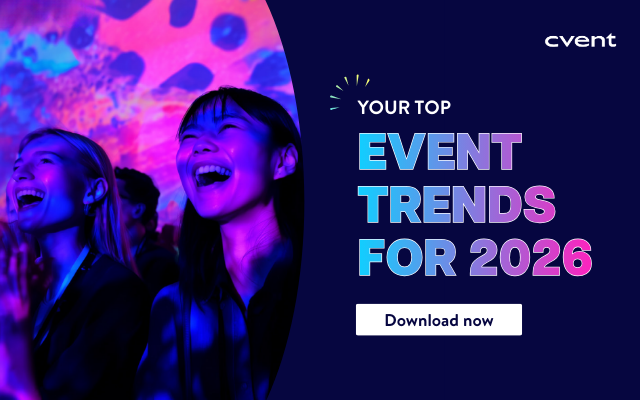
Events in 2026 will not be defined by flashy formats or the latest buzzwords but by intentionality instead.
Now that AI has become an expectation, audiences are more discerning about how they spend their time.
To help planners, marketers, and hospitality professionals navigate this shift, Cvent has released Your Top Event Trends for 2026, a new ebook that goes beyond surface-level predictions.
Drawing on industry research, planner insights, and real-world examples, the ebook breaks down the biggest forces reshaping events in nine trends and what you can do about them today.
Here are three trends from the ebook and why they matter for your 2026 strategy.
Trend 1: AI goes operational

AI has moved from pilot projects to the core of how modern event teams work. The conversation has shifted from “what’s possible?” to “what’s provable?”
Data from Cvent shows that 66 per cent of event professionals say AI allows them to spend more time on high-value work, underlining its shift from experiment to expectation.
Across the event lifecycle, AI is being used to:
- Accelerate sourcing and diagramming, surfacing right-fit venues and layouts faster, with less manual back-and-forth.
- Turn survey responses, engagement data, and session behaviour into insights that directly inform future event design, rather than static reports.
- Reduce repetitive admin so planners and venues can focus on higher-value work like stakeholder alignment, content strategy, and experience design.
But success is not just about where AI is deployed – it’s about how. Teams are investing in AI literacy, setting clear governance around data usage and tool selection, and tracking impact by looking at: hours saved, faster cycles, better attendee experiences, and stronger outcomes.
Trend 2: Trust becomes a brand differentiator
In an AI-saturated, low-trust digital world, credibility is a competitive advantage. People are encountering more algorithmically generated content, more noise, and more ambiguity about what is real – and they are responding by being more selective and more skeptical.
Events stand out precisely because they cut through that fog. They create spaces where:
- Conversations are unscripted and human, not canned soundbites.
- Products and solutions can be seen, tested, and questioned in real time.
- A brand’s values show up in how it treats attendees, not just what it says in a campaign.
Trust is built through hundreds of small signals: accurate floor plans and diagrams, reliable AV and Wi-Fi, clear accessibility information, transparent data practices, and proactive communication when plans change.
For venues and suppliers, this trend raises the bar. Technology needs to operate seamlessly in the background, removing friction so staff can focus on hospitality, not firefighting. Data must be collected with intent, explained clearly, and protected rigorously, because how you handle data is now part of how audiences judge your brand.
The brands that rise to the top in 2026 will be the ones that make trust a design principle, not a tagline.
Trend 3: B2B Still Demands Authentic Emotion
Even in B2B, buying decisions are emotional before they are rational. In 2026, emotion is what earns attention, mindshare, and action.
The events that stand out will not feel generic or transactional but intentional, human, and story-driven. Strong programs are built around a simple question: “How do we want people to feel when they leave?”
That emotional outcome then shapes everything else – format, content, pacing, space, and sensory cues.
We are seeing this play out in:
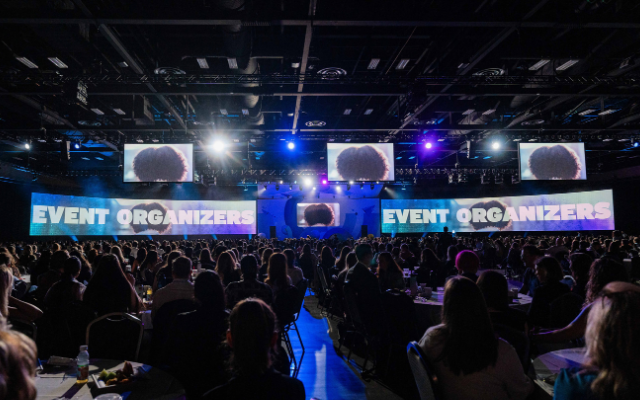
- Keynotes that borrow techniques from entertainment: using lighting, music, staging, and pacing to create anticipation and focus, not just spectacle.
- Space design that supports the desired emotional arc: buzzy, high-energy areas for connection; quiet zones for reflection; intuitive flows that reduce stress and cognitive load.
- Local and sustainable touches that give attendees a sense of place and purpose, reinforcing the story the event is trying to tell.
This kind of emotional resonance is a team sport. Event and marketing teams, venues, AV partners, and F&B all contribute to a cohesive narrative. When they are aligned on the feeling that they are trying to create, the experience becomes far more memorable – and far more likely to translate into long-term relationships and revenue.
See all nine event trends shaping 2026
These are just three of the nine trends reshaping how events are designed, sourced, and measured in 2026. If you are planning your next year of programmes, or rethinking how events support your broader go-to-market, you want the full picture: data points, practitioner quotes, and concrete ideas you can put into play now.
Download Your Top Event Trends for 2026 to explore all nine trends, see how leading teams are responding, and get practical guidance to build an event strategy that is more intentional, more human, and more accountable in the year ahead.