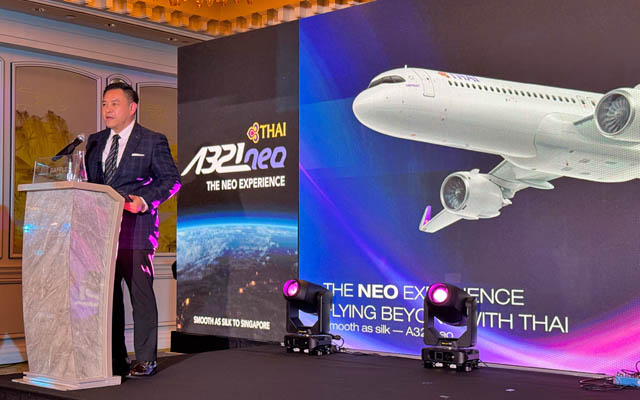
Thai Airways officially entered a new phase of short- and medium-haul travel on January 22, 2026, as its first Airbus A321neo, named “Bowonrangsi”, completed its inaugural commercial flight from Bangkok to Singapore.
The flight, TG413, marked more than a fleet upgrade, representing a milestone in the carrier’s recovery following the completion of its court-supervised business rehabilitation triggered by Covid-19.
Speaking at a launch event at Raffles Hotel Singapore on the evening of January 22, Kittiphong Sansomboon, chief commercial officer of Thai Airways, shared that the A321neo has a total of 175 seats, comprising 16 in Royal Silk and 159 in Economy.
In Royal Silk, travellers have access to fully flatbed seats with a 180-degree recline, paired with 17.3-inch 4K touchscreen entertainment systems. The Economy cabin accommodates 159 passengers in a 3-3 layout, with seats featuring a 10-degree recline, six-way adjustable headrests, and 13.3-inch personal displays.
Asked why Singapore was chosen as the A321neo’s first destination, Kittiphong replied that the outbound market remains important to the airline.
“In the 1960s when Thai Airways went international, Singapore was among the first few destinations that we operated flights to. There is so much history and heritage, hence I thought it fitting,” he said.
Kittiphong also told TTG Asia that this aircraft is the first of 32 A321neo ordered from Airbus, with deliveries scheduled over the next three years. In 2026, 16 aircraft are due to be delivered.
On network deployment, he stated: “The A321neo will be deployed to India and China. In China, aside from Beijing and Guangzhou, we plan for it to serve new secondary destinations (for Thai Airways) such as Chongqing, Changsha and Shenzhen. We will also deploy this aircraft in the CLMV (Cambodia, Laos, Myanmar, Vietnam) region.”
He also addressed sustainability as the airline expands across Asia-Pacific.
“Sustainability is not just a marketing slogan for us – it is our promise. The A321neo delivers a 20 per cent improvement in fuel consumption compared with the A320, and it is also capable of operating on up to 50 per cent SAF (sustainable aviation fuel),” he said.