Minor Hotels will take over management of NH Hua Hin from January 16, 2026, expanding the NH Hotels and Resorts presence in the seaside town of Hua Hin.
The hotel will operate under the NH Hua Hin name and will comprise 152 rooms and suites, starting from 30m², with views of the city or surrounding mountains. Accommodation will include deluxe rooms, studios, family rooms with bunk beds and one-bedroom suites, catering to leisure and business travellers.
NH Hua Hin will come under Minor Hotels’ management from January 2026, expanding the group’s presence in Hua Hin
NH Hua Hin will include three F&B outlets: an all-day dining restaurant serving international and local dishes, a lobby café offering light meals and drinks, and a rooftop bar beside an infinity pool. Leisure facilities will also include the rooftop swimming pool, a fitness centre and a Kids’ Club with indoor and outdoor areas.
For meetings and small events, the property will offer a function room measuring 110m², with capacity for up to 90 guests.
Hua Hin, located about 200 kilometres south of Bangkok, is a long-established coastal destination. NH Hua Hin sits at the southern end of the town, around 400 metres from Hua Hin Beach, and close to local night markets such as Cicada Night Market and Hua Hin Night Market. Shopping centres including Bluport Hua Hin and Market Village Hua Hin are also nearby. The destination provides access to wider attractions in Prachuap Khiri Khan province, including Khao Sam Roi Yot National Park and Pa-La-U Waterfall in Kaeng Krachang National Park.
The rebranding reflects Minor Hotels’ strategy to grow its select-service portfolio in key Asian markets. NH Hua Hin will become the fourth NH Hotels and Resorts property in Thailand, joining existing hotels in Bangkok and Phuket. It will also be the group’s third property in Hua Hin, alongside Anantara Hua Hin Resort and Avani+ Hua Hin.
Group CEO of Minor International Dillip Rajakarier said: “NH Hua Hin will set a new benchmark for accessible hospitality in Hua Hin, complementing our luxury and premium offerings in the region.”
Grand Copthorne Waterfront Hotel Singapore presents a focused Valentine’s programme centred on staycations and dining, running from February 12 to February 16, 2026.
Set along the Singapore River, the hotel positions its Valentine’s offering around time spent on site, combining accommodation with meals designed for couples who prefer a contained and unhurried celebration.
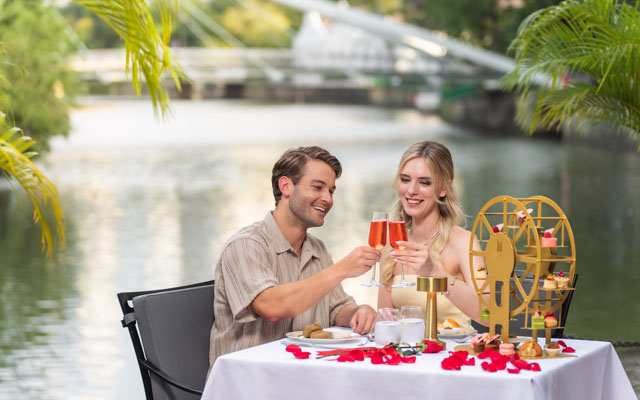
Valentine-themed afternoon tea is served at The Lobby Lounge, offering a daytime option for couples within the hotel’s riverside setting
Two Valentine’s staycation packages are available across the five-day period. Both include an upgrade to a Premier Room, subject to availability, Prosecco Rosé on arrival, Valentine-themed in-room amenities, a rose-petal turndown service and late check-out. Guests also receive one-for-one gin cocktails from The Lobby Lounge gin cart and one-for-one Epicure Brunch on February 15, 2026.
The Valentine’s staycation with romantic dinner includes an overnight stay and a four-course Valentine’s set dinner for two. Dinner may be served either in-room or at the Executive Club Lounge on level 29, which overlooks the city skyline. Packages are priced from S$362 (US$269).
An alternative option pairs the overnight stay with a Valentine-themed afternoon tea for two at The Lobby Lounge. The afternoon tea features Pryce Tea pairings and the hotel’s unlimited scone trolley, served in a riverside setting. Packages are priced from S$295.
For couples not staying overnight, a four-course Valentine’s dinner is also available as a standalone experience from February 12 to February 16, 2026. The menu includes Hokkaido scallops with crabmeat gateau, a choice of lobster bisque or mushroom cappuccino soup, main courses such as braised US beef short ribs or slow-roasted Atlantic salmon, followed by a raspberry and lychee dessert. Dinner is priced at S$168 per couple at The Lobby Lounge, including two glasses of house wine, or S$228 per couple at the Executive Club Lounge, including one bottle of Prosecco.
In The Magician’s Nephew, the first novel in C S Lewis’s Chronicles of Narnia, the author imagined a world between worlds – a tranquil forest dotted with mirror-clear pools, each a portal to another realm. The best of Asia-Pacific’s airports now conjure something similar, transforming the turbulence of transit hubs into restorative environments of calm and sensory renewal.
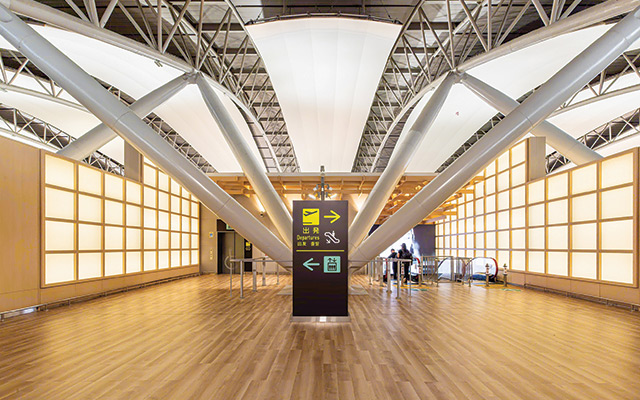
Timber design and natural light redefine Kansai International Airport ahead of World Expo 2025
Destinations, not detours Designed with nature’s materials and interwoven with cultural themes, these new terminals are portals in their own right: artful, biophilic sanctuaries that allow travellers to move through calm instead of chaos, while quietly steeping them in the sense of place.
“Airports are now the leaders out of all sectors in design and development. They want to make memorable environments – to introduce garden concepts in cities,” observed Patrick Keane, founder of Enter Projects Asia (EPA).
At Bengaluru’s Kempegowda International Airport Terminal 2, Keane’s studio has reimagined the post-security landscape as a living organism. Opened in 2024, the 12,000m2 departure hall, crafted from nine kilometres of hand-woven rattan, feels more arboreal than architectural. Sculptural pods are surrounded by hanging gardens, vines, and 700-year-old olive trees.
“If you think of rattan structures, bamboo framing, handmade elements and wood – you think wellness retreat, somewhere remote. But now you’re seeing that in an airport that welcomes 20 million visitors a year. If you touch a pod, it feels like a tree, not a wall. Wellness has become mainstream,” Keane reflected.
Across the East China Sea, global design firm Populous has brought similar material sensitivity to Japan’s Kansai International Airport, renewed ahead of World Expo 2025 Osaka Kansai.
“The T1 renovation project was envisioned as the symbolic gateway to the World Expo – the ‘first pavilion’ that sets the tone for visitors’ experience of Japan,” explained Ben Dawson, Populous’ principal and head of aviation, APAC. “The renovation prioritised openness, clarity, and cultural immersion.”
A once-enclosed immigration hall now bathes in natural light. Timber finishes and exposed trusses recall Japanese craftsmanship, while intuitive sightlines – literally framing the passenger journey – create ease and orientation.
Techo International Airport (KTI) in Cambodia’s Kandal province introduces a new vernacular to Cambodia’s aviation. Developed by Cambodia Airport Investment Co. (CAIC) and spanning 2,600 hectares, its sweeping scalloped wooden roofline and vaulted timber lattices reinterpret Khmer architecture in a distinctly contemporary key. The interior will feature a traditional wooden Cambodian house for passengers to visit – a cultural touchpoint amid the choreography of departure.
In Vietnam, the vast Long Thanh International Airport is taking shape. Designed for a final capacity of 100 million passengers annually, its first phase will debut in 2026 with what is expected to be the world’s largest bamboo structure – a glulam (glued laminated timber) canopy of interlacing bamboo arches. More than sustainable, the design draws on the material’s deep cultural resonance in Vietnam.
Across these projects, new airport terminals in Asia-Pacific are no longer conduits of motion but living works of architecture – immersive ecosystems of plant-based materials that refresh, restore, and reawaken the senses before flight.
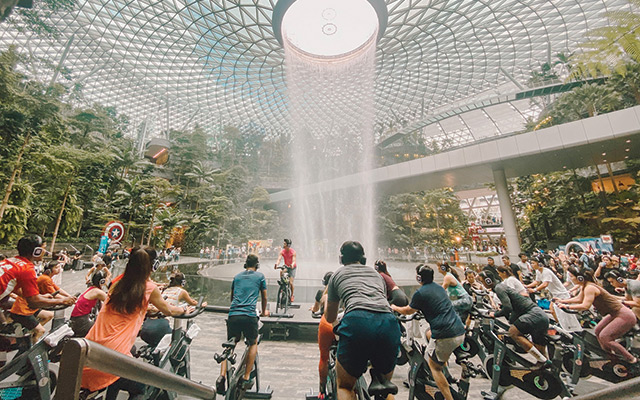
Passengers can take Rhythm cycling classes amid greenery at Changi Airport’s Forest Valley
Portals of calm If Bengaluru and Kansai express biophilia through material empathy, Singapore’s Changi Airport has turned sensory design into science. With 600,000 plants, a signature Orchid Tea scent, and the aptly named Quiet Terminal Initiative, Changi orchestrates fragrance, light, and sound into what it calls “wellness through seamlessness”.
Carpeted floors hush the terminal’s tempo, while immersive installations such as Dreamscape and Wonderfall sync movement with nature’s rhythms, transforming waiting into wonder.
Wellness extends beyond design: the Minmed Wellness Collective at Jewel’s Canopy Park offers yoga, barre, and Pilates, while rhythm cycling classes in the Forest Valley overlook the Rain Vortex. Travellers can even rent a bike and cycle outdoors from Terminal 2 to Jurassic Mile, where life-sized dinosaurs line a 3.5-kilometre park connector – proof that wellness can be playful as well as peaceful.
Behind the scenes, Amadeus technology powers Changi’s biometric bag drops, translating operational efficiency into a subtler kind of well-being: freedom from friction.
In Australia, Woods Bagot’s design for Western Sydney International (Nancy-Bird Walton Airport), opening 2026, takes this idea of emotional ergonomics to heart.
“Our approach has been to create a space for everyone – a place that is easy to navigate and in which people feel calm,” said Jodi Archer, Sydney aviation lead at Woods Bagot.
Filtered sunlight softens through slatted ceilings, changing hue through the day. Wide circulation paths, clear sightlines, and sensory rooms desensitise tension points. Seating areas adapt to individual rhythms – from contemplative corners to communal zones.
“Wellness services are scattered throughout. People find what they need, when they need it,” Archer added.
Here, architecture choreographs emotion as much as movement, immersing passengers in tranquil, light-filled environments that ease transitions between destinations.
Harmony with the planet Wellness now extends beyond the traveller – it encompasses the planet itself. At Western Sydney, the terminal’s roof generates solar energy, harvests rainwater, and filters daylight through energy-efficient skylights designed to limit heat gain. “Sustainable and recycled materials will be used throughout the terminal, including the structure, finishes and furniture,” noted Archer.
At Kansai, Populous’ approach to adaptive reuse – increasing capacity without expanding the footprint – is a quieter but equally powerful act of sustainability.
“That decision alone has massive benefits in terms of energy, materials, and cost,” Dawson explains.
For its work in Bengaluru, EPA merged digital precision with handcraft, collaborating with Thai artisans to handweave each section at its Bangkok studio before assembling them using bespoke logistics software that streamlines production and shipping.
This fusion of digital precision, handmade craft, and natural materials defines the firm’s approach to sustainable innovation – an act of ecological as well as cultural regeneration.
And at Changi, sustainability quite literally takes root. The airport’s dense horticultural network serves as both air filter and acoustic buffer, moderating temperature and humidity while softening the sensory impact of travel itself.
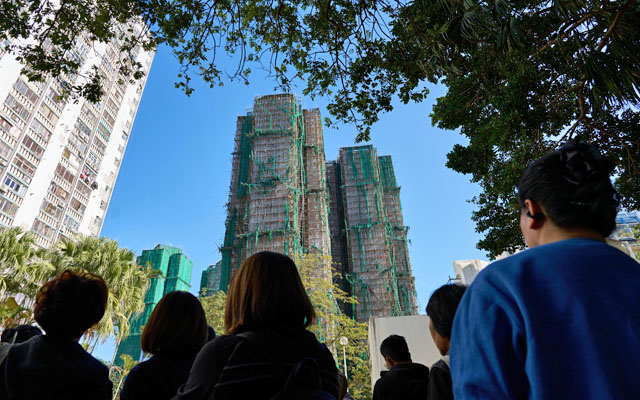
Hong Kong’s tourism sector took a cautious approach to recovery immediately after a deadly blaze broke out on November 26, 2025 with several events and festive celebrations cancelled out of respect. These included the 2025 Sun Hung Kai Hong Kong Cyclothon scheduled for November 30 and Oxfam Trailwalker 2025, which was due to take place from November 28 to 30 last year.
Some tourism-related activities resumed in early December following a brief suspension. Christmas Town at Statue Square and the laser light show A Symphony of Lights returned on December 10, while Hong Kong Disneyland restarted its nightly musical light-and-drone show on December 8 after an 11-day pause.
Hong Kong scaled back tourism and public events after the November 26 fire, before a phased return of activities; photo by A Content Company
The Hong Kong Tourism Board’s New Year Countdown was also adjusted in format, with a focus on conveying positivity and blessings. Fireworks were cancelled, and celebrations were relocated to the Chater Road Pedestrian Precinct in Central, featuring a live music performance by Air Supply followed by a light show themed New Hopes, New Beginnings to mark the start of the new year.
Elsewhere, multiple countdown activities were held across the city, including the New Year’s Eve Countdown Party Moment at Hong Kong Disneyland and a special countdown concert held for the first time at the West Kowloon Cultural District, as locals and visitors welcomed 2026.
An anonymous travel trade stakeholder said the impact on visitors had been limited, apart from the cancellation of fireworks, which was widely understood. He shared: “Hotel operators anticipated some cancellations for the New Year’s Eve due to fireworks cancellation and relocation of countdown, particularly rooms offering harbour views. We expected more visitors than last year, but the government will play down the forecast.”
Prince Travel director of sales Wing Wong said he hoped the city would gradually return to normal after weeks of tributes and public support.
He commented: “As 2026 begins, Hong Kong enters a new chapter with the newly-elected lawmakers of the eighth Legislative Council taking office. We have to move forward step by step. I am optimistic for this year because our economy becomes (more) stable and more events and sports-related activities are lined up, (such as the) 2026 Lions International Convention which returns to Hong Kong this July.”
Travel Industry Council executive director Fanny Yeung said the families affected by the fire would likely want the community to move forward.
“Travel trade is keen to see the upcoming Chinese New Year Fireworks Display continue, (alongside) a series of experiences and celebrations, such as the Chinese New Year night parade,” she added.
Destination China general manager and owner Gunther Homerlein noted he had received messages from clients, though none questioned whether events would proceed.
“Those most affected were really the travellers arriving immediately after the fires with several events delayed or postponed. Due to the time of the year, not so much of that was MICE,” he pointed out.
He observed that, amid broader global news, the fires were likely to be recognised during Chinese New Year but were not expected to have a major impact on planned activities and celebrations. He added that while the incident would have a significant effect on the families involved and their immediate circles, it was unlikely to disrupt festivities more widely.
The Tourise Destination Initiative (TDI), a global effort by governments, international organisations, academia and the private sector to transform tourism destinations into living laboratories for innovation, has launched its first project, AI for Tourism Safety.
The scheme aims to provide practical guidance for TDI member destinations to leverage AI for the greater protection of their visitors and residents. It builds on insights from Surveillance or Safety? How Cities are Rewriting Tourism, a white paper by the University of Pennsylvania’s Penn Institute for Urban Research.
Ahmed speaking on the role of AI in strengthening safety and governance in urban tourism destinations; photo by Tourise
Authored by Mauricio Rodas, visiting scholar at the institute and former mayor of Quito, Ecuador, the research explores the ethical and operational challenges of AI in urban tourism. Only two per cent of cities worldwide are deploying AI for safety, “mainly due to a lack of policy and regulatory frameworks”, said Rodas, adding that the project can “close that gap by offering practical guidance for cities to protect everyone who calls a destination home, whether permanently or temporarily”.
“Urban destinations are the heartbeat of the global tourism industry, and it is imperative that no city, anywhere in the world, ever feels unsafe for its visitors or residents,” said Ahmed Al-Khateeb, Saudi Arabia’s minister of tourism and chairman of Tourise.
“We are calling on cities to lead with integrity. Safety innovations must be anchored in responsible governance. By applying technology with foresight, we protect travellers and reinforce the trust that defines the future of tourism.”
Founding members of TDI include representatives of UN Tourism, Singapore Tourism Board, the Tourism Ministries of the Maldives, Ecuador and South Africa, and the cities of Venice (Italy), Paris (France), Miami (the US) and Chefchaouen (Morocco).
Malaysia Airlines has introduced a new fare campaign aimed at encouraging travellers to plan journeys for the year ahead, covering leisure, family and business travel across its domestic, regional and longhaul network.
The campaign, titled Time for New Chapters, is open for bookings from January 7 to 20, 2026, for travel until November 30, 2026. Return fares start from 159 ringgit (US$35), all in.
Malaysia Airlines outlines its 2026 travel plans with early booking fares, expanded route options and refreshed in-flight services
Members of the airline’s Enrich loyalty programme receive early access to selected fares from January 6, 2026, as well as an additional five per cent discount. Non-members can sign up during the campaign period to access the same fares.
The promotion covers destinations across Malaysia Airlines’ international and regional network. Longhaul routes include London, Seoul and Shanghai, while regional destinations include Cebu, Siem Reap and Krabi. Some regional services are operated via sister airline Firefly from Kuala Lumpur International Airport Terminal One.
Travellers can also make use of the airline’s Bonus Side Trip programme, which allows a complimentary stopover in Malaysia when travelling through Kuala Lumpur. The programme includes destinations such as Penang and Langkawi and is positioned as part of preparations for Visit Malaysia 2026.
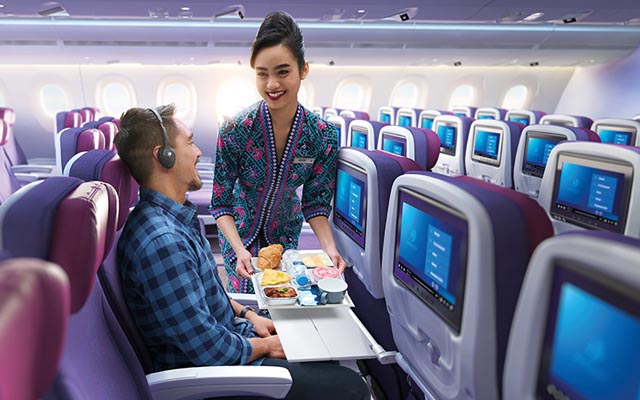
Malaysia Airlines continues to introduce its Airbus A330neo aircraft on selected routes, including Tokyo, Bali, Melbourne, Sydney and Auckland. The aircraft feature updated cabin interiors, new seating and larger in-flight entertainment screens. Complimentary Wi-Fi is available across all cabin classes on selected aircraft through the MHconnect service, alongside the airline’s MHstudio in-flight entertainment platform.
From January 1, 2026, Malaysia Airlines will refresh its in-flight dining with updates to its Best of Malaysia and Best of Asia menus. The Best of Malaysia offering will feature rotating state-based dishes, starting with Selangor-inspired meals on selected domestic routes, while the year-round Best of Asia menu will continue with themed selections from South Korea from January to February and Thailand from March to April, available across selected regional services in all cabin classes.
An exhibition exploring the vision, design and planning behind Singapore’s upcoming Changi Airport Terminal 5 (T5) has opened to the public, offering visitors an overview of how the airport is preparing for future growth.
Titled T5 In the Making, the immersive exhibition runs from January 6 to March 2026 at Terminal 3’s Arrival Hall and is free to enter. Jointly organised by the Ministry of Transport, the Civil Aviation Authority of Singapore and Changi Airport Group, the exhibition has attracted strong early interest, with 15,000 visitors registering for tickets since public registration opened on December 15, 2025.
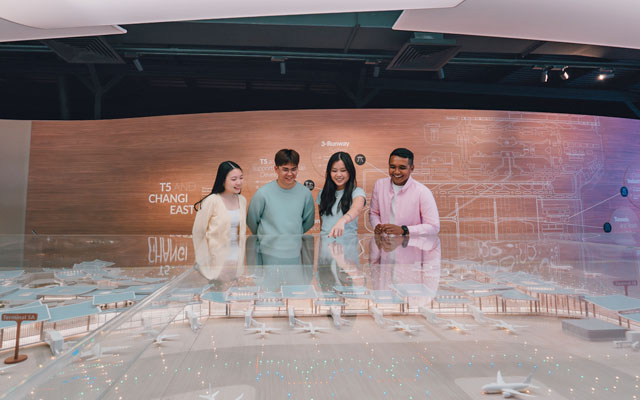
A scale model of Changi Airport’s T5 is on display at the exhibition; photo by Changi Airport Group
T5 is a central element of Changi Airport’s expansion plans and is expected to significantly increase passenger handling capacity, with the exhibition tracing the role of aviation in Singapore’s development and outlining how the project is intended to support the country’s long-term connectivity and economic needs through its scale, design, operations and sustainability goals.
Visitors move through five themed zones charting Changi Airport’s evolution, including its shift from Paya Lebar to Changi, and an overview of T5’s layout and capacity. Other sections focus on technologies being studied to address manpower constraints, an ageing population and climate change, as well as the broader Changi East development.
Interactive features include AI-based installations that invite visitors to imagine future travel experiences, alongside detailed scale models of T5 and surrounding infrastructure.
The exhibition was officially launched by Jeffrey Siow, acting minister for transport and senior minister of state for finance. The opening event was also attended by Sun Xueling, senior minister of state at the Ministry of Transport and the Ministry of National Development, together with representatives from across the airport community.
Moxy Bangkok Ratchaprasong reaches its second year with a set of offers and additions aimed at travellers and Bangkok residents looking for a central, flexible city stay.
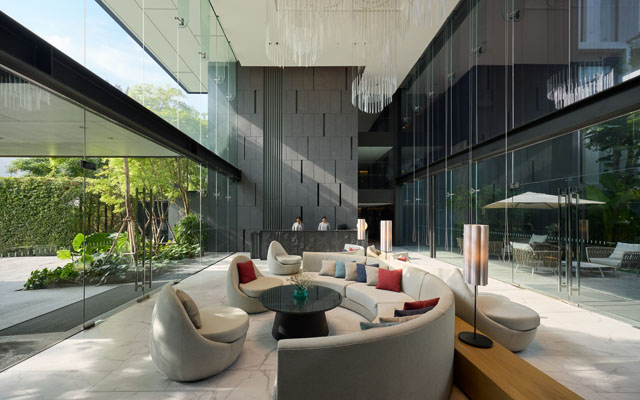
Located in the Ratchaprasong district, the hotel combines accommodation, dining and social spaces within walking distance of shopping centres, offices and public transport, positioning itself as a base for both short visits and staycations.
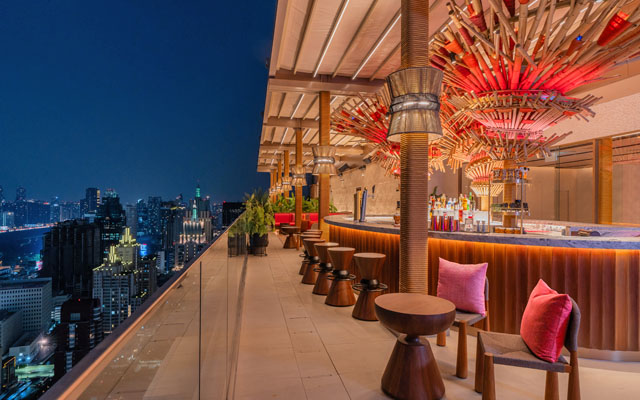
Sato San Rooftop Bar frames sunset views across Ratchaprasong, adding a new evening setting to Moxy Bangkok Ratchaprasong
The Moxy Bangkok Turns 2 stay offer, available for bookings and stays until March 31, 2026. The promotion applies across all room categories with no blackout dates. Guests receive 2,000 Marriott Bonvoy bonus points per room per night, a 20 per cent discount on food and beverage at Moxy Bar and Restaurant on the ninth floor and Sato San Rooftop Bar on the 32nd floor, along with two-hour early check-in and two-hour late check-out. Marriott Bonvoy membership is required for the bonus points, and early and late check-in are subject to room-type eligibility.
Alongside the anniversary offer, the hotel introduces Sundown at Sato San Rooftop Bar. Held daily from 18.00 to 20.00, Sundown focuses on the city’s sunset period, offering Thai-Japanese-inspired food and drinks priced from 150 baht (US$4.30), with views across the Ratchaprasong skyline. The initiative is aimed at after-work gatherings and informal pre-dinner visits, adding a defined time-based experience to the rooftop.
Sato San Rooftop Bar operates daily from 17.00 until late and accommodates up to 201 guests. The venue combines city views with a menu influenced by Thai and Japanese cuisines, supported by a cocktail list and background music that shifts from early evening into night. The rooftop is open to hotel guests and the public, with entry restricted to those aged 20 and above in line with Thai regulations.
Vivian Kong Man-wai has been elected to represent the tourism functional constituency in Hong Kong’s Legislative Council following the 2025 Legislative Council General Election held on December 7, 2025.
Kong succeeds Perry Yiu, who held the tourism seat for the past four years. She secured 131 votes, defeating her sole opponent Ma Yat Chiu, who received 23 votes. Kong was the youngest lawmaker elected in the election.
Since August 2024, Kong has worked as assistant external affairs manager at the Hong Kong Jockey Club, where her responsibilities include promoting horse-racing tourism. On December 29, 2025, the government appointed her as a member of the Tourism Strategy Committee for a term running from January 1, 2026 to December 31, 2027.
StarCruises will launch a fitness-themed cruise in partnership with Under Armour on board Star Voyager from January 19 to 23, 2026.
The four-night roundtrip sailing from Port Klang to Phuket and Singapore introduces a structured fitness programme integrated into a standard cruise itinerary. The sailing forms part of Star Voyager’s limited deployment from Port Klang, which runs from December 19, 2025 to February 2, 2026.
Star Voyager will host the Fitness @ Sea programme in partnership with Under Armour on a four-night sailing from Port Klang in January 2026
The Fitness @ Sea programme will feature daily workout sessions led by an Under Armour-certified trainer. Activities include Animal Flow, Pilates-based sessions, functional training and group fitness challenges. All sessions are complimentary and open to guests, with registration available on board on a first-come, first-served basis. Guests who complete the full series of activities will receive Under Armour merchandise, subject to availability.
Fitness @ Sea is scheduled on one specific sailing but sits within a wider Port Klang programme offering weekly departures. These include three-night cruises to Medan and Singapore departing on Fridays, and four-night cruises to Phuket and Singapore departing on Mondays.




 Since August 2024, Kong has worked as assistant external affairs manager at the Hong Kong Jockey Club, where her responsibilities include promoting horse-racing tourism. On December 29, 2025, the government appointed her as a member of the Tourism Strategy Committee for a term running from January 1, 2026 to December 31, 2027.