TTG Asia
Asia/Singapore Tuesday, 10th March 2026
Page 2065

East Asia guns for 30 million arrivals by 2020

0

SOUTH Korea, Japan and China, so disagreeable in the realm of history and geopolitics, have come together to promote the cause of regional tourism.

Japan’s tourism minister Akihiro Ota met with South Korean counterpart Kim Jong Deok and Li Jinzao of the China National Tourism Administration, marking the first time in four years the tourism ministers held trilateral talks, according to Jiji Press.

The meeting yielded an agreement to cooperate towards 30 million arrivals by 2020, when Japan hosts the 2020 summer Olympic Games.

Media in Japan also reported that the three countries would collaborate on a Visit East Asiacampaign to draw more tourists during Games.

Japan alone has already set a target for 20 million arrivals by 2020.

Quality Hotel CKS Sydney Airport opens after US$2.3m facelift

0

FOLLOWING an A$3 million (US$2.3 million) refurbishment, Quality Hotel CKS Sydney Airport has reopened.

Under the Choice Hotels Australasia umbrella and managed by the Lancemore Group, the hotel has upgraded its reception and common areas, restaurant and all 121 guestrooms.

One of Sydney’s nine on- and off-site airport hotels and positioned as an affordable, boutique offering, Quality Hotel CKS Sydney Airport features premium King Koil beds, a gastro pub and bar, and a conference room that converts to a cinema by night.

King, twin, triple and family rooms are available, as well as overnight parking and return airport transfers for all flights.

“Quality Hotel CKS Sydney Airport will be working closely with the local industry as part of the Choice Privileges programme,” a Choice Hotels spokesperson said. “Trade partners have been invited to view the property during development and will attend the launch this month.”

AirAsia bigwigs launch start-up programme for SEA entrepreneurs

0

A NEW incubator and accelerator programme aimed at nurturing start-ups in the travel, payments and retail verticals in South-east Asia was launched last Friday, backed by the big names behind AirAsia Group.

Called Tune Labs, the programme will dispense RM5 million (US$1.4 million) to support regional entrepreneurs and was founded by Tony Fernandes, Kamarudin Meranun and Lim Kian Onn.

Tony Fernandes said in a release: “It has always been a personal goal of mine to promote and grow the start-up scene in South-east Asia. There is a lot of talent in the region which, to date, has lacked the access and opportunities that are readily available to budding entrepreneurs in the West.

“Through Tune Labs, my partners and I seek to provide the guidance and mentorship that we found hard to come by in the early days of building AirAsia and envisage a structured environment to encourage, validate and ultimately implement exciting, new ideas that will hopefully revolutionise and change the way we go about our everyday lives.”

Tune Labs consists of two distinct paths for applicants to develop and cultivate their ideas.

The first component, the incubator, will be conducted three times a year. Each session is a 12-week bootcamp for applicants with early-stage ideas with the aim of transforming those ideas into commercially viable propositions.

The accelerator programme provides entrepreneurs with access to capital and partnership so they can launch validated ideas and business plans – which may also include graduates from the incubator programme – in the market.

Both programmes give participants access to partnerships developed over the years by the founders, the established infrastructure and support system of Tune Group and the ability to leverage in-house technical and software development capabilities.

Lim Kian Onn said: “Tune Labs allows aspiring entrepreneurs to concentrate solely on developing and growing their ideas. The ability to utilise the wider Group’s assets coupled with essentials like office space, finance and legal – will significantly reduce costs and improve management focus.”

Further information on Tune Labs and information on application are available atwww.thetunelabs.com.

HKTB intensifies marketing for Indian family and youth segments

0

A BIGGER budget, more roadshows and a new campaign slogan are being rolled out for the Indian market in the year ahead as Hong Kong Tourism Board (HKTB) seeks to capitalise on its gains from last year.

Anthony Lau, executive director, HKTB, shared that the India market expanded at one of the fastest rates last year, growing 18.7 per cent year-on-year.

“While growth was robust, it was not an easy year as we faced fierce regional competition. But we aim to capitalise on this by increasing our core marketing and promotional budget by 50 per cent compared to last year,” he said.

Hong Kong budgeted HK$9.1 million (US$1.2 million) for marketing in FY2014-2015, working out to HK$13.7 million for FY2015-2015.

The NTO has introduced it My Time for Hong Kong slogan to India, and will launch an extensive media campaign with an emphasis on TV commercials and digital channels including social media.

To highlight Hong Kong’s MICE potential, HKTB is planning roadshows in Mumbai, Kolkata, Delhi and Chennai this August. It will also welcome about 30 travel consultants from India to Hong Kong for a tradeshow in December.

The NTO is also in talks with Indian producers to film two Hindi soap operas in Hong Kong.

Peter Hoslin, regional director Europe and new markets, HKTB, said: “We received 60.1 million international travellers overall, which is 12 per cent growth. Mumbai and Delhi still remain key source cities, but we are also focusing on other cities from which we have direct connectivity like Bengaluru, Chennai, Hyderabad and Kolkata.”

RWS eyes higher visitor inflow with new Genting Hotel Jurong

0

RESORTS World Sentosa (RWS) will launch Genting Hotel Jurong end this month as it seeks to increase visitorship to its gaming and entertainment attractions.

The first major hotel in Singapore’s growing Jurong Lake District will soft open on April 30 and hold its grand opening almost a month later, on May 27.

Well-connected by expressways and public transport, the 557-room hotel is a 15-minute drive from Tuas Checkpoint, which connects Singapore to Johor Bahru in Malaysia, and a 40-minute drive from Singapore Changi Airport.

A free shuttle bus service will also operate 24/7 to ferry guests between Genting Hotel Jurong and RWS.

“Genting Hotel Jurong will boost RWS’ room inventory significantly and forms part of our business strategy to drive greater visitorship to RWS. It allows us to be part of the exciting transformation that is taking place at the Jurong Lake District,” said Chow Keng Hai, vice president of rooms, RWS, in a statement.

The three room types offered are the 18m2 superior room, 27m2 deluxe room and 54m2suite. Each room is equipped with free Wi-Fi and a flat-screen TV.

The hotel also provides a range of MICE facilities. The pillarless 427m2 Genting Ballroom features a high ceiling with ample natural light and seats up to 300 guests.

Five meeting rooms at the hotel offer natural daylight and flexible layouts, while the rooftop sky lounge with an adjoining lawn is suitable for more intimate events.

As part of the hotel’s green efforts, a rainwater collection system has been implemented to reduce water consumption for irrigation purposes.

Centara embarks on China expansion

0

THAI hospitality group Centara Hotels & Resorts has gained a foothold in China with a newly clinched deal to manage a hotel in Guangdong.

The contract with Zhaoqing Yuhao Properties Development will see Centara open Centara Resort Zhaoqing in 4Q2017.

Located in Zhaoqing city in Guangdong, the resort allows quick access to the South China business and leisure centres such as Guangzhou, Shenzhen, Hong Kong and Macau.

The four-star resort will have 250 resorts and a range of family-friendly facilities including a water park, swimming pools, a pool bar, an all-day restaurant plus two other dining venues, a fitness centre, spa, and kids’ club.

An 800m2 ballroom is available for meetings and events.

Chris Bailey, senior vice president of sales and marketing, said in a release: “I believe this resort is an ideal start for our expansion in China, and it provides a valuable synergy with our other Centara properties around the world.”

Chinese cruise traffic to Japan set to soar after visa waiver

0

JAPAN’S lifting of visa regulations for Chinese tourists on board selected cruise ships that homeport in China has encouraged greater travel to the country.

About 10 ships, including a number owned by Royal Caribbean International and Costa Cruises, have been approved by both Japanese and Chinese governments.

Yang Lei, CEO of Ctrip’s cruise department said online cruise bookings on Ctrip.com to Japan and/or South Korea have increased over 30 per cent in the immediate aftermath of the March 18 announcement.

A number of cruise operators originally offering mono South Korea itineraries now also include calls in Japan.

“Visiting two countries is definitely more attractive to our customers,” said Zhang Ji, cruise product director of Tuniu.com, a Chinese OTA.

With Japan’s visa waivers, South Korea’s Busan and Incheon ports may need to lower their port charges to compete with Japanese ports in the future, he added.

One Japanese port that has benefited from the visa waiver is Nagasaki’s new Sasebo port, which will welcome 15 visits during the 2015 season.

By Li Xu.

Worldhotel & Residences Makati quits Worldhotels

0

WORLDHOTEL & Residences Makati has severed ties with independent hotel collection Worldhotels, and will be dropping the brand name and support services that came with it.

The 252-key hotel and 149-unit residences project is owned by China Oceanis Group of Companies, led by its Singaporean president and CEO, Lim Chee Yong, through H2O Ventures.

A source within the company told TTG Asia e-Daily that the property – scheduled for a late 2015 or early 2016 opening – will no longer wear the brand name or receive sales, marketing and reservations support from Worldhotels.

Hotel H2O in Manila, likewise owned by H2O Ventures, also quit Worldhotels as of March.

TTG Asia e-Daily understands that internal changes within H2O Ventures were a main factor in the breakup, and a separate source has it that the owning company is mulling joining up with E-HORS reservations system and replacing the Worldhotel name with Seven Seas for the Makati project.

Neither Worldhotels nor Lim could be reached for comment.

China Oceanis plans to construct a Seven Seas Hotel in Palawan and Seven Seas Hotel & Residences in Boracay, having already set up C2G Hospitality and Consultancy in the Philippines in preparation for the above, said the source.

Worldhotels has two member hotels in the Philippines, the boutique Le Monet in Baguio City and the recently opened Hotel Luna, a museum hotel in UNESCO World Heritage Site Vigan in Ilocos.

Betting on a growing middle class

0

Integrated resorts in Asia seek out the region’s middle classes to offset the effect of China’s anti-graft policy that has hit their gaming tables  

10apr_ir_3
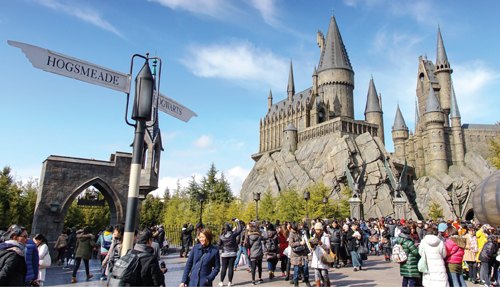
Universal Studios Japan’s new Wizarding World of Harry Potter is an attraction for Asian families

With most IRs in Asia-Pacific geared towards foreign tourists, especially China’s booming middle class, it is not surprising that the anti-graft crackdown by the Chinese government has had a cooling effect on casinos across the region, with Macau the most affected.

Casino revenue in the former Portuguese colony declined for 10 consecutive months to MOP21.5 billion (US$2.7 billion) in March, down from MOP35.4 billion a year earlier, according to data released by Macau’s Gaming Inspection and Coordination Bureau.

“There is still a huge market outside of China that we have yet to tap into,” said Irene Wong, executive director of sales & guest services and hotel operations, MGM Macau. She added that the company has embarked on a strategy to broaden its customer base by offering diversified non-gaming experiences to “accommodate the transformation that Macau is going through”.

Industry players also urge Macau’s IRs to adopt a different game plan to stay competitive. EGL Tours Macau’s general manager, Sabina Iong, said: “As Chinese traffic has dropped recently, (Macau) hotels have now switched to wooing markets like Taiwan and South Korea with attractive hotel rates. IRs should boost (marketing) efforts in South-east Asia as (Macau’s) rate are reasonable and no longer jacked up by the Chinese.”

The Chinese visitor slump has also hit the Philippines, although the business models of Philippine IRs have made them less reliant on the China market than their peers.

“We have to admit we’re all looking forward to getting a good slice of the outbound market from China…we haven’t seen as many Chinese casino players as we would like,” said Francis Hernando, vice president for gaming licensing and development at Philippine Amusement and Gaming Corporation. “But we are not looking at players only; about 90 per cent of (IR) space is not devoted to gaming.”

Mint Leong, managing director at Sunflower Holidays, a Malaysian inbound firm specialising in the China market, said that only a small percentage of her Chinese clients visit Resort World Genting, the only IR in Malaysia with casinos, attracted by curiosity rather than the desire to gamble.

She said: “Most first-time visitors want to see what Genting is about. For repeat visitors to Malaysia, Genting is no longer a must-visit destination, thus the Chinese government’s anti-gambling declaration will have no impact on demand for the resort.”

Meanwhile, India outbound players are witnessing a good demand for IRs in destinations like Macau, Singapore, Malaysia, Thailand and the Maldives.

“Indians looking to indulge in casinos used to head to Goa and Nepal. IRs in Macau like The Venetian Macao opened up the concept of multi-dimensional resorts in India. However, IRs in other destinations like Marina Bay Sands in Singapore are also finding many takers in the Indian market. Segments including leisure, MICE and honeymooners are fuelling the demand for IRs,” said Ashutosh Rawal, general manager, Fun Holidays.

“A lot of these IRs are now investing in the Indian market through activities like roadshows, which have enhanced the trade’s knowledge of these products and the promotion of IRs among their clients,” said Rajji Rai, chairman, Uniglobe Swiftravel.

Several consultants share that the myriad options offered under one roof has been a critical reason why Indian tourists are attracted to IRs.

“Resorts World Sentosa in Singapore, Genting Highlands in Malaysia and Laguna Phuket in Thailand have emerged  as major attractions for Indian travellers. Bintan Resorts in Indonesia is also growing in demand – we are seeing a year-on-year growth of six-10 per cent, said Rajesh Bhalla, manager sales-India, GTMC.

While IRs’ multiple activities are a pull factor for the Indian market, theme parks are a stronger draw for Indonesian outbound travellers, especially among families with children during school holidays and the Lebaran period.

Agustinus Pake Seko, director of Bayu Buana Travel Services, said: “Parents nowadays listen to their children when it comes to picking a destination for their holidays, therefore theme parks play an important role in this.”

Ivone Valentine, tour counter supervisor of Dwidaya Tour, said: “We take into consideration theme parks when creating holiday season packages for families.”

Having established names like Resorts World, Disneyland and Universal Studios in a destination or the addition of well-known characters into theme parks also play a significant role in promoting an IR.

Agustinus said: “The opening of the Wizarding World of Harry Potter in Universal Studio Japan, for example, has managed to attract both new and repeat family travellers to the country.”

This article was first published in TTG Asia, April 10, 2015 issue, on page 15. To read more, please view our digital edition or click here to subscribe

Additional reporting by Mimi Hudoyo, S Puvaneswary and Marianne Carandang

Raising the stakes for prosperity

0

It’s full-fledged war in Asia’s integrated resort scene as new players get into the game and existing properties up the ante with fresh attractions
10apr_ir_1
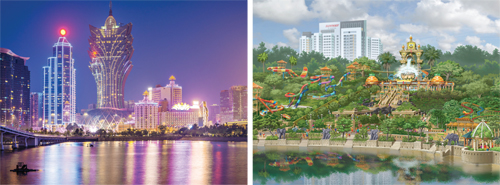
From left: Home to ritzy casinos and big hotels, Macau is often dubbed the ‘Las Vegas of the East’; Nickelodeon Lost Lagoon at Sunway Lagoon

Despite the growing number of rivals in the region, Macau, the world’s biggest gaming destination, is now gearing up for another wave of integrated resort (IR) openings this year, with most of the new additions emphasising non-gaming elements developed by existing players.

This May, Galaxy Entertainment Group will launch the expansion of flagship property Galaxy Macau and the new Broadway at Galaxy Macau, while Melco Crown Entertainment is set to open Studio City, its second IR in Macau after City of Dreams, in 3Q2015 (see page 24).

A Melco Crown Entertainment spokesman commented: “The Hollywood-inspired Studio City is designed to capture the increasingly important mass market segment. The innovative offerings will achieve diversification and cater to a broad range of customers in Macau.”

Welcoming the additions to Macau’s IR landscape, Gray Line Tours, managing director, Andy Wu, said: “With more new players, we don’t lose customers to other destinations that have IRs. These new developments definitely help boost Macau’s appeal because they bring new elements that enrich the city’s offerings. This may generate new source markets as well as win back the Hong Kong market as they always look for new stuff.”

The Philippines has also mounted a serious challenge with a clutch of new IRs along Manila Bay.

Solaire Resort & Casino completed its Phase 1A expansion last November to unveil a new Sky Tower with a 312-suite hotel, 10 gaming salons, a 1,760-seat theatre and a 2,000m2 meeting facility.

In February, Melco Crown Entertainment launched the US$1.3 billion City of Dreams Manila with 930 rooms, 380 gaming tables, 1,700 slot games and 1,700 electronic games.

Melco will tap its Macau VIP database and a “net of prospects” in South-east Asia and Australia, said co-chair and CEO, Lawrence Ho.

“Ultimately, what we think will underpin this property is first and foremost the domestic market,” he added.

Open since 2009, Resorts World Manila will add 227 rooms and a grand ballroom at Marriott Hotel Manila in its phase-two expansion, plus the extension of Maxims Hotel and the construction of Hilton Manila and Sheraton Hotel Manila in its third phase.

Meanwhile, sister property Resorts World Bayshore is scheduled to open in 2018 to feature 1,200-1,500 keys across four brands (Genting Grand, Crockfords, Westin and Okura).

In Malaysia, Resorts World Genting (RWG) also announced in 4Q2013 a RM5 billion (US$1.4 billion) investment over 10 years to enhance the 50-year-old hilltop gaming resort, a reflection of the diversification drive that regional IRs are undertaking to broaden their appeal and market reach.

In the first phase of the revamp, 1,286 rooms will be added to First World Hotel to bring its inventory to 7,345 rooms. Supply at RWG stands at 9,858 rooms, comprising budget, four-star, five-star and two luxury properties, Crockfords and Maxims.

RWG will also develop Twentieth Century Fox World, a 10.1ha theme park featuring 25 rides and attractions from Fox’s films including Ice Age, Rio, Alien and Night at the Museum. A stone’s throw away, Sky Avenue will comprise 165 retail and F&B outlets and a new cable car station.

Sunway Group has entered a strategic collaboration with Viacom International Media Networks Asia in April 2014 to introduce Nickelodeon Lost Lagoon at Sunway Lagoon. Due to debut in mid-2015, the RM100 million park will mark Asia’s first Nickelodeon-branded destination starring SpongeBob SquarePants, Dora the Explorer and Teenage Mutant Ninja Turtles.

Commenting on the evolving IR scene in Malaysia, Sunway Lagoon general manager, Sean Choo, said: “It is crucial to perform upgrades within the theme park every now and then…The fact that Sunway Lagoon also introduces new rides and thrills every year to continue attracting visitors, not just locally but on an international level, is a clear indication of how competitive the industry has become.”

Arokia Das, senior manager at Luxury Tours Malaysia, said the closure of Genting Outdoor Theme Park in 2013 had resulted in a significant drop in business from the Indian sub-continent, Thailand and Vietnam, so he hopes the new attractions will enable Malaysia to “compete with the likes of Universal Studios Singapore and Tokyo Disneyland”.

South of Singapore, the 1,300ha mega IR development Lagoi Bay has elevated the allure of Bintan island with its highly anticipated crop of resorts and lifestyle attractions.

The 30-key Sanchaya luxury retreat officially launched in January, while the 196-room Swiss-Belhotel Lagoi Bay and Plaza Lagoi shopping mall opened in March. A 100-year old museum ship turned hotel, Doulos Phos, is expected to open this Christmas, following the launch of Bintan Marketplace in 2H2015.

Bintan Resorts also expects to open its own international airport in early 2017.

When asked if Singapore’s high-profile IRs are rivals to Bintan, Bintan Resorts International director of marketing, Asad Shiraz, said: “Bintan prefers not to compete with Singapore, as Bintan was conceived to complement the offerings of Singapore without obvious overlaps or duplication.

“Singapore is a modern, built-up metropolis with exciting events, shopping and man-made attractions; Bintan, on the other hand, is a tranquil tropical island getaway,” he added.

Furthermore, Bintan can be packaged as a twin destination with Singapore to offer “greater dimension, depth and variety”, Asad opined.

So concurred CEO of Singapore-based GTMC Travel, Samson Tan, who has just started focusing on the India & China markets: “(Bintan) will be an option to combine with Singapore as (the demand for) mono Singapore from the region seems to have slowed down. We need to make transfers (immigration and transport) from Singapore to Bintan an even smoother process in order to increase more visitors.”

Bintan Resorts earlier partnered the Changi Airport Group to emphasise the twin-destination concept, especially to the India market. Visitors from India to Bintan Resorts can now enjoy a S$30 (US$22) voucher while on transit at Changi Airport, along with a free Mangrove Discovery Tour.

What else is on the cards

Australia Aquis Great Barrier Reef Resort The yet-to-be-constructed A$8 billion (US$6 billion) Aquis Great Barrier Reef Resort is set to be a game changer for Cairns’ tourism industry. To be located on 314ha of land north of Cairns near the Great Barrier Reef, this mega-resort and casino will become the largest in the world with 7,500 rooms across eight luxury hotels. It opens in 2018.

South Korea Incheon Airport project To be modelled after Resorts World Singapore, Incheon Airport has announced a tourism project to build a new foreigner-only casino, shopping mall and hotels to attract Chinese visitors by taking advantage of the city’s geographical proximity to Beijing and Shanghai.

Set to be completed by 2019, the Incheon Airport project is expected to cost between five to six trillion won (US$4.5-5.4 billion) and will be developed on a 327ha plot of vacant land near the second passenger terminal. Three other IRs are also being built near the airport as part of the South Korean government’s plans to imitate Macau’s cluster of IRs.

10apr_ir_2

Macau The Parisian Macao The US$2.7 billion Parisian Macao (left)is expected to open in 2016 and feature more than 3,000 hotel rooms and suites, some 45,500m2 of retail space, F&B offerings, meeting and convention facilities, and a half-sized replica of the Eiffel Tower.

Australia Queen’s Wharf Brisbane The city of Brisbane wants to attract Asia-Pacific’s gamblers with a ‘Singapore-style’ IR, which will be constructed on prime waterfront land at the Queen’s Wharf precinct to the tune of A$1 billion. The resort, which Queensland’s department of state development said draws inspiration from Singapore’s Marina Bay Sands, will include luxury hotels, function centres, F&B outlets, residential units and a pedestrian bridge, as well as gaming facilities.

This article was first published in TTG Asia, April 10, 2015 issue, on page 12. To read more, please view our digital edition or click here to subscribe.

Additional reporting from Paige Lee Pei Qi, Prudence Lui and Marianne Carandang