 Your company has made significant moves in Bhutan and SriLanka recently. As andBeyond accelerates its expansion, which specific Asia-Pacific subregions (e.g. South-east Asia’s rainforests or North Asia’s highlands) are being prioritised for the next phase?
While we’ve made meaningful commitments in Bhutan and Sri Lanka, we don’t currently have plans to expand further in the region from a DMC perspective.
However, we are reviewing certain other options in north India, Nepal, Sri Lanka, and a deepening of our investment in Bhutan in terms of potential lodge or camp investments. These are very early stage at the moment however.
Our current focus is on deepening our investment and commitment in the areas we already operate, as well as creating a platform for further future expansion into other areas of Asia.
The African safari model is well-defined. How is andBeyond adapting its luxury adventure DNA to suit the unique landscapes and cultural sensitivities of the Asia-Pacific, where the wildlife experience is often more elusive and forest-based?
Our approach in Asia-Pacific begins with recognising that the region is fundamentally different from Africa – ecologically, culturally, and experientially. The goal is not to replicate an African safari, but to craft the most compelling Asian wildlife, cultural and wilderness experience possible.
This starts with deep listening and collaboration. We work closely with conservation partners, government stakeholders, scientific experts and local communities, supported by detailed research into each landscape’s unique opportunities and limitations.
While our service style carries a ‘golden thread’ across continents – strong conservation partnerships, exceptional guiding, and a light footprint – its expression is always adapted to the place. In Asia, wildlife can be more elusive, the landscapes are often forested, and cultural immersion plays a much bigger role. We design around these realities rather than imposing a familiar model onto a different environment.
Although many still associate andBeyond primarily with Africa, we have been operating internationally for decades: 20 years in India, 10 years in South America, and now across four continents. That global experience allows us to bring our luxury-adventure DNA into Asia in a way that is sensitive, nuanced, and deeply rooted in local context.
Ultimately, our aim is to help protect Asia’s most irreplaceable places by creating experiences that are immersive, meaningful, and leave minimal footprint.
Conservation challenges in Asia (such as tiger or elephant corridors) differ greatly from the vast savannahs of Africa. What does “scaling impact” look like in measurable terms for your Asian operations by 2030?
For andBeyond, scaling impact in Asia by 2030 begins with where we choose to grow. Our most effective lever is expanding our lodge footprint in high-biodiversity regions where our presence can simultaneously strengthen conservation management, and deliver immersive guest experiences that reinforce the value of protecting these landscapes.
Asia’s ecosystems are more complex and fragmented than Africa’s, so “impact” is less about quantity and more about quality. For instance, deepening understanding through immersive experiences of the ecosystem, local communities, and the conservation realities on the ground. When guests experience this depth, they become advocates for the preservation of these landscapes.
By 2030, scaling impact will be measured in three ways.
First, conservation outcomes around key habitats: Supporting protection and corridor connectivity for species such as tigers, elephants, and snow leopards by providing partnerships, research support and community based conservation. Success is measured by improved management effectiveness, reduced habitat pressure, and strengthened community tolerance and stewardship for wildlife.
Second, community outcomes: Conservation in Asia requires local buy-in. Scaling impact means increasing access to education, healthcare, youth skills development, and local enterprise opportunities, creating long-term resilience and foundation to make conservation durable.
Third, long-term impact investment: Vision 2030 aims to grow impact funding in parallel with business expansion. In Asia, this translates into stable, long-term financing for conservation partners and community programmes in the landscapes where we operate and plan to expand.
Importantly, “scale” in Asia is not strictly about hectares. Even modest improvements in corridor functionality, or reductions in human-wildlife conflict, can yield outsized ecological and social benefits in fragmented systems.
Many Asia-Pacific destinations struggle with overtourism. How is andBeyond implementing its low-footprint model in Asia to ensure that luxury travel acts as a solution to, rather than a cause of, environmental pressure?
Overtourism is fundamentally a volume problem – too many people extracting too much value from a single place. Our model has always been intentionally different: low-volume, high-value, small-footprint lodges located in ecologically sensitive areas. In regions where tourism performance is measured through volume, this approach can seem counterintuitive.
Through our partnership with Wild Impact, we ensure that the economic benefits from a conservation area can rival, and often exceed, those of high-volume tourism without increasing visitor numbers. We invest directly in social services, education and healthcare outcomes, youth employment pathways, and micro-enterprise development linked to tourism supply chains, ensuring that conservation landscapes deliver measurable socio-economic benefits while remaining ecologically sustainable.
The outcome is two-fold. Guests enjoy rare, exclusive experiences with a lower ecological footprint, and communities experience tangible, measurable benefits that support long-term conservation and sustainable development.
When conservation areas become economically relevant because of value, not volume, the pressure to increase visitation diminishes. Luxury travel becomes part of the solution – protecting sensitive ecosystems while catalysing resilient, thriving local economies.
Are you seeing a difference in how the Asian high-net-worth traveller views sustainability compared to your traditional Western markets? How is andBeyond tailoring its 2026 offerings to meet the demands of this demographic?
We’re seeing a clear shift among Asian high-net-worth travellers toward greater interest in sustainability and positive impact. More guests are asking informed questions – about conservation practices, community engagement, and how their travel contributes positively – early in the booking process. Others engage deeply once on location, experiencing first-hand our work in community development, conservation partnerships, and protection of extraordinary natural areas.
At andBeyond, we design experiences with intention and restraint. We start with the impact – environmental, cultural, community – and shape the guest journey around it. The result is an experience that feels rare, meaningful, and protected rather than consumed, leaving a lasting impression on both guests and the landscapes they visit.
With your focus shifting to long-term strategy and global growth, what is the biggest challenge you foresee in keeping andBeyond an “impact-first” company as it evolves into a multi-continental luxury brand?
One of the biggest challenges as we grow is that our impact model is intentionally complex, and therefore not easily summarised. Vision 2030, and our independence through Wild Impact, is built around long-term, systemic change rather than single-issue philanthropy. That depth can be harder to communicate in a world that prefers quick stories or simple metrics.
But this complexity is a strength, not a weakness. It reflects the reality of conservation. Meaningful, lasting impact requires patience, partnerships, and a holistic approach across ecosystems, economies and communities.
Another key challenge is evolving how we measure success. Traditional output metrics (e.g. building a classroom) do not capture whether the intended outcome was achieved (e.g. improved education for learners or community resilience).
Vision 2030 pushes us to go beyond outputs and ensure every investment has measurable, long-term benefit. To achieve this, we’re building a robust data insights capability that will allow us to track real outcomes and co-design solutions with our partner communities. It’s an ongoing journey, but it ensures that as we expand globally, we remain true to being an impact-first, outcomes-driven company.





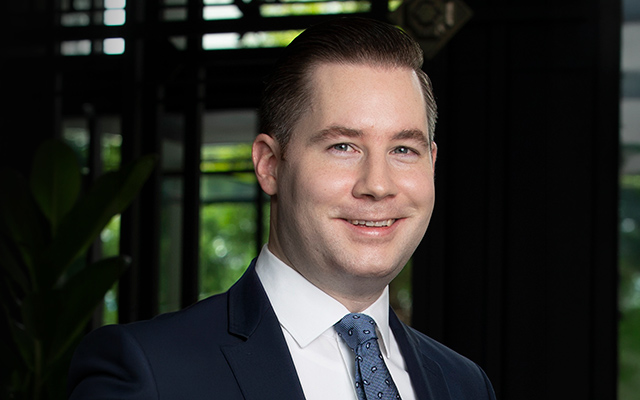
 Weiss returns to the property after previously serving as hotel manager from 2021 to 2024 and being part of the pre-opening team. He most recently held the role of hotel manager at The Apurva Kempinski Bali, where he oversaw multiple divisions and operations.





