TTG Asia
Asia/Singapore Monday, 23rd March 2026
Page 1893

Tokyo room rates soar in 2015

0

35625705_l

AVERAGE hotel room rates in Asia-Pacific escalated last year, with Tokyo, Sydney and Singapore being the three most expensive cities for hotel bookings, according to research released by corporate travel solutions provider HRS.

The HRS Annual Asia-Pacific Hotel Price Radar indicated that average room rates in Tokyo rose by 30.3 per cent to S$269 (US$191) in 2015, and in Sydney by 6.92 per cent to S$266 and in Singapore by 11.3 per cent to S$262.

In fourth place was Melbourne, which saw a decline of 19.5 per cent in average room rates to S$232. The only other city in the top 10 spot to see cheaper hotel prices was Kuala Lumpur with a 5.6 per cent decrease to S$105 on average per night. Meanwhile, Jakarta saw the greatest year-on-year increase with a 34.8 per cent hike to S$139.

Todd Arthur, managing director APAC at HRS, said: “The rise in business-related travel drive hotel rooms demand, and cities with the top hotel room rates indicates the business hotspots within the Asia-Pacific region.

“Hotel room rates increases are driven by higher levels of business confidence, and our findings are synonymous with the GBTA Foundation’s prediction of global business travel spending to increase 6.5 per cent over 2014.”

The study also finds business travel being relatively unaffected by crisis events. While the Bangkok bombings had impacted leisure travel in some ways, HRS data shows that the city witnessed a 31 per cent increase in room rates in 2015.

As well, hotel nights in Beijing increased by 22.2 per cent despite the city’s smog crisis which appeared in late 2015.

Thailand ropes in GTA and partners to drive upscale travel

0

gta-event

(From left) Juthaporn Rerngronasa, deputy governor for International Marketing, TAT, and Ivan Walter, CEO, GTA

THE Tourism Authority of Thailand, which has “fundamentally changed” its marketing plan to focus on quality experience rather than arrival numbers growth, has roped in GTA and partners to drive upscale travel to the Kingdom in a pledge signed yesterday at the ‘g meet’ in Bangkok.

TAT deputy governor Juthaporn Rerngronasa said TAT is focusing on enhancing a “Thainess” image, one that conjures a quality leisure destination in which visitor experience and length of stay, not numbers, count.

The new emphasis should yield an eight per cent increase in tourism revenue to US$66.5 billion, US$43 billion of which is from the international market, she said.

As part of the new plan, there will be increased focus on digital media and content marketing, including an Amazing Stories initiative, a move to target specific higher-yield niches including luxury travel, cruise market, health/wellness, honeymoons, golf and community tourism.

ASEAN is on TAT’s radar, with plans to promote weekends and road travel in ASEAN with Thailand as an anchor.

GTA’s CEO Ivan Walter said the pledge is more than just a symbol. “We believe that through our partnership, we will be able to encourage more upscale travellers to visit Thailand to appreciate indigenous travel experiences – lavish accommodation and personalised unique on-the-ground excursions. But most importantly, we want people to enjoy pleasant interactions with Thai culture, its environment and its greatest asset – its Thai people.”

Other GTA partners that have joined the commitment include AccorHotels, AIS, Caissa Touristic, Compass Hospitality, Derbysoft, Far East Hospitality, Flight Centre, JTB, MakeMyTrip, Metglobal, Minor Hotel Group, Onyx Hospitality Group, SiteMinder, Starwood Hotels & Resorts, Thai Airways International and Tuniu.

MATTA finds Sabah travel advisory unfair

0

tan-kok-liang

Tan: Sabah safe for tourists

THE Malaysian Association of Tour & Travel Agents (MATTA) has expressed regret over the British Foreign and Commonwealth Office’s decision to raise the terrorism threat level for the islands off Sabah from ‘general’ to ‘high’.

The advisory warned “against all but essential travel to all islands off the coast of eastern Sabah from Kudat to Tawau, including (but not limited to) Lankayan, Mabul, Pom Pom, Kapalai, Ligitan, Sipadan and Mataking”.

Tan Kok Liang, inbound vice president, MATTA, said: “The travel advisory was based on a high-profile kidnapping in May last year. But crime and terrorism can happen anywhere and anytime. It is a global issue not exclusive to Sabah.

“For example, a group of terrorists killed 130 people and injured another 368 in Paris last November but there was no travel advisory against visiting France or the capital city, and rightly so.”

Tan added that he was prepared to host stays for those issuing travel advisories so that they can report on the actual safety and security situation, instead of creating fear and frightening tourists away from Sabah.

He also said that reports from the ground indicate there are no imminent threats to the public.

“The travel advisory would be more fair and balanced if the British Foreign and Commonwealth Office had verified information with the Malaysian Ministries of Home Affairs or Foreign Affairs,” he said.

GTA thinking out loud a future

0

ivanwalter

Walter: New ownership will help us

GTA anchors itself on a Vision 2020 as parent Kuoni Group puts itself up for sale and travel distribution continues to be fast changing.

The largest business unit of Kuoni pondered out loud its future yesterday, hosting an inaugural ‘g meet’ in Bangkok where it flew in a select group of suppliers, clients, technology companies and media to openly discuss the future of intermediaries.

Kuoni’s Board of Directors is supporting a takeover bid by Swedish private equity company EQT.

Meanwhile, competitor TUI is also seeking to sell Hotelbeds, with EQT speculated as a suitor. All this, along with current disrupters such as Airbnb and yet-unknown ones, is enough fodder to overturn a cart. But GTA’s CEO, Ivan Walter, stays rooted with a vision of GTA being the market leader by 2020 as “the world’s easiest travel distribution partner to do business with” – which he said is not as easy as it sounds.

The market is huge, complex and fragmented, said Walter. “Our mission is to reduce the complexity in the next few years. We have spoken to suppliers and clients in a structured way, asking them: What is it that you find painful? What is it that we could streamline, facilitate and make easier?”

A lot of components needs to happen before a room or an excursion can be sold to a client, he pointed out. “So how do we engage our technology partners to make it a rounded, easy and seamless experience? How do we embrace mobile, or help facilitate clients who do not have the funds to go digital? How do we evolve our portfolio so that the inventory, rates, products are relevant to clients and suppliers? We have over 200 million requests on price and availability every single day, how can we mine this data to benefit us all? How can we mobilise a sales effort to deliver business to suppliers and destinations that they find hard to get by themselves?”

The intermediary hotel market is worth US$170 billion, said Walter, and while giants like Expedia and Priceline are taking a lot of share, there are thousands of smaller players out there who try to innovate and give a different digital experience. “We can facilitate their growth (through inventory, technology, HR support, etc),” said Walter, alluding to the vast opportunities that exist for GTA.

But to fulfil the vision, GTA needs to invest in technology and people. In an interview with TTG Asia, asked whether the Kuoni sale clouds the vision, Walter said on the contrary, “new ownership will help us” in terms of resources to grow organically and inorganically.

“As well, today we are part of a listed company, which means obligations to communicate results and meet shareholders/analysts’ expectations. In a private environment, the obligation is less, so we can actually focus a lot more on mid and longterm targets to get us to where we want to be,” he said.

A Kuoni Group statement said EQT “is committed to invest” to enable the company to grow and strengthen its position as a leading service provider to the global travel industry and governments and to further increase its profitability. Group CEO Zubin Karkaria together with the current management team will continue to lead the company.

Asked if morale is affected with Kuoni first selling of its tour operating division, then the current sale bid, Walter said: “Absolutely not as people (within Kuoni) see the opportunity that we can move faster. We are in a growth market. It’s good news for everyone.”

– More reports in TTG Asia, April issue

Photo of the day: Best Western signs first Vib hotel in Bangkok

0

best-western-signs-first-vib-hotel-in-bangkokOlivier Berrivin, Best Western Hotels & Resort’s managing director of international operations – Asia, signed an agreement with Narin Thitipoonya, owner of Matasiri Company, for the first ever Vib Hotel in Bangkok. The new-built Vib Bangkok will offer 89 rooms when it opens in 1Q2018.

Mid-market buzz builds up

0

Taipei’s hotel supply is making progress in the mid-market segment as developers bet on the rising wave of Asian FITs
26feb-taiwan

With yearly visitor arrivals already hitting the 10 million mark a few years ago, Taiwan is fast becoming a hotspot for Asian FITs, especially independent travellers from China.

Since Taiwan opened its doors to Chinese independent tourists in 2011, the number of Chinese FITs arrivals into Taiwan rose from 191,148 in 2012 to 522,443 in 2014, reaching nearly 1.3 million from January to November 2015, according to figures from the National Immigration Agency. Last September, Taiwan further raised the daily quota of Chinese FITs from 4,000 to 5,000, way more than group tours which is limited to 2,500 per day.

The surge in visitor numbers also call for more mid-market hotels. According to figures from CBRE and Taiwan Tourism Bureau, the mid-tier hotel is the only segment to display a robust growth, from 353 properties in 2012 to 458 properties in November 2015. Furthermore, 135 new hotels are scheduled to be completed over the next two years.

In December 2015, the 465-room Courtyard by Marriott Taipei launched on the 7th to 30th floors above CityLink Mall, which is connected to the Nangang Station serving the Taipei Metro and Taiwan Railway.

Owned and operated by the local Leofoo Tourism Group, the property has revealed its interest in attracting business traffic as it resides close to the Nangang Exhibition Center and Nangang Software Park as well as a host of technology companies in the Nangang district.

Even as the popularity of budget hotels has grown on the back of a Chinese visitor influx, higher-price international branded hotels the likes of Courtyard by Marriott still have “great potential” in Taiwan’s hospitality market, remarked a Leofoo Tourism Group spokeswoman.

“Although the number of hotels in Taipei continues to increase, international branded hotels have not expanded as much in recent years. Therefore, the future development of tourism business market in Taiwan should not be limited to the Chinese market,” she said, adding that Courtyard by Marriott Taipei will rely on its established branding to attract tourists from around the world.

Targeted at leisure and FIT travellers, the 88-room Aloft Taipei Zhongshan also opened its doors last December, while the city’s second Aloft is scheduled to open in Beitou in October 2016.

Hotel manager of Aloft Taipei Zhongshan, Tiffany Lin, said: “Although we won’t be able to accommodate large tour groups, we will explore opportunities to work closely with travel agents to reach our target market.

“Lately we have seen an increasing number of FITs from Hong Kong, Macau and China. We hope (that with our positioning as) a US brand, we will attract guests who have been using hotels in this (Zhongshan) area and are willing to experience new hotels, as well as those who are aware of our brand. Taiwan still needs more mid-range or luxury properties to fuel future tourism.”

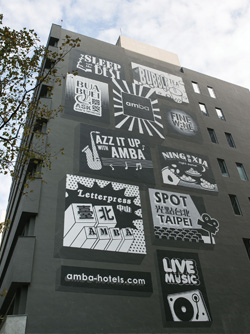
The mid-range trend is not confined to global hospitality players only. Homegrown companies like Ambassador Hotel Group celebrated its 50th anniversary with a new brand – amba Hotels. Unlike the full-service Ambassador hotels, amba stresses fun and creative elements. So far, both the 90-key amba Zhongshan and 160-key amba Ximending are now operational, with the 190-key Songshan and Kenting slated to open in 2016 and 2017 respectively.

Welcoming a more diversified hotel scene in Taipei, Swire International Travel’s general manager, Norman Meng, said: “Taiwan has been less popular in the tourist market until recent years. These international hotel brands not only enhance Taiwan’s brand exposure but also create more hotel choices for burgeoning FIT travellers from China, Hong Kong and South-east Asia.”

Suki Sin, director of Hongkong-based Muse Travel, opined: “International mid-tier hotels may offer a choice as minsu homestays are mostly scattered in he countryside and not available in the city. However, Hong Kong travellers prefer to stay in local boutique style hotels due to their special design.”

This article was first published in TTG Asia, February 5, 2016 issue, on page 22. To read more, please view our digital edition or click here to subscribe.

More heading to Phuket for plastic surgery

0

21575001_l

MEDICAL tourism in Phuket is on the rise with an overwhelming majority of visitors coming to the resort island for aesthetic treatments, according to research by consultancy C9 Hotelworks.

Close to half of all medical offerings were cosmetic surgeries such as breast implants, liposuction and face contouring while more than a third of all medical tourists sought after anti-aging treatments. Over the past five years, more than 15,000 foreigners have arrived for breast augmentation procedures alone.

The average amount spent at hospitals or clinics for cosmetic surgery is nearly twice that of anti-aging patients, with median costs of 150,000 baht (US$4,200) and 80,000 baht respectively. The length of stay of cosmetic patients average around 12 days, roughly twice that of those who come for anti-aging treatments.

“Aesthetic procedures have increasingly grown to dominate the market, with cosmetic surgery being the most popular product led mostly by Australians, and anti-aging treatments being driven by travellers from Mainland China,” said Bill Barnett, managing director, C9 Hotelworks.

He added: “Existing medical demand reveals high investment potential which is drawing more domestic and international groups into commercial projects such as large-scale expansions and acquisitions. We expect the Phuket healthcare tourism sector to be a positive long-term proposition.”

Ascott fast-tracks China expansion

0

citadines-guoxitai-xian_facade

IN a bid to accelerate its expansion in mainland China, Ascott has partnered with Dongfu Investment Development – a real estate subsidiary of China’s largest state-owned construction and infrastructure builder, China State Construction Engineering Company.

Kevin Goh, Ascott’s managing director for North Asia, said: “Mainland China is Ascott’s largest market. We have recorded three consecutive years of expansive growth in the country with more than 2,000 units added year-on-year.”

He added that demand for quality serviced residences in mainland China is likely to grow, riding on the growing popularity of domestic travel especially to first and second tier cities.

Kicking off the Ascott-Dongfu Investment partnership is a management contract for the 148-unit Citadines Guoxitai Xi’an, slated to open in 2018.

This adds to Ascott’s portfolio of more than 14,000 units in 24 cities owned and operated by them in mainland China.

Ascott has further plans to leverage the partnership and expand in cities such as Shanghai and Jinan as it advances towards its target of 20,000 units in the country by 2020, Goh added.

MCB faces anxious wait on new operating model

0

melbourne-exhibition-centre

THE Melbourne Convention Bureau (MCB) will join forces with the state’s tourism body Visit Victoria later this year, but just what that new business model looks like remains a mystery.

Speaking at AIME 2016 in Melbourne on Monday, MCB’s CEO Karen Bolinger said they were “well down the track in negotiations as to what stays and what goes”.

Last August, the Victorian Minister for Tourism and Major Events John Eren announced a “once-in-a-generation shake-up” of the tourism and major events sector, creating a new entity, Visit Victoria, to bring Tourism Victoria, the Victorian Major Events Company and “a new conventions division” under the one umbrella. The announcement stated: “Bringing the key entities together will end inefficiencies and duplication”.

“We’re in discussions with Visit Victoria as to how MCB will sit within that portfolio,” said Bolinger. “It’s certainly recognised that we are a key component.”

“They see us as an incredibly strong operating model. They’d like to mirror Visit Victoria on our model because we do so well and we have that commercial approach to doing business.”

But the merger isn’t so simple, explained Bolinger: “We are a membership-based organisation so anything we do needs to go to members for a vote. They will be voting on whether that is the right offer for them and whether they would like to take that forward,” adding that voting was likely to take place by the beginning of April and the current sentiment amongst members was “neutral”.

“We’ll hopefully have a good case, but if it isn’t strong enough there is a risk it may not get voted through,” she said.

Asian travel employment to remain strong

0

16498954_l

EMPLOYMENT in Asia-Pacific’s travel and hospitality industry is expected to remain healthy this year, bucking the trend forecasted in most other sectors, according to a study conducted by ACI HR Solutions.

The ACI HR Solutions 2016 Travel and Hospitality Industry Salary and Employment Trends Report indicates that 44 per cent of hiring managers surveyed expected new headcounts in 2016, albeit with more modest volumes compared to previous years.

Andrew Chan, founder and CEO, ACI HR Solutions, said: “As in the previous surveys we have conducted since 2012, salary continues to be an important factor for candidates. A total of 41 per cent indicated they would need to see 11 to 22 per cent salary increase when considering a new job.”

He added: “Notwithstanding, the importance of career development was also similar to recent results with a total of 69 per cent of all respondents indicating that career progression was either ‘extremely important’ or ‘very important’ and only five per cent saying career progression was unimportant.”

In a worrying trend, 30 per cent of respondents felt career prospects with their present employer were ‘poor’ or ‘zero’, compared to 26 per cent from last year’s survey. This percentage has been increasing for the third year running.

Compounding on this is 47 per cent of employed respondents indicating that they would change employers in 2016, with a further 12 per cent contemplating leaving the industry altogether.

And while 77 per cent of respondents indicated that they have received a pay increase in the past 12 months, it appears that salary gains in some countries are slowing, with Singaporean and Indonesian respondents experiencing a 15 per cent and 30 per cent decline in pay raise respectively.

Modest increments were seen in Thailand (12 per cent), Malaysia (8 per cent) and Hong Kong (4 per cent) in this year’s report, with the highest average annual salaries once again belonging to Macau (US$109,621) and Hong Kong (US$85,596). Indonesia posted the survey’s lowest average salary at US$44,492.