TTG Asia
Asia/Singapore Friday, 3rd April 2026
Page 1387

Cambodia’s tourism sector eyes new markets in region

0
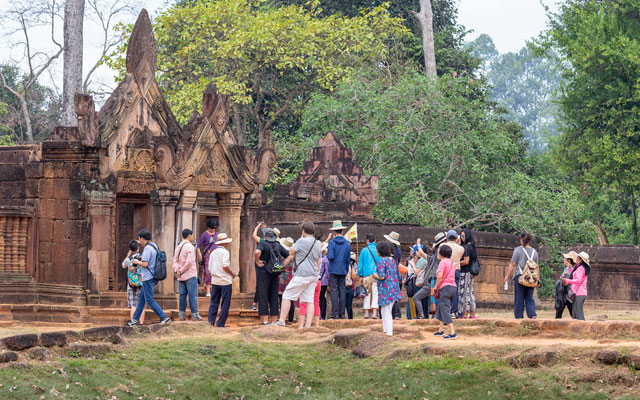
Cambodia is looking to develop new visitor source markets from the Asia-Pacific. Chinese tourists at Banteay Srei, one of the smallest sites at Angkor, pictured

With tourist arrivals from China, Thailand and Vietnam coming in greater numbers than before, Cambodia is keen to develop new feeder markets in the region for growth.

Several new visitor source markets are coming onto the radar of PATA Cambodia Chapter’s (PCC), which invited tour operators to its inaugural Biz Fair held last week from September 3 to 5.
Cambodia is looking to develop new visitor source markets from the Asia-Pacific. Chinese tourists at Banteay Srei, one of the smallest sites at Angkor, pictured

Among the emerging feeder markets PCC is targeting is Bangladesh. Sinan Thourn, PCC chairman, said: “If you look at the country, it has about three million people travelling abroad, and they are looking for new destinations. Many go to Malaysia, Thailand and Singapore. Cambodia is overlooked and is missing out.”

Thourn added that PCC wants to attract the masses of Indonesians who travel to Thailand annually but skip neighbouring Cambodia. He said: “Outbound tourism from Indonesia is growing and a lot go to Thailand.”

India, Pakistan, Sri Lanka and Nepal will also be targeted in 2019. “We predict these markets will pick up. We can’t just focus on China,” added Thourn. PCC plans to organise a series of fam trips, carry out targeted marketing and build on the first Biz Fair.

Mohosin Iqbal, CEO of Amazing Tours in Bangladesh, said with Thailand ranking as Bangladesh’s second most popular outbound destination, he plans to push neighbouring Cambodia.

Said Iqbal: “Cambodia is our new destination and we have a strong and growing outbound market looking for new countries. Interest in Cambodia is already starting.”

Sariul Islam Razu, CEO of Serve International, added he will put together packages promoting Cambodia to his clients.

However, Thourn said the main challenge remains with air connectivity. “There are no direct flights from these destinations. We are only two hours away from Indonesia, for example, but with no connections we seem so far away. But we can’t wait for the flights to come to start pushing, we have to start now.”

Nuno Costa, marketing and sales director of Cambodia Airports, said they are currently working with several airlines to develop routes to new destinations. He added: “Indonesia is one of them. At this point, we are still in talks.”

Lombok’s Mount Rinjani puts hiking trails off limits for a year

0
Mount Rinjani is a popular spot for trekkers
Mount Rinjani is popular with trekkers

Mount Rinjani’s hiking trails are expected to remain close for a year, after the recent Lombok earthquakes triggered landslides and fissures at the park, the Jakarta Post reports.

Head of Rinjani National Park, Sudiyono reportedly told KompasTravel that the park is not safe for visitors now.

Over the span of about a year, landscape and ecosystem recovery will take place, he said. The year-long closure is also expected to give time for the soil to stabilise.

Mövenpick CEO Olivier Chavy steps down after Accor acquisition

0
Chavy steps down as AccorHotels is now the new owner of the Mövenpick brand

Following AccorHotels’ completion of its acquisition of Mövenpick Hotels & Resorts on September 3, Olivier Chavy announced on his personal LinkedIn page that he has stepped down from his role as the CEO and president of the Swiss hotel chain with immediate effect.

Chavvy shared that it is with a “mix of emotion, immense gratitude, pride and some sadness” as he leaves his position at Mövenpick, a role that he took up in 2016. “I am going to take that much-needed breather, and then start searching for a new challenge,” he wrote.

Chavy steps down as AccorHotels is now the new owner of the Mövenpick brand

AccorHotels has now acquired 100 per cent of Mövenpick’s share capital, and the full brand use rights for the Movenpick Hotels & Resorts brand for all activities related to the hospitality business.

The French hospitality giant currently has 84 properties in Asia and Europe, numbering 20,000 rooms, in Mövenpick’s name. The brand’s global pipeline of 42 signed or proposed properties, scheduled to be opened by December 2021, is now in the control of AccorHotels.

For members of Le Club AccorHotels, the transaction now brings the Movenpick network into the loyalty programme, where members can now earn and redeem points at all Movenpick properties.

Koh Samui’s measured approach to growth pays off in hotel performance: C9

0
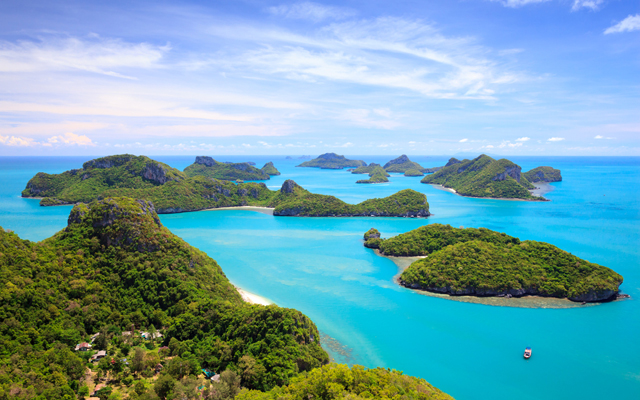
Angthong national marine park, Koh Samui

Despite recording strong growth in international passenger arrivals in recent years, C9 Hotelworks says the Koh Samui remains a “calm in the middle of a gathering storm” as most of Thailand’s resort destinations face an onslaught of mass tourism.

A new report by C9 showed that international passenger arrivals at Koh Samui’s airport over five years doubled in 2016, rising another 15% in 2017 over the previous year. Two factors that come into play in the airlift is Bangkok Airways’ proliferation of codeshare agreements along multiplication of more regional direct routes, C9 says.

Angthong national marine park, Koh Samui

C9 pointed out that while LCCs have tapped into Asia’s soaring consumer class in most destinations, creating dizzying growth numbers, the island’s privately-owned airport has allowed for poised and sustained development over the past five years.

In Koh Samui, airlift, luxury hotel brands and a developing wellness sector are among the factors that are “boding well for a sustainable growth profile”, according C9.

Citing figures from STR, C9 observes the domino effect of the various factors at play on the defined uptick in Koh Samui’s hotel performance over the past three years. Numbers from the Thai Hotels Association reflect a market-wide RevPAR increase as of the end of June of 7%, comparing year-on-year figures.

C9 Hotelworks managing director Bill Barnett said the island’s appeal to upscale travellers stems from its barefoot luxury makings, complemented by global brands such as Four Seasons, W, Conrad, InterContinental and the recently opened Ritz-Carlton, but also a rising tide of wellness focused resorts.

“According to market research, wellness properties such as Kamalaya, Samahita and Vikasa attract year-round visitors, have strong appeal overseas, and trade far less seasonally than many of the legacy properties,” he continued.

“Not only is occupancy a strong point but a longer average length of stay, loyalty in terms of returning guests and direct booking are key attributes.”

Looking ahead, C9’s research points out the growing influence of mainland China which is linked to Bangkok Airways plan to expand airlift to that region.

This trend can be seen in airport international passenger arrivals that by the end of June this year saw Chinese grow by 58%.

One of the traditional geographic source markets Germany also saw a year-on-year spike of 35% for the same period.

Buhdy Bok now MD of One Faber Group

0

Buhdy Bok, an industry veteran with two decades of experience in the aviation and cruise sector, has been appointed managing director of One Faber Group in Singapore.

The One Faber group was last year rebranded from Mount Faber Leisure Group, and has a portfolio spanning Singapore Cable Car, Wings of Time, Sentosa Merlion, Faber Peak Singapore, Dusk Restaurant & Bar, Spuds & Aprons, Good Old Days, Show Bites, Fun Shop, Cable Car Gift Shop and local membership programme Faber Licence.

Bok will be responsible for taking on the next phase of building One Faber Group’s business through its portfolio of leisure products at Faber Peak Singapore and Sentosa Island.

He spent 15 years with Singapore Airlines in the Singapore, Shanghai, Nanjing and Milan offices and seven years with Costa Cruises based in Shanghai. He last held the position of chief commercial officer with NokScoot Airline, a joint venture between Scoot and Nok Air, based in Thailand.

Second edition of STB’s Marketing Innovation Programme now open

0
STB will match marketing costs dollar to dollar

The Singapore Tourism Board (STB) is inviting all Singapore-based business to apply to its second edition of its Marketing Innovation Programme (MIP), which was launched in April 2017 to inspire businesses to experiment more boldly in marketing.

In this edition, businesses will now stand to receive a dollar-for-dollar matching award of up to S$300,000 (US$217,755; excluding GST) to cover the marketing costs pertaining to their campaigns, including creative production of assets and collaterals, marketing-related costs for publicity events and activation, talent engagement and media buys.

STB will match marketing costs dollar to dollar

This is in addition to covering the distribution costs of the campaign that were supported under the inaugural edition of MIP.

Applicants will be evaluated by a panel comprising STB and industry representatives against criteria such as innovativeness and potential to drive tourism outcomes and feasibility of the campaign.

The first MIP attracted 44 proposals from businesses across a wide range of industries, of which three campaigns by AccorHotels, Millennium Hotels and Resorts, and Wildlife Reserves Singapore were granted support for showing the strongest potential of telling a great Singapore story and enhancing the city state’s destination appeal.

Said Jacqueline Ng, STB’s director, marketing partnerships and planning: “We encourage businesses to be bold in pushing the boundaries of marketing and creative storytelling of their businesses to showcase the passions and possibilities of Singapore.”

Applications close on October 15, 2018.

Another airline bites the dust amid Myanmar’s overcapacity

0
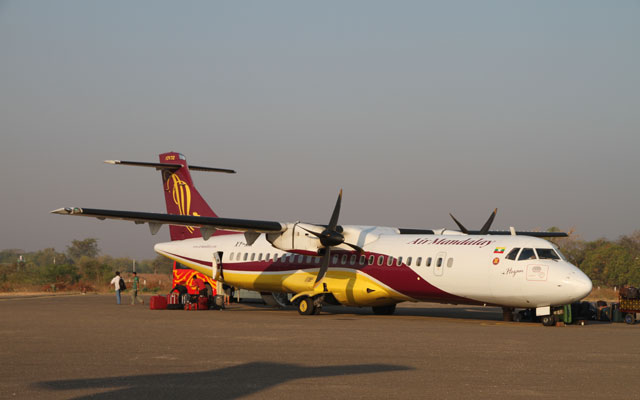
XXX. Photo credit: Flickr/Travel Aficionado

Air Mandalay has suspended all scheduled and charter services to restructure its business, the fourth domestic airline in Myanmar to wind up in the face of high fuel prices and slower than projected demand.

Myanmar’s second oldest airline suspended services starting from September 4, with no confirmed date for the resumption of operations. Speaking to the Myanmar Times, Air Mandalay’s spokesperson May Thandar Wi said this would be subject to market conditions.

Air Mandalay has shuttered once more. Photo credit: Flickr/Travel Aficionado

The airline joins Air Bagan, Apex airline and FMI Air to have wound down, leaving six domestic businesses to compete in the sector.

The company stated in a press release that it “has been extremely difficult” to operate in the country and the situation has worsened since 2011, when “a number of new airline licenses were approved to operate in the country.

While president Thein Sein’s administration since 2011 limited the number of airlines operating in the country to 10, there is already too much competition and an overcapacity in the small market. Along with high operational costs, this has seen many domestic airlines making losses, May Thandar Win told the Myanmar Times.

And in 2014-15, the airline was unable to operate for more than a year due to the delay in issuance of import permit for its two Embraer ERJ145 jet aircraft and a nine-month delay in 2017-18.

A foreign private joint venture airline with the government incorporated on October 6, Air Mandalay’s routes before the recent suspension covered Yangon, Myitkyina in Kachin, Sittwe in Rakhine and Tachileik in Shan.

K11 Artus luxury hotel residences to rise in Hong Kong’s Victoria Dockside

0
Concept of the K11 Artus, which will form part of the Victoria Dockside development

Hong Kong’s art and design district Victoria Dockside will soon see the addition of K11 Artus, a new luxury hotel residence concept, announced New World Development.

Located at the Tsim Sha Tsui waterfront, the property is scheduled to open in summer 2019. It will have 287 residences spanning 14 storeys, featuring open-air waterfront views of Victoria Harbour and Hong Kong Island.

Concept of the K11 Artus, which will form part of the Victoria Dockside development

“Artus marks a major milestone for the K11 brand with our expansion into the hospitality sector,” said Adrian Cheng, K11 founder and executive vice-chairman of New World Development.

New York-based architectural studio Kohn Pedersen Fox designed the building while Bangkok-based P Landscape will be responsible for the surrounding greenery. In addition, renowned Hong Kong-based architect Andre Fu and his studio AFSO have been engaged to create the interiors.

Artus will be part of the Victoria Dockside development, a 278,700m2 art and design district in Tsim Sha Tsui. This US$2.6 billion development includes the K11 Atelier office tower and K11 Musea, a new ultra-high-end experiential retail, art, cultural and dining destination.

Paul Cunningham, general manager of hospitality and portfolio management of New World Development, said in a statement: “Combining the convenience of hotels and the comfort of serviced apartments, ARTUS offers flexible rental plans from short- to long-term stays to accommodate the needs of our guests.”

Bored with unique experiences: how the phrase loses its meaning

0

Unique experiences. Two words that invoke anticipation, excitement, wonder – but why oh why am I so bored with them?

The race in travel & tourism to provide unique experiences to travellers is relentless. Just this past month, examples include Airbnb throwing a contest offering participants the chance to spend a night in a custom-designed bedroom on the Great Wall of China (although it had to withdraw the contest after an online backlash).

Or, just look at the new wave of unique experiences being offered in the Maldives. They include The Muraka, the world’s first undersea residence at Conrad Maldives Rangali Island; an ice rink at Jumeirah Vittaveli (I’m still baffled why anyone would want ice when the bluest water is all around); and the Sculpture Coralarium at Fairmont Maldives Sirru Fen Fushi, although the fate of this underwater art museum cum coral regeneration project is still unclear at the time of writing.

It’s not unique experiences themselves that bore me; it’s that the term ‘unique experiences’ is so over-used that it has lost its meaning and become an industry cliché.

Here’s a typical example, from a speaker at ILTM Asia Pacific opening forum recently: “We believe that nowadays this market (Gen Me and Gen X) is defined through the combination of the richness and uniqueness of the travel experience itself, not just the hotel brand or the flight class. Accordingly, this experience must also deliver a level of social bragging rights that allows travellers to express their individuality. It needs to be aspirational, enviable – and, above all, Instagrammable.”

The industry is taking the need to provide unique experiences all too seriously that it may be counter-intuitive. The first issue I have is, unique for whom? Travel is an experience in itself and unique to an individual. This past year, I’ve been to places that are unique for me, for example Paestum in southern Italy, and others that aren’t, for instance, New Zealand, even though I’m sure it is for others.

Moreover, unique experiences can easily be copied in today’s global world and social media sharing. There are many undersea or underwater restaurants now. There are so many tours and activities that ‘living like a local’ has also become another cliché. Isn’t it exhausting to keep trying to come up with unique experiences when a differentiator today can quickly become a standard tomorrow? And in doing so, isn’t the industry actually helping to create the ‘very demanding, always want something new, something Instagrammable’ customers it laments about today?

Who says we have to empower the customers so completely? Why not lead and shape the customer towards mindful travel rather than ‘insta’ travel (Instagram, instant gratification travel) which is so fleeting – like a spoilt kid who gets a new toy and seeks what’s next?

Ask new questions to shape the new traveller, e.g. what’s a unique experience that cannot be copied?

For me, that always has been great customer service – it’s unique to the place that offers it, is unique for everybody, and is almost always the first thing I remember about the travel and something that stays with me.  Is it an Instagrammable experience? No, it’s far more lasting and what keeps me loyal to a place, brand and service.

I fear the incessant chant on something as nebulous as the need to provide unique experiences is sidetracking the industry from discussing more meaningful issues.

GM for Hilton Garden Inn Puchong named

0

Kumar Muniandy has joined Hilton Garden Inn Puchong in Malaysia as general manager.

Prior to joining Hilton, Kumar was the general manager of the Oasia Suites Kuala Lumpur. He also served as general manger at the Sri Tiara Residences Kuala Lumpur.

A 20-year hospitality veteran, Kumar began his career as a waiter and bartender at Tasik Hotel in Seremban, before becoming a management trainee at Holiday Inn City Centre in Kuala Lumpur.

From there, Kumar went on to hold positions locally and internationally such as assistant manager in Singapore, night manager and guest service manager in the UK before moving up to the general manager position.